
All insights

What Are UGC Ads? Definition, Formats, Rules

What are UGC ads? A UGC ad is a paid ad built to look like a real customer filmed it. The five formats, the parts that decide performance, and the 2026 rules.

Kevin Dosanjh
"CMO, AI Vidia" · Updated August 8, 2026
Three smartphones on a light wooden table, each screen showing a soft blurred vertical video still of a person holding a product, beside a blue notebook and a ring light.
On this page10 sections

UGC ads are paid social ads produced to look like content a real customer filmed, not like a brand commercial. A person talks to camera, opens a package, or shows a problem and the fix, and the ad sits in the feed next to organic posts. AI Vidia produces this format for DTC brands as AI UGC ads, so this page answers what are UGC ads in the terms a media buyer actually uses: the five formats, the five parts that decide performance, and the disclosure rules in force in 2026. One number frames the rest. Meta for Business reports that campaigns with 5 or more creative variations see 30 to 50 percent lower CPA, and UGC is the format most brands use to reach that variation count.

The definition turns on production style, not on who pressed record. A brand can commission a creator, script the read, and still ship a UGC ad. UGC describes the framing, the pacing, and the camera language, and that is what the auction responds to. The working definition worth keeping: a UGC ad is a paid ad built to be mistaken for a post until the hook has already landed.

Why UGC ads carry so much paid social volume

30 to 50%LOWER CPA WITH 5+ VARIATIONS
91%OF BUSINESSES USE VIDEO MARKETING
5%OF CREATIVES BECOME WINNERS
2.4xROAS, INDIANBITES COHORTS

Polished brand ads are recognized as ads inside the first second, and feed users skip on recognition. UGC framing delays that recognition long enough for the hook to land, which is why the format absorbs so much of the creative volume on Meta and TikTok. Wyzowl 2025 found that 91 percent of businesses use video marketing and that 30 percent cite production cost as the top barrier: the format that earns attention is also the one most brands cannot produce at the rate the auction consumes it.

That gap is a production problem before it is a creative one. Content Marketing Institute 2025 found that 73 percent of B2B marketing teams cite producing enough content as their biggest challenge, and roughly 5 percent of creatives become winners. A brand shipping 4 UGC ads per month at that hit rate finds a winner about twice a year, while the winners it already runs fatigue inside 3 to 4 weeks. Under-producing UGC leaves spend parked behind ads that stopped working, which is the problem an AI UGC ad agency built for performance marketing exists to solve.

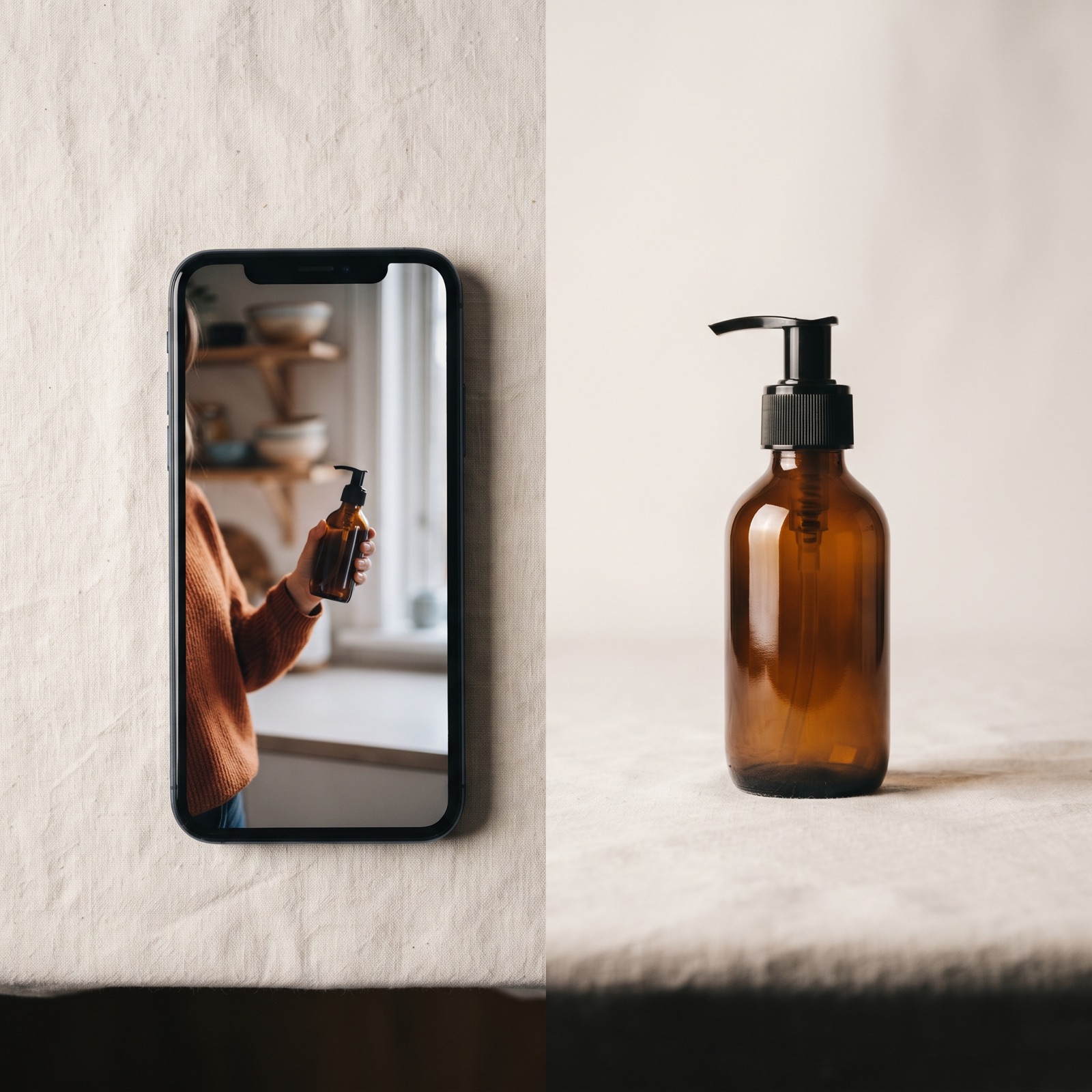
A smartphone showing a soft blurred vertical still of a person holding a small bottle in a home kitchen, placed beside a polished studio product shot of the same bottle on a plain sweep backdrop.
Left, the handheld framing a feed reads as content. Right, the studio framing a feed reads as an ad in under a second.

The five UGC ad formats

Five formats cover almost every UGC ad running on Meta and TikTok. They differ in what the camera actually shows, which is why they sit at different points in the funnel and fail in different ways.

UGC ad formatWhat it showsBest-fit funnel stageThe usual failure
TestimonialOne person to camera describing a specific resultConsideration and retargetingThe claim is generic, so it reads as a script instead of an experience
UnboxingHands opening the package and the first reactionCold prospectingThe product does not appear until second 8, long after the scroll
Problem and solutionThe pain acted out, then the product resolving it on cameraCold prospectingThe pain is stated instead of shown, so nothing is demonstrated
Day in the lifeThe product used inside a real routine with real contextConsiderationContext swallows the product and no single benefit lands
Street interviewUnscripted-looking reactions from several different peopleTop of funnel and social proofEvery reaction says the same thing, so the format plays as staged

Read the failure column as the brief. Testimonial ads fail on specificity, so the brief should demand a number, a timeframe, or a before state rather than an adjective. Unboxing and problem and solution both fail on timing: each lives or dies on the first 2 seconds, and each works cold because it carries its own context inside the frame. Day in the life fails on focus, so cap every cut at one benefit. Street interview fails on repetition, which is why it needs genuinely different answers, including one lukewarm answer, to stay credible.

The UGC Ad Anatomy

The UGC Ad Anatomy is the strategic framework the AI Vidia team applies before any UGC ad gets briefed. It names the five parts that decide performance and states what good looks like for each. Score an existing ad against all five and the weak part is usually obvious in under a minute.

  1. Hook. The first 1 to 2 seconds, carried by a spoken line and a visual state at the same time. Good looks like a specific claim or a visible problem tied to the product, on screen before the sentence finishes; a greeting or a brand name burns the only cheap attention the ad ever gets.
  2. Context. The 2 to 4 seconds that tell the viewer who is talking and why it applies to them. Good looks like one concrete situational detail, a kitchen, a gym bag, a commute, that lets the right viewer self-identify; skip it and cold audiences have nothing to attach the claim to.
  3. Demonstration. The product doing the thing, shown rather than described. Good looks like an unbroken shot of the action with hands in frame, close enough that the mechanism is legible on a phone; cutting away to a packshot here is where most UGC ads quietly turn back into brand ads.
  4. Proof. The reason to believe: a result, a number, a duration, or a comparison against the old way. Good looks like one falsifiable statement instead of three vague ones, and it has to be true of a real customer, because the disclosure rules below make fabricated proof a legal problem.
  5. Call to action. The single next step, spoken and on screen. Good looks like one instruction that names the offer, placed while the viewer is still watching; two competing asks split the response and neither one gets measured cleanly.
Want a structured plan for your AI creative pipeline?
20-minute call, no pitch deck.
Book a call

Kevin's take

The practical test takes ten seconds. Mute the ad and watch it. If the demonstration still reads without audio, the anatomy is intact. If the ad becomes a person mouthing words next to a product, the demonstration slot is empty, and no hook rewrite fixes that.

The First 12 UGC Variants

The First 12 UGC Variants is the tactical framework for a brand's opening UGC test batch. Twelve is deliberately small: enough cells to read hooks against each other, small enough that the review loop gets fixed before real volume arrives. AI Vidia runs it inside the first 14 days of a Pilot Sprint, and it is the same loop described in the working definition of performance creative.

  1. Write the brief around one claim. Name the single claim the batch is testing, the audience it targets, and the proof it rests on. A batch testing three claims across twelve cells cannot tell you which variable moved.
  2. Decide creator or character. Choose between briefing human creators and running a locked AI character set before anything is produced, because the two paths carry different lead times, costs per variant, and disclosure requirements. Mixing both in one batch is fine, but record the split so the read is not confounded.
  3. Build 12 variants across 4 hooks. Take 4 distinct hooks and cut each across 3 formats from the table above, holding demonstration, proof, and call to action constant. Twelve cells covers the hook axis, the variable that moves hook rate first, and every cell ships in 9:16.
  4. Read the batch at the 5 percent winner rate. Roughly 5 percent of creatives become winners, so twelve variants is a batch that produces zero or one winner. Judge it on hook rate and hold rate per cell rather than on whether a winner appeared, because at this volume winner count is close to noise.
  5. Re-brief from the losing cells. Kill every cell below the hook-rate floor, keep the two strongest hooks, and rebuild the next twelve around them with new formats rather than new claims. Two or three cycles turns a hook list into a hook library, which is what makes 30 or more variants per week readable.

Human creator UGC and AI UGC, compared honestly

Human creator UGC means briefing a real person to film on their own phone. AI UGC means generating the presenter, the voice, and often the scene. Both produce the same five formats, and they differ on four axes: lead time, cost per variant, consistency, and what can honestly be claimed on camera.

Human creators win on credibility that cannot be manufactured. A real customer describing a real result carries something a generated presenter does not, and in categories where trust is the whole purchase that is worth the scheduling. The trade-offs are real: sourcing, shipping product, briefing, and reshoots put a typical turnaround in weeks, cost scales linearly with every new variant, and consistency drifts because each creator brings their own lighting and delivery.

AI UGC wins on volume and consistency. A locked character set produces the same face, voice, and framing across hundreds of ads, new variants cost close to nothing once the set exists, and a hook rewrite becomes a re-render instead of a reshoot. The honest trade-offs: generated presenters look uncanny when the model is pushed too far, a generated person is not a real customer, and the disclosure rules below apply on every platform. AI Vidia holds a brand-safe review bar across 1,000+ AI ads and AI stills, because generated output needs a review gate human footage does not.

For most DTC brands the workable answer is both. Use human creators for the testimonial slot, where a real customer's real experience is the asset, and use AI UGC for the hook, format, and ratio volume that testing consumes. The formats are identical, so the two sources compete inside the same test matrix.

The compliance layer most definitions skip

Most pages that define UGC ads stop at the format. In 2026 the disclosure rules are part of the definition, because they decide what a UGC ad is allowed to show. Four rules set the baseline.

Meta requires an AI info label on photorealistic AI-generated ad content, mandatory since July 2026, and Meta labels compliant content rather than rejecting it. TikTok bans AI-generated public figures endorsing products outright. The transparency obligations in EU AI Act Article 50 took effect on 2 August 2026, so AI-generated or manipulated content must be disclosed. The US FTC line under 16 CFR 465.2 is the sharpest of the four: an AI character presenting a real customer's real testimonial with disclosure is lawful, while an AI character posing as a fake customer with a fabricated experience is an illegal fake testimonial.

Read those four together and one rule falls out for the testimonial format. The AI presenter is not the problem. The fabricated experience is. A generated spokesperson reading a verified customer quote, labeled, is a compliant ad; the same spokesperson inventing a customer identity and a result is not. A brand running AI UGC needs a per-platform disclosure workflow and a testimonial sourcing policy before the first batch ships, not after a takedown.

Proof: what UGC volume looks like in production

AI Vidia has shipped more than 1,000 AI ads for named client accounts like Andy Okay and IndianBites, at 30 or more variants each week and a brand-safe review bar. On UGC specifically, IndianBites returned 2.4x ROAS on the winning cohorts of its tested variants, and those numbers exist because the format is run as a test matrix rather than as a set of one-off films.

The live public case is IndianBites, a fast-growing DTC food brand with a Meta account starving for fresh creative, where traditional food photography could not keep up with the weekly testing cadence. The AI Vidia team shipped 142 AI ads in 11 weeks, including UGC-style creator frames, across 18 hero concepts each tested in 6 to 10 variant cuts. The result was 2.4x ROAS on winning cohorts and a weekly cadence. The full numbers are in the IndianBites case study.

A UGC ad is not a cheaper commercial. It is a testable claim with a face on it, and the brands that treat it that way end up with a hook library instead of a highlight reel.
Eighteen printed concept cards in a column, each fanning out rightward into a row of six to ten smaller vertical ad variant cards showing blurred people with food dishes, a few cards tinted burnt orange.
142 ads in 11 weeks is 18 hero concepts, each cut into 6 to 10 variants, with the burnt orange cards marking winning cohorts.

When each UGC format wins

Run problem and solution when the category has an obvious pain and the product resolves it visibly. It carries its own context, so it works on cold traffic, and the demonstration slot does most of the work. Run unboxing when the product has physical presence worth revealing, and move the reveal into the first 2 seconds; unboxing ads that respect real-life pacing lose the viewer before the box is open.

Run testimonial when a real customer will go on record with a specific result, and run it against warm audiences where the claim can be precise instead of introductory. Without a specific result it collapses into a script, and under 16 CFR 465.2 an invented result is not an available option.

Run day in the life when the product's value is habitual rather than dramatic, and cap each cut at one benefit. Run street interview when the category benefits from apparent consensus, and keep one lukewarm answer in the edit so the format stays believable. Rebrief the whole batch if no cell contains a real demonstration, because a UGC batch without demonstration is a brand batch with worse production values.

The next step

If the format is right and production is the constraint, book a 30 minute scoping call and the AI Vidia team will map the first 12 variants against your current hooks. To see UGC as finished, ad-ready work with the disclosure workflow attached, start with the AI UGC ads service. First creative inside 72 hours of kickoff.

Frequently asked questions

01What are UGC ads?
UGC ads are paid social ads produced to look like content a real customer filmed rather than a brand commercial. A person talks to camera, opens a package, or shows a problem and the fix, and the ad runs in the feed next to organic posts on Meta, TikTok, and YouTube. The definition turns on production style, not on who pressed record, so a scripted creator shoot is still a UGC ad if the framing reads as a post. The working test is whether the ad is mistaken for content until the hook has already landed.
02What does UGC stand for?
UGC stands for user-generated content, meaning photos and videos made by everyday people or creators rather than by a brand's studio. A UGC ad borrows that look and runs it as paid advertising with a media budget behind it. The label describes the framing, the pacing, and the camera language rather than the source of the footage. That is why a brand-commissioned or AI-generated video can still qualify as a UGC ad.
03What are the main types of UGC ad?
Five formats cover almost every UGC ad on paid social: testimonial, unboxing, problem and solution, day in the life, and street interview. Testimonial and day in the life fit consideration and retargeting audiences, while unboxing, problem and solution, and street interview carry their own context and work on cold prospecting. Each format has a predictable failure: testimonials go generic, unboxings reveal the product too late, and street interviews repeat the same answer. Pick the format from the job the ad has to do rather than from a showreel.
04Why do UGC ads perform better than polished brand ads?
Polished brand ads are recognized as ads inside the first second, and feed users skip on that recognition. UGC framing delays recognition long enough for the hook to land, which buys watch time and click-through on the same budget. Volume compounds the effect: Meta for Business reports that campaigns with 5 or more creative variations see 30 to 50 percent lower CPA. IndianBites returned 2.4x ROAS on the winning cohorts of its tested variants.
05What are AI UGC ads and how do they differ from creator UGC?
AI UGC ads use a generated presenter, voice, and often scene instead of booking a human creator to film on their own phone, and both approaches produce the same five formats. Human creators win on credibility that cannot be manufactured, because a real customer describing a real result carries proof a generated presenter does not. AI UGC wins on volume and consistency: a locked character set holds the same face and framing across hundreds of ads, and a hook rewrite becomes a re-render instead of a reshoot. Most DTC brands run both, using creators for testimonials and AI for the hook and ratio volume that testing consumes.
06Do UGC ads made with AI have to be disclosed?
Yes, and the rules differ per platform and jurisdiction. Meta requires an AI info label on photorealistic AI-generated ad content, mandatory since July 2026, and labels compliant content rather than rejecting it. TikTok bans AI-generated public figures endorsing products outright, and the transparency obligations in EU AI Act Article 50 took effect in August 2026. Under US FTC 16 CFR 465.2, an AI character presenting a real customer's real testimonial with disclosure is lawful, while an AI character posing as a fake customer with a fabricated experience is an illegal fake testimonial.

Next step

Get your first 12 on-brand AI variants in 14 days.

Book a 20-minute strategy call with the AI Vidia team. No pitch deck, just a structured plan for your creative output.

Book a call

Read next