
All insights

What Is Performance Creative? A 2026 Definition

Performance creative is ad creative built to be tested and judged on hook rate, CPA and ROAS. The definition, the metrics, the operating model, the org shapes.

Kevin Dosanjh
"CMO, AI Vidia" · Updated August 8, 2026
A media buyer's desk with a laptop showing a blurred rising performance curve in orange and blue, beside piles of printed ad frames growing from a single card to a tall stack.
On this page8 sections

Performance creative is ad creative produced to be tested and judged on media outcomes: hook rate, click-through rate, cost per acquisition, and return on ad spend. It is not a visual style and it is not a quality tier. It is a different job description for the same craft, one where the brief ends in a measured result rather than an approved asset. AI Vidia is a performance creative studio in Copenhagen that has shipped 1,000+ AI ads and AI stills for named client accounts like Andy Okay and IndianBites. This article defines the term precisely, separates it from brand creative and from design as a function, and sets out the operating model that produces it.

The sharpest test of whether a team is doing performance creative is what happens after an ad ships. Brand creative is finished when it is approved. Performance creative is finished when it has been scaled or killed on data, usually inside two weeks. Motion's 2026 creative benchmark, built on 578,750 creatives and USD 1.29B in analyzed spend, found that roughly 5 percent of creatives become winners and that the top 1 to 2 percent of creatives absorb about half of total spend. A discipline with a 1 in 20 hit rate cannot be run on taste.

What changes when creative is judged on media outcomes

5%CREATIVES THAT BECOME WINNERS
30%HOOK RATE THAT COUNTS AS GOOD
3 to 4WEEKS TO CREATIVE FATIGUE
73%TEAMS BLOCKED BY CONTENT VOLUME

Three things change the moment creative is scored on the media plan instead of on the review call. The unit of work stops being the asset and becomes the cohort: one concept plus its variants, shipped together and read together. Approval stops being the finish line and becomes the entry ticket, because a creative that clears brand review has only earned the right to be tested. And the calendar stops being campaign-shaped and becomes weekly, because the platform burns creative on a fixed clock. At scale, Meta creative fatigue decays performance inside a 3 to 4 week window, with audience frequency above roughly 2.5 as the danger zone.

Performance creative is also not a synonym for design. Design is a craft: composition, typography, colour, motion, casting, edit rhythm. Performance creative is an operating discipline that spends that craft against a media plan. A studio can produce excellent design and still not be doing performance creative, if nothing it makes is variant-planned, shipped in cohorts, or killed on evidence. The reverse fails too: volume without a brand standard produces creative that gets pulled in review rather than in the auction. The AI Vidia team runs both constraints at once and holds a brand-safe review bar across that volume.

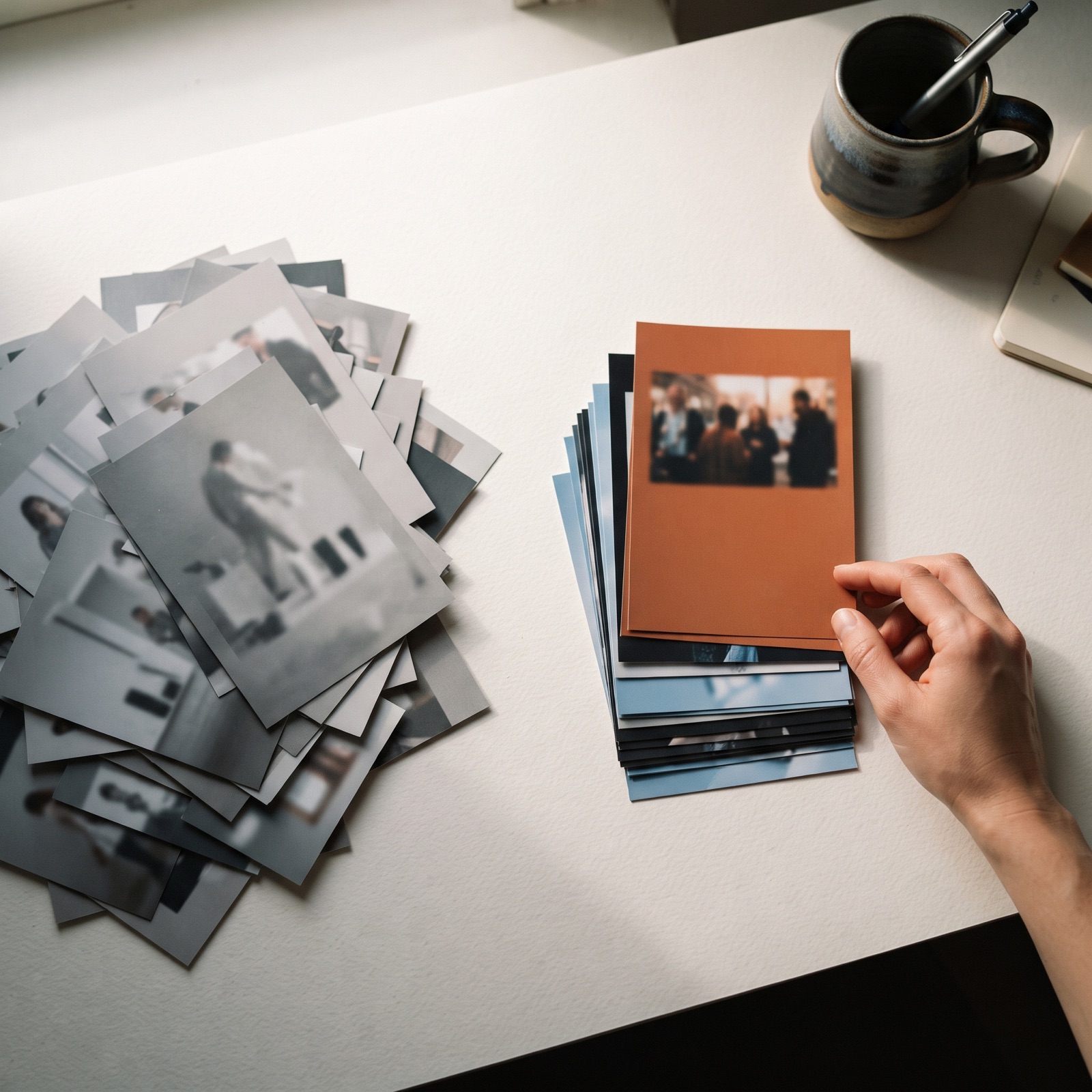
Overhead editorial scene of printed vertical ad frame cards sorted into two physical piles on a warm white desk, a large loose grey killed pile on the left and a small neat kept stack on the right with two cards tinted burnt orange.
Performance creative ends in a kept pile or a killed pile, never in an approval.

Volume follows from that arithmetic, not from a preference for more. At a 5 percent winner rate, a team shipping 10 creatives a month finds a winner roughly every other month while its current winner fades inside 3 to 4 weeks, so the account loses ground even when nothing goes wrong. Meta for Business reports that campaigns with 5 or more creative variations see 30 to 50 percent lower CPA, and Forrester measures a 20 to 35 percent paid media ROAS improvement when creative volume increases. The binding constraint is rarely ideas: Content Marketing Institute 2025 found that 73 percent of B2B marketing teams cite content volume as their biggest challenge.

The metrics that actually govern performance creative

Performance creative is governed by six numbers, read in sequence. Reading them out of order is the most common way a team spends a month optimising the wrong layer.

MetricWhat it measuresHealthy benchmarkDecision it drives
Hook rateShare of impressions that keep watching past the opening seconds30 percent or higher (Motion 2026, 578,750 creatives)Below the line, rewrite openings before shipping more variants
Hold rateShare of hooked viewers still watching at the end of the cutNo public cross-account number; judge against the account's own top decileStrong hook plus weak hold means the opening over-promises. Recut the middle, keep the hook
CTRShare of impressions that click throughRead as a move against the account's trailing 30 days, not an absoluteAttention without clicks means the creative is a brand asset. Move it out of the test
CPACost per acquisition on the cohort30 to 50 percent lower with 5 or more creative variations (Meta for Business)Flat CPA while variant count rises means the cuts are too similar. Add concepts, not cuts
ROASRevenue returned per unit of spend on the cohort20 to 35 percent improvement as creative volume rises (Forrester); 2.4x on AI Vidia winning cohortsScale the winning cohort, hold the rest flat
FrequencyAverage number of times a person in the audience saw the adAbove roughly 2.5 is the danger zoneRotate the winner out before the 3 to 4 week decay window closes

Read hook rate first, because it gates everything downstream. Motion's benchmark puts a good hook rate at 30 percent or higher, and a batch below that line has a hook problem, not a volume problem; adding variants to weak openings multiplies the weakness. Hold rate is read second, against the account's own best work rather than a public number, because a creative that hooks well and holds badly is over-promising in the first seconds.

CTR, CPA and ROAS are the commercial layer, and they are read at cohort level rather than per asset. CPA answers whether the cohort is efficient, ROAS answers whether it deserves more budget, and a wide gap between them usually points at the offer or the landing page rather than the creative. Frequency is the last read and the only one that behaves as a clock rather than a score: above roughly 2.5 with CPA rising, the account is being burned faster than it is being fed, and the answer is rotation, not a bid change. For the grid mechanics behind sizing a cohort, read how AI Vidia sizes a creative testing matrix from 4 to 35 variants.

Want a structured plan for your AI creative pipeline?
20-minute call, no pitch deck.
Book a call

The Performance Creative Operating Model

The Performance Creative Operating Model is the strategic framework the AI Vidia team runs on every account. It has 5 steps and it is a loop, not a launch plan. The output of step 5 is the input to step 1 of the next cycle.

  1. Insight to concept. Start from a claim a customer would recognise: a review sentence, a support ticket, an objection the sales team hears every week. A concept is that claim plus a format and a hook angle, written in one line before anything is produced. Concepts sourced from customer language beat concepts sourced from a brand deck, because the hook has to survive the first 3 seconds in front of a stranger.
  2. Concept to variant matrix. Expand each concept into a matrix of cuts that vary one thing at a time: hook, opening frame, claim, proof, call to action. Hold the split between one concept per 4 variants and one per 6, so the batch tests real alternatives instead of one idea in six outfits. Ratios are coverage, not tests: the 9:16 cut reaches placements and is never counted as a variant.
  3. Ship into the account. Creative sitting in a shared drive has no performance. The cohort goes live in one batch, with naming that carries concept, variant and hook so the read is possible later, and with enough budget per creative to gather judgeable events. Splitting a small budget across too many cells produces noise that looks like data.
  4. Read at the winner rate. Judge the cohort against a 5 percent expectation, not against hope. A batch of 20 that produced one winner is the system working as designed; a batch of 20 that produced none twice running is a concept problem, not a cut problem. Read hook rate before CPA, because a hook failure explains a CPA failure but never the reverse.
  5. Rotate before fatigue. Schedule the winner's replacement the week it starts winning, not the week it starts decaying. With a 3 to 4 week decay window and frequency above 2.5 as the trigger, the next cohort should already be in production when the current one peaks. Teams that wait for the decline to show up in the dashboard are permanently one cycle late.

Kevin's take

The uncomfortable part of that position is what it implies about ownership. Performance creative asks a creative team to be measured on something it does not fully control, which is why it only works when the kill rule is written before the batch ships. A kill rule agreed in advance is a process. A kill decision argued after the numbers land is a personality contest.

The Weekly Creative Cadence

The Weekly Creative Cadence is the tactical framework: one week inside a working performance creative team. It runs the same way every week, which is the point. A cadence that moves with the calendar stops producing comparable reads.

  1. Monday, brief day. Turn last week's winners and losers into this week's concepts. The brief names the concept, the single variable each variant changes, the metric that will judge it, and the kill threshold. Briefs written on Monday and produced the same week keep the loop short enough that the insight is still true when the ad goes live.
  2. Tuesday and Wednesday, batch ship. Produce and ship the full cohort in one batch instead of trickling assets in as they finish. A batch shipped together can be compared; assets shipped on different days are confounded by budget, day of week and audience state. AI Vidia ships 30 or more variants each week on this rhythm.
  3. Thursday, mid-week read. Read hook rate and hold rate only. This is a diagnostic pass, not a budget pass: the goal is to catch a broken opening before it burns another two days of spend. Nothing is scaled on a Thursday.
  4. Friday, kill and scale. Apply the thresholds set on Monday. Kill everything below the hook rate floor, hold the middle, and move budget to the cohort clearing CPA and ROAS targets. Every decision is logged with a one-line reason, because the log is what makes next Monday's brief better than a guess.
  5. Friday afternoon, re-brief. Convert the week's winners into next week's concepts by naming what actually worked: the hook, the claim, the format, or the casting. Winners get a variant family, losers get a single post-mortem line, and the hook library grows by whatever survived. That library is the compounding asset in the whole system.

Proof: the operating model in production

AI Vidia has shipped 1,000+ AI ads and AI stills across named client accounts like Andy Okay and IndianBites, with a creative-director review on every asset and 2.4x ROAS on tested winning cohorts. Accounts running the model ship between 40 and 200 AI video ads per brand per month, at 30 or more variants each week. That volume serves the winner rate: at roughly 5 percent, a brand has to ship in the tens per month to bank winners monthly instead of quarterly.

The live public case is IndianBites, a fast-growing DTC food brand with a limited production budget and a Meta account starving for fresh creative, where traditional food photography could not keep up with the weekly testing cadence. The AI Vidia team built a brand-locked style system, then shipped a weekly 12-variant batch of food hero shots, recipe-in-action sequences and UGC-style creator frames: 142 AI ads in 11 weeks, 18 hero concepts each tested in 6 to 10 variant cuts, and 2.4x ROAS on winning cohorts. The full numbers are in the IndianBites case study.

Performance creative is not a better looking ad. It is a system that turns one insight into twenty testable cuts, then tells you on data which cut buys your next customer.
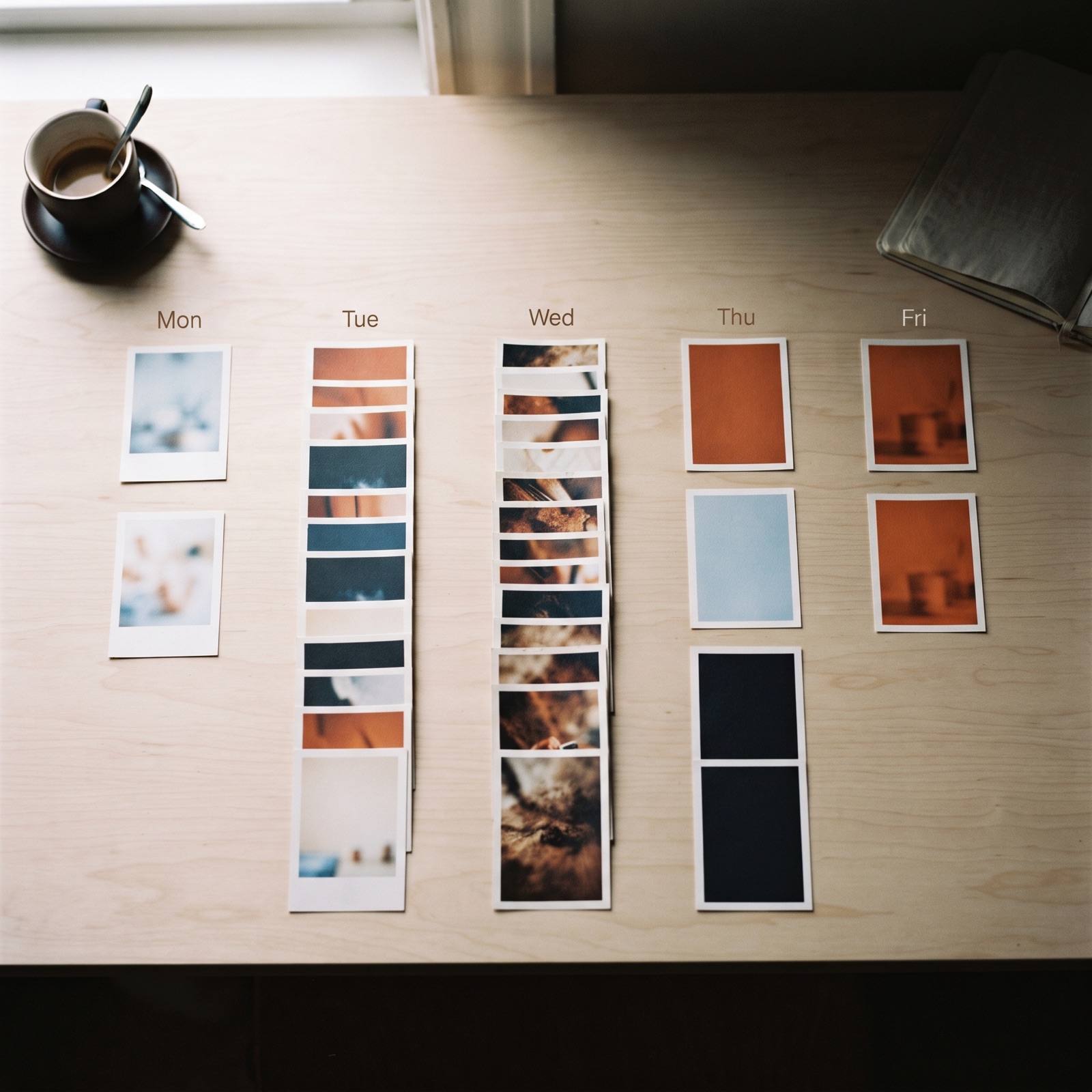
Overhead editorial scene of small printed vertical ad cards laid out in five daily columns across a warm white desk, the middle columns densest and two cards in the final column tinted burnt orange.
One week of the cadence: briefs on Monday, the full batch shipped mid-week, kill and scale calls on Friday.

Which org shape actually produces it

Three shapes produce performance creative, and they fail in different places. An in-house pod is a small dedicated team of a strategist, an editor and a designer sitting beside the media buyer. It has the fastest insight loop of the three, because the person reading the numbers and the person cutting the ad share a room. It breaks on volume: a team of three designers cannot produce 200 assets per month when they are already stretched at 40, and hiring is slow, since it takes 3 to 4 months to recruit a senior creative.

A freelance bench is a roster of editors and creators briefed per batch. It flexes on cost and absorbs spikes well, which makes it the usual first answer to a volume problem. It breaks on consistency and on memory: every freelancer relearns the brand, and brand review becomes the bottleneck the pod was supposed to remove.

A studio retainer buys a standing production system: a brand lock, a fixed weekly cadence, and an agreed monthly volume. It breaks when it is bought as an asset supplier rather than an operating partner, which is what happens when a brand orders a fixed number of files instead of a running test programme. The comparison against buying tools instead of a system is set out in the breakdown of AI ad creative tools versus a done-for-you studio.

The decision rule is short. Under roughly EUR 10,000 of monthly paid social spend, keep it in-house and fix hook rate before adding volume. Between EUR 10,000 and EUR 30,000, an in-house pod with a freelance bench for overflow is usually the right shape. Above EUR 30,000, with frequency drifting past 2.5, the volume required stops being a staffing question and becomes a production system question, which is the point at which an AI performance marketing agency earns its retainer.

The next step

To have your account read against this model, book a 30 minute scoping call and the AI Vidia team will run the Performance Creative Operating Model on your last 30 days of hook rate, CPA and frequency data. To see what the output looks like as finished work, start with the AI video ads service. First creative inside 72 hours of kickoff, full weekly cadence inside three weeks.

Frequently asked questions

01What is performance creative?
Performance creative is ad creative produced to be tested and judged on media outcomes: hook rate, click-through rate, cost per acquisition and return on ad spend. It is not a visual style or a quality tier, it is an operating discipline in which the brief ends in a measured result rather than an approved asset. Work is planned as cohorts of a concept plus its variants, shipped into a live ad account, and then scaled or killed on data, usually inside two weeks. AI Vidia produces performance creative for DTC and consumer brands, having shipped 1,000+ AI ads and AI stills for named client accounts like Andy Okay and IndianBites.
02What is the difference between performance creative and brand creative?
The difference is when the work is finished and what judges it. Brand creative builds recognition and feeling, is usually a small number of hero assets, and is finished when it is approved. Performance creative is finished only when it has been scaled or killed on account data, and is produced in variant-planned cohorts on a weekly cadence. Both can be made by the same people, but only performance creative is scored on hook rate, CPA and ROAS rather than on craft.
03Is performance creative just another word for design?
No. Design is a craft made of composition, typography, colour, motion, casting and edit rhythm. Performance creative is an operating discipline that spends that craft against a media plan, with variant matrices, kill rules and a weekly read. A team can produce excellent design and still not be doing performance creative if nothing it makes is variant-planned, shipped in cohorts, or killed on evidence.
04Which metrics measure performance creative?
Six numbers govern it, read in sequence: hook rate, hold rate, CTR, CPA, ROAS and frequency. Motion's 2026 benchmark, built on 578,750 creatives and USD 1.29B in analyzed spend, puts a good hook rate at 30 percent or higher, and hook rate is read first because a hook failure explains a CPA failure but never the reverse. Meta for Business reports that campaigns with 5 or more creative variations see 30 to 50 percent lower CPA, and Forrester measures a 20 to 35 percent paid media ROAS improvement as creative volume rises. Frequency above roughly 2.5 with CPA rising is the signal to rotate rather than to change bids.
05Why does performance creative require high creative volume?
Volume is arithmetic, not preference. Motion's 2026 benchmark found that roughly 5 percent of creatives become winners and that the top 1 to 2 percent of creatives absorb about half of total spend, so winner count scales with how much gets tested. At scale, Meta creative fatigue decays performance inside a 3 to 4 week window, with audience frequency above roughly 2.5 as the danger zone, so replacements have to arrive faster than winners decay. AI Vidia accounts ship 40 to 200 AI video ads per brand per month at 30 or more variants per week for exactly this reason.
06Should performance creative be produced in-house, by freelancers, or by a studio?
Three shapes work and each breaks at a different point. An in-house pod has the fastest insight loop but breaks on volume, because a team of three designers cannot produce 200 assets per month when they are already stretched at 40 and it takes 3 to 4 months to recruit a senior creative. A freelance bench flexes on cost but breaks on consistency and memory, since every freelancer relearns the brand and brand review becomes the bottleneck. A studio retainer buys a brand lock, a fixed weekly cadence and an agreed monthly volume, and is the usual answer above roughly EUR 30,000 in monthly paid social spend.

Next step

Get your first 12 on-brand AI variants in 14 days.

Book a 20-minute strategy call with the AI Vidia team. No pitch deck, just a structured plan for your creative output.

Book a call

Read next