Know what to check
Would You Approve This Ad? is a free two-minute challenge from AI Vidia, an AI ad creative studio for consumer brands. Compare six ads with their approved product facts and decide: ready for product review, a mismatch to fix, or not enough evidence. It trains the check that stops a beautiful ad from showing the wrong product.
How this challenge was made
- Made by
- AI Vidia
- First published
- Updated
- Method version
approve-this-ad/1
- The ads
- All six ads were made with AI image tools for fictional brands: four for this challenge, each built around one of the six checks, and two frames from our HAVREL demo.
- Who judged the HAVREL frames
- Two blind AI review passes, not people, judged them against a written fact sheet, neither seeing the other's verdict. On a client job, a creative director at AI Vidia checks every file before it reaches you.
- How the score works
- Each ad tests one of six predefined checks and has one right call. A fix counts only when you also flag the fact the ad breaks; the right call with the wrong fact counts as missed. Your blind spot is the first check you missed. Your answers stay in this browser tab.
Why a beautiful ad still needs a product check
A buyer orders the product in the ad, not the one on your shelf. Ecommerce usability research from the Baymard Institute found that 42% of users try to judge a product's size from its images, so size, parts and labels are product facts, not styling.
Generated and edited scenes add a pocket, drop a pipette or change a word on a label while everything else looks right. A review against approved facts catches that; a gut check on how premium it looks does not.
- Ready for product reviewThe product matches every approved fact.
- Fix a specific mismatchSomething in the ad breaks a fact.
- Not enough evidenceThe references cannot settle it.
The six checks
Each ad tests one habit. Your result names the first one you missed.
- 01Claims against the pack
- Read every number and promise in the copy against the pack and the fact sheet.
- 02Parts and components
- Count the parts: caps, pipettes, straps, pieces in the box. Generated scenes add and drop them.
- 03Seeing when it is right
- An unusual style is not a defect. Approve what matches every fact, however stylised.
- 04Product details
- Compare pockets, seams, buttons and trims with the reference, not with what looks plausible.
- 05Size and scale
- If nothing shows the size, ask for the measurements and an in-scale photo instead of guessing.
- 06Label consistency
- Check the label in every frame of a video, not only the first one.
Answer key and explanations
Spoilers. Open one ad to see its approved reference, the ad, the right call and why. Each ad has its own link.
Ad 1: HOLTBY, Dog food, salmon and oat
Fictional brand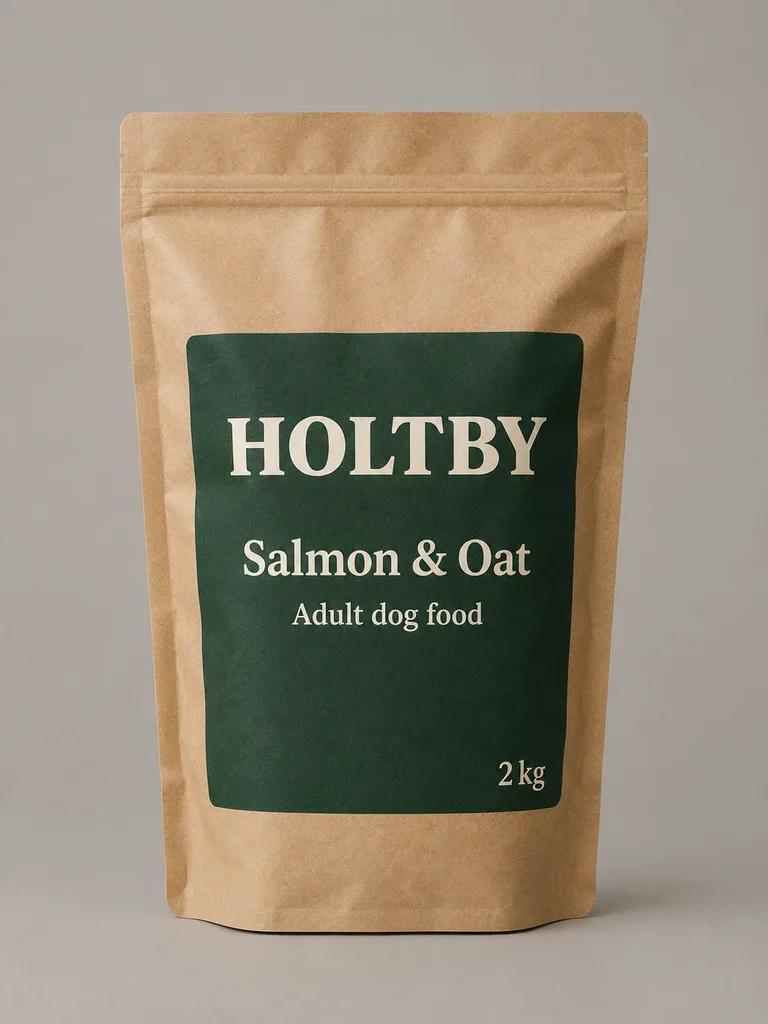
Approved reference 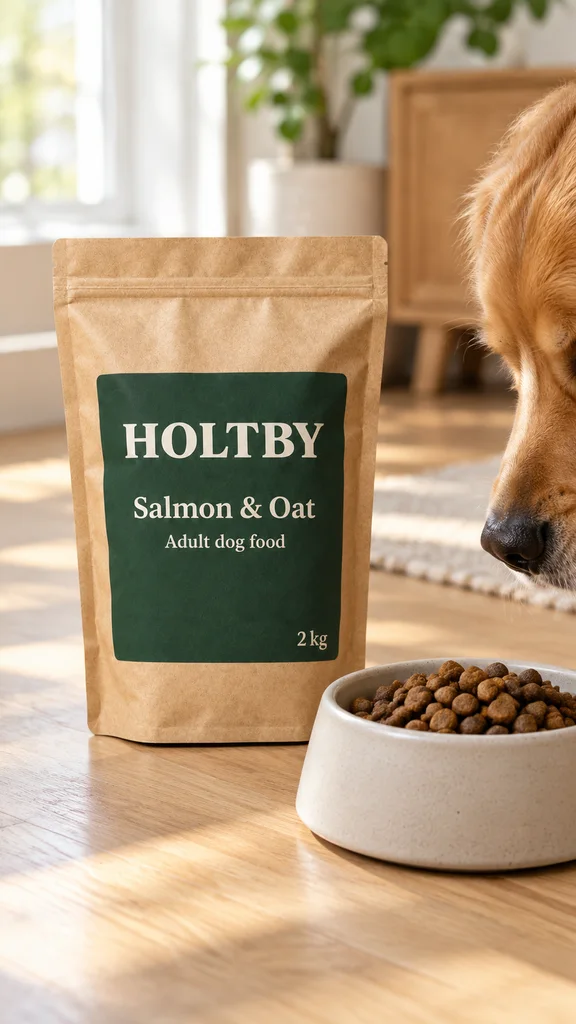
The ad Answer: Fix a specific mismatch (net weight)
- Name
- HOLTBY Salmon & Oat
- Net weight
- 2 kgThe mismatch
- For
- Adult dogs
- Pack
- Kraft pouch, green label
Ad copy“Our new 3 kg bag. Salmon and oat for grown-up dogs.”
The reference and the pack in the photo both say 2 kg; the headline says 3 kg. The words on an ad are part of the product check: a size the pack cannot back up is a mismatch, however good the photo looks.
Check 01: Claims against the pack. Read every number and promise in the copy against the pack and the fact sheet.
Ad 2: HAVREL, Face serum
HAVREL demo · fictional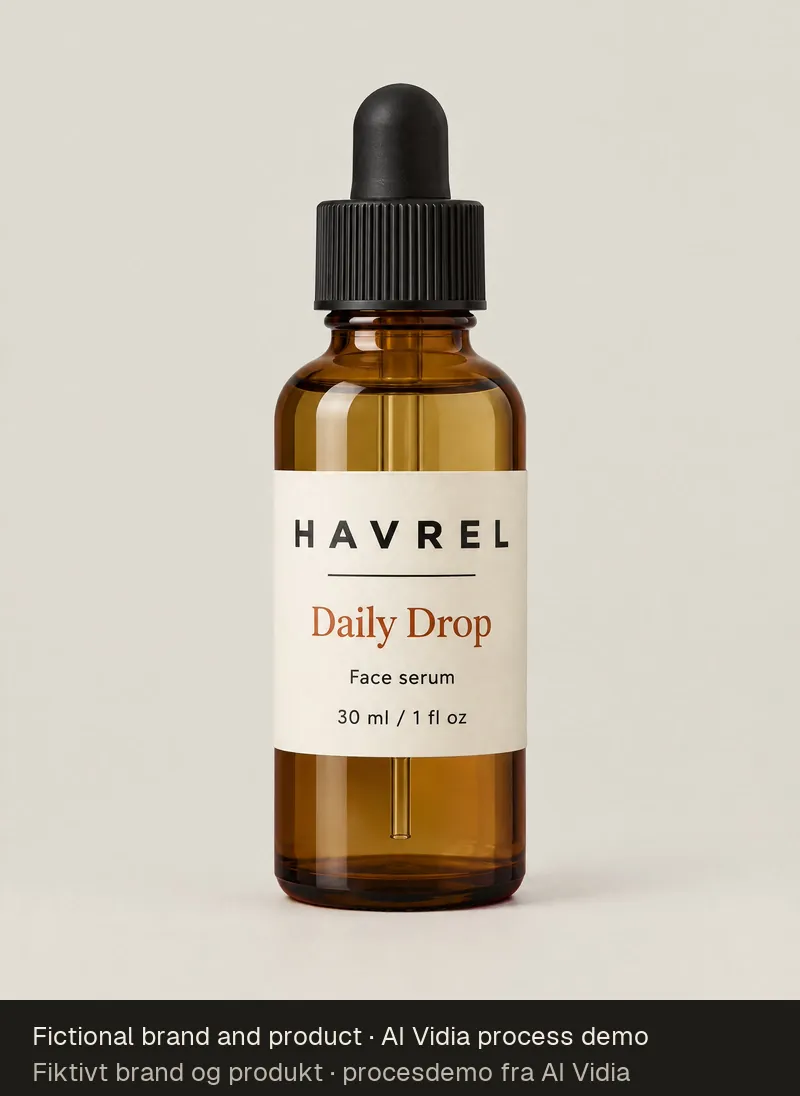
Approved reference 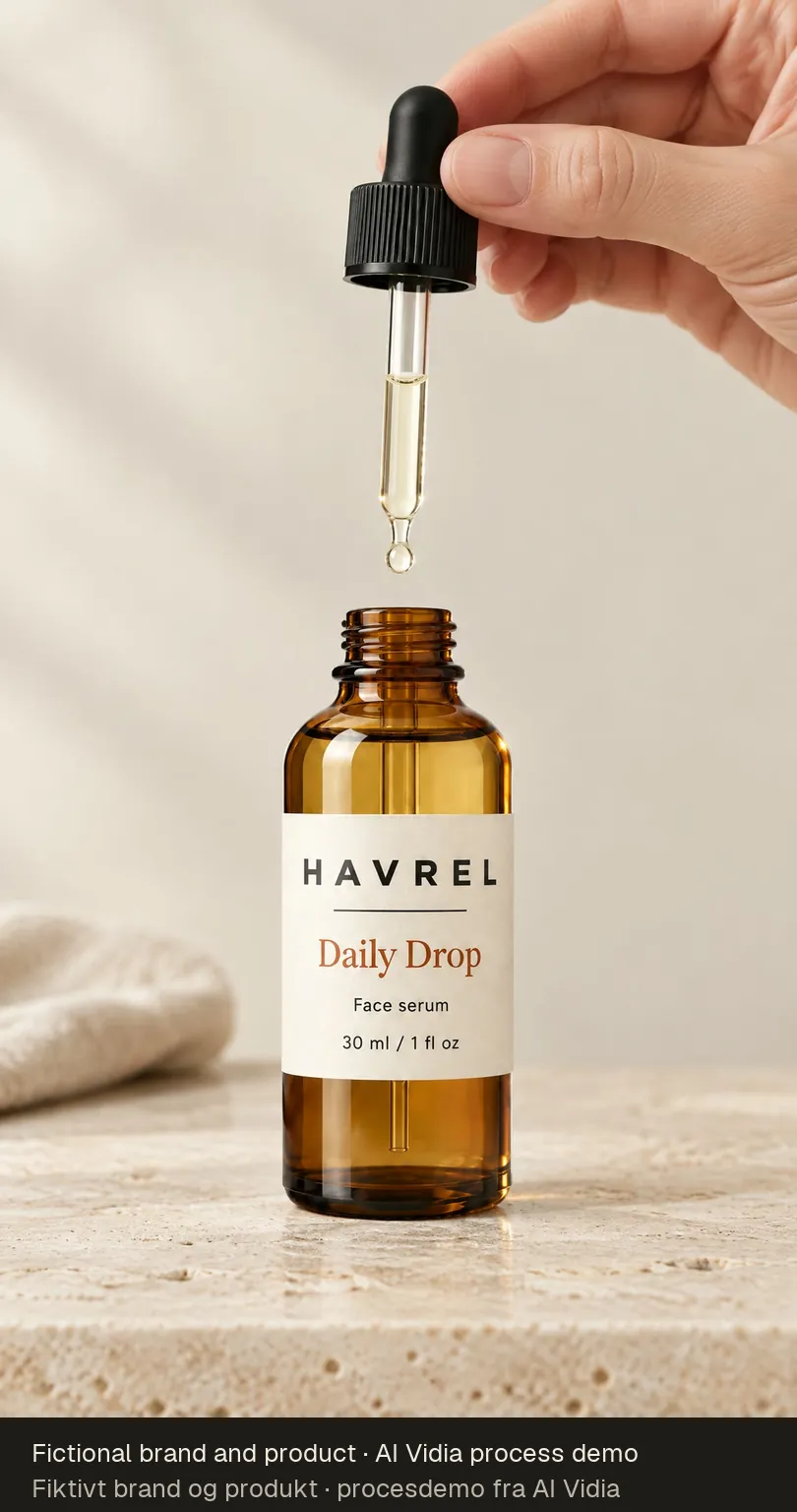
The ad Answer: Fix a specific mismatch (dropper)
- Name on the label
- HAVREL Daily Drop
- Bottle
- Amber glass with a cream label
- Dropper
- One glass pipette with a black bulbThe mismatch
- Collar
- Ribbed black collar
The bottle is open and its pipette is in the hand, so the pipette still standing inside the bottle is a second one. The one in the hand also narrows to a tapered tip. This frame comes from our HAVREL demo, a fictional serum, where two blind AI review passes, not people, rejected it.
Check 02: Parts and components. Count the parts: caps, pipettes, straps, pieces in the box. Generated scenes add and drop them.
Ad 3: HAVREL, Face serum
HAVREL demo · fictionalApproved reference 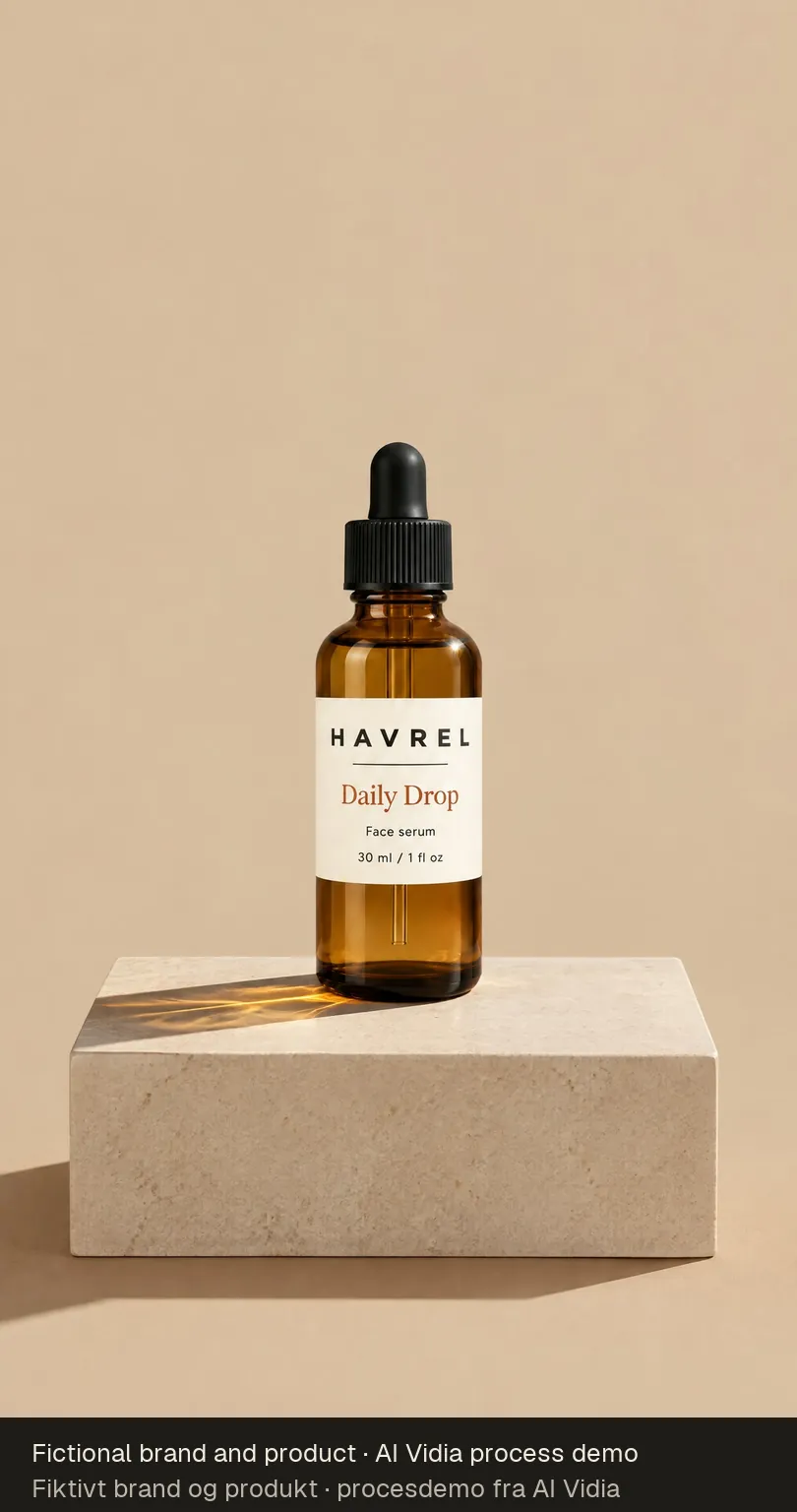
The ad Answer: Ready for product review
- Name on the label
- HAVREL Daily Drop
- Bottle
- Amber glass with a cream label
- Dropper
- One glass pipette with a black bulb
- Collar
- Ribbed black collar
Hard light and a stone block make it look unusual, but every fact holds: one bottle, amber glass, cream label, black collar and one pipette. A stylised scene is not a defect. In our HAVREL demo, both blind AI review passes approved this frame.
Check 03: Seeing when it is right. An unusual style is not a defect. Approve what matches every fact, however stylised.
Ad 4: ARNVIK, Waxed cotton field jacket
Fictional brand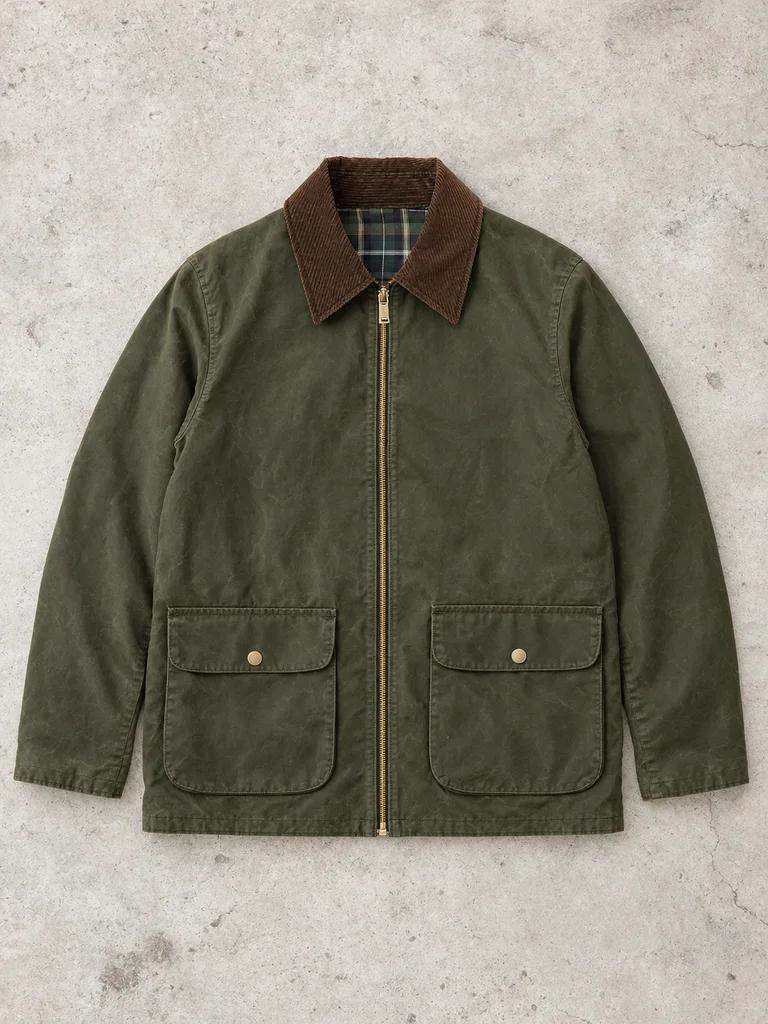
Approved reference 
The ad Answer: Fix a specific mismatch (pockets)
- Colour and fabric
- Olive waxed cotton
- Collar
- Brown corduroy
- Pockets
- Two hip pockets with flaps; no chest pocketsThe mismatch
- Closure
- Brass front zip
The jacket in the ad has two chest pockets. The reference has none: only the two hip pockets. Everything else matches, which is exactly why an added detail slips through. A buyer who orders this jacket gets a different one.
Check 04: Product details. Compare pockets, seams, buttons and trims with the reference, not with what looks plausible.
Ad 5: PELTO, Ceramic table lamp
Fictional brand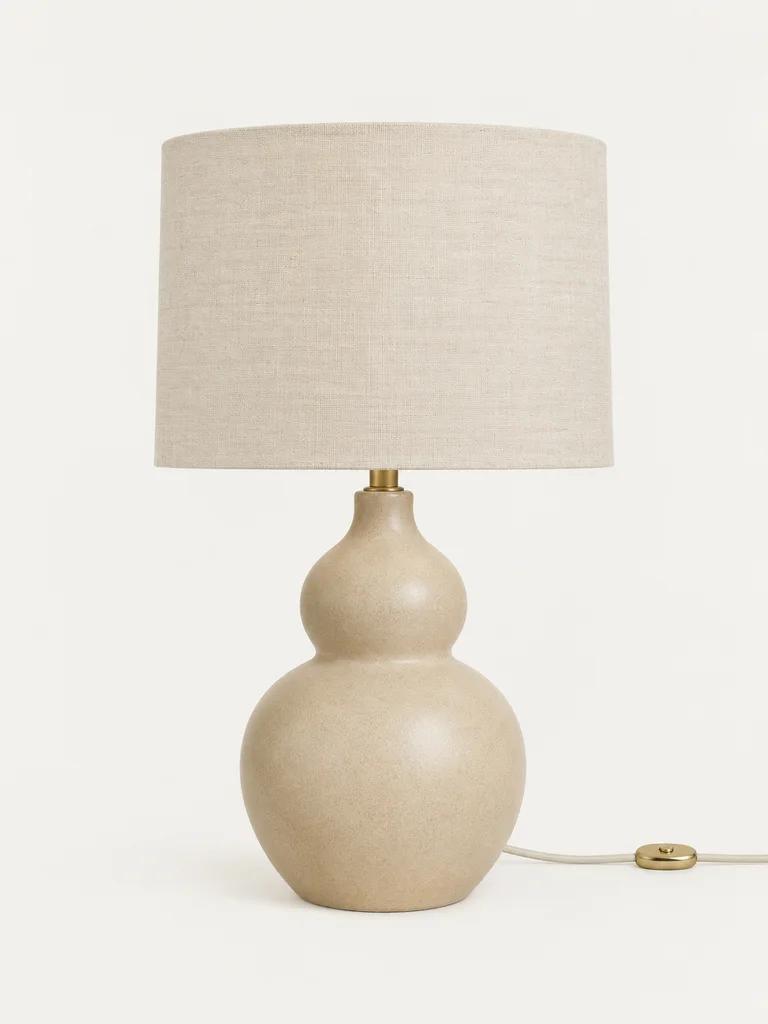
Approved reference 
The ad Answer: Not enough evidence
- Base
- Matte sand glaze
- Shade
- Linen drum shade
- Switch
- Brass, on a cream cord
- Height
- Not supplied
Ad copy“Small enough for any nightstand.”
The headline makes a size claim, but nothing in the references or the frame gives the lamp's size. The honest call is to ask for the measured height and a photo in a real room before approving, not to guess.
Check 05: Size and scale. If nothing shows the size, ask for the measurements and an in-scale photo instead of guessing.
Ad 6: OKSELA, Night cream
Fictional brand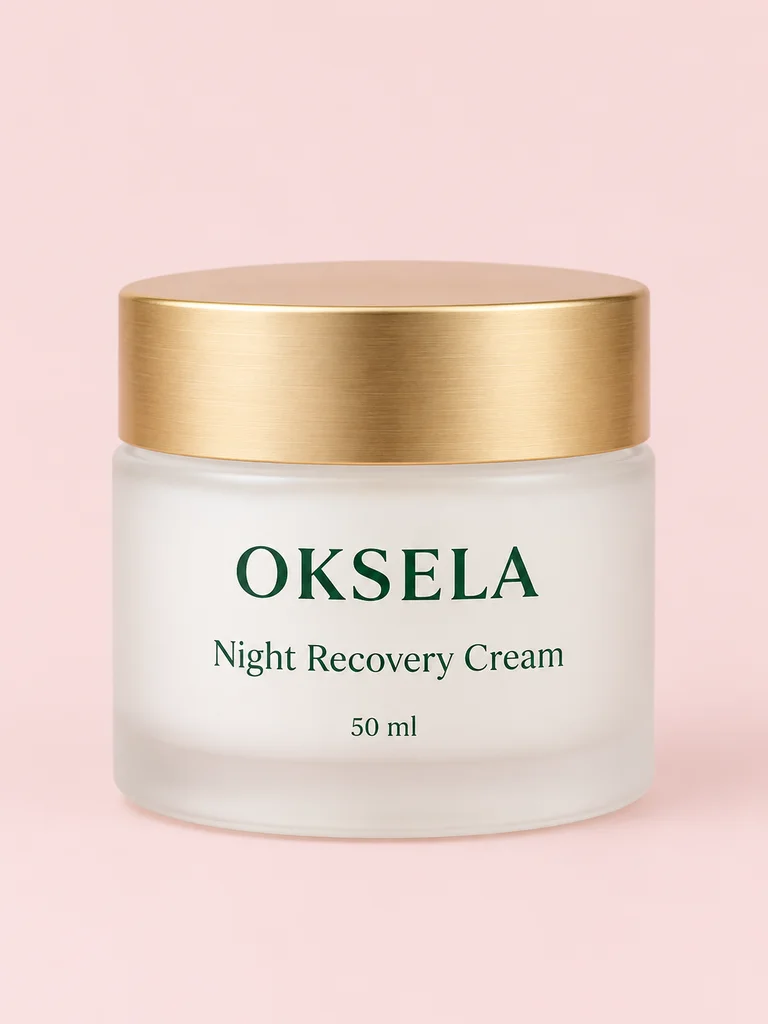
Approved reference 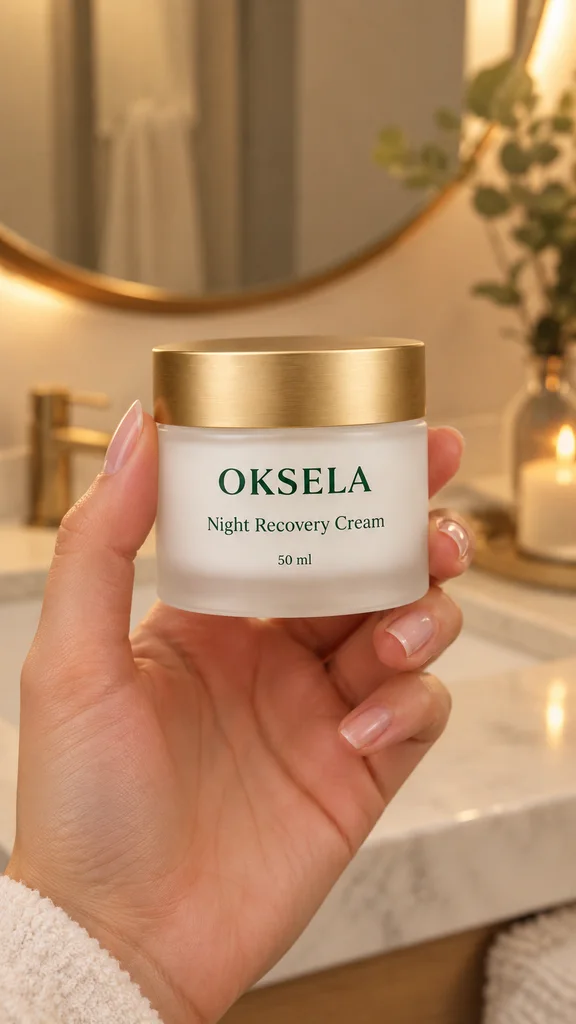
The ad · 0:02 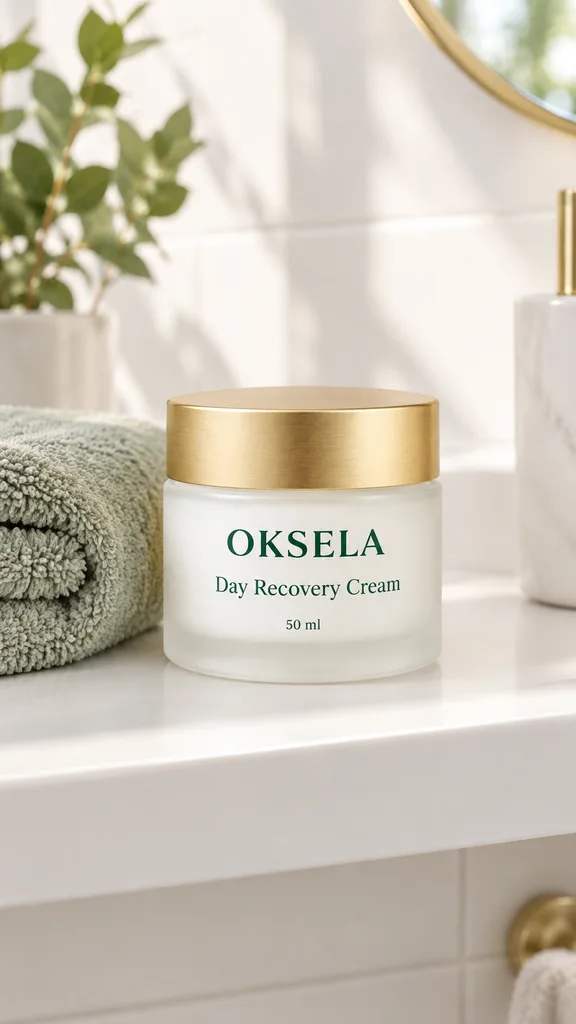
The ad · 0:09 Answer: Fix a specific mismatch (product on the label)
- Brand
- OKSELA
- Product on the label
- Night Recovery CreamThe mismatch
- Size
- 50 ml
- Lid
- Brushed gold
At 0:02 the label says Night Recovery Cream; at 0:09 it says Day Recovery Cream. Each frame looks fine on its own, so check every frame against the reference, not just the first one.
Check 06: Label consistency. Check the label in every frame of a video, not only the first one.
What the challenge is not
- It is not an AI detector. Real footage can be wrong and a stylised image can be right.
- A product-accuracy call is one step. Brand, legal and platform checks come after it.
- The score covers these six fictional ads only. It is not compared with anyone else.
Questions about checking ads
How do you check an ad before it goes live?
Put the approved product facts next to every frame: name and label text, size, parts, colours and every claim in the copy. Mark each one as matching, wrong or not shown, and fix or ask before approving.
Is this a test for spotting AI images?
No. Whether a frame was filmed, shot or generated does not decide the call. The question is whether the ad shows the product the buyer will receive, and whether the references can prove it.
When is not enough evidence the right answer?
When the ad claims something the references cannot settle, such as a size with no measurements or a result with no documentation. Ask for the missing reference instead of approving or rejecting on a guess.
Where do these ads come from?
AI Vidia made all six for fictional brands with AI image tools: four for this challenge and two frames from our HAVREL demo, a fictional serum. In that demo, two blind AI review passes, not people, judged every attempt against a written fact sheet. None of these products exist.
Can we use it with our team?
Yes. Send your colleagues the challenge link; everyone gets the same six ads, so the scores compare fairly. The result card shows a score and a blind spot, never the answers.