
All insights

AI UGC Ad Agency: The Buyer's Guide for 2026

How to hire an AI UGC ad agency in 2026: what a retainer delivers monthly, six questions that expose a reseller, published pricing, and 30/60/90 day gates.

Kevin Dosanjh
Founder, AI Vidia · Updated August 8, 2026
A compact production setup with a glowing ring light and a smartphone in a rig, beside a neat stack of printed cards in burnt orange, ink blue and white.
On this page8 sections

An AI UGC ad agency is a done-for-you studio that writes the hooks, produces creator-style video ads with a locked cast of AI characters, and ships finished, ad-ready variants into your Meta, TikTok and YouTube accounts on a weekly cadence. AI Vidia runs that model from Copenhagen for DTC and consumer brands. This page is not a vendor list. It is the buyer's guide to the engagement itself: what lands in the ad account each month, the questions that separate a production studio from a reseller, how retainer pricing works, and what the 30, 60 and 90 day reviews should show.

What an AI UGC ad agency delivers month to month

40VIDEOS PER MONTH ON RETAINER
72HFIRST CREATIVE AFTER KICKOFF
5%VARIANTS THAT BECOME WINNERS
EveryASSET CD-REVIEWED

The monthly deliverable is a count, a cadence and a format spread, not a folder of clips. AI Vidia publishes three tiers in euros. The Pilot Sprint runs 14 days at a one-time EUR 4,900 and delivers 18 videos plus a winners report. The Performance Retainer is EUR 8,500 per month and ships 40 on-brand videos per month in weekly batches. The Brand System is EUR 18,000 per month, ships 70 videos per month, and runs multi-market. Every tier includes ratio cuts for 9:16, 4:5 and 1:1 and delivery of ad-ready files against your ad account.

Volume arrives on a ramp, not on day one. The AI Vidia ramp is 12 variants in week one, 30 to 50 in week two, and 80 to 150 from week three, with the first creative in your hands within 72 hours of kickoff. A growth lead should build the media calendar against that curve. A retainer that promises full monthly volume in week one is promising something no character lock and no claims review survives.

The count matters for arithmetic reasons, not ambition. Meta for Business reports that campaigns with 5 or more creative variations see 30 to 50 percent lower CPA, and roughly 5 percent of creatives become durable winners. Forty variants a month therefore produces about two ads worth real spend. A brand buying 8 variants a month is buying a rounding error. A brand buying 40 with no testing plan attached is buying storage.

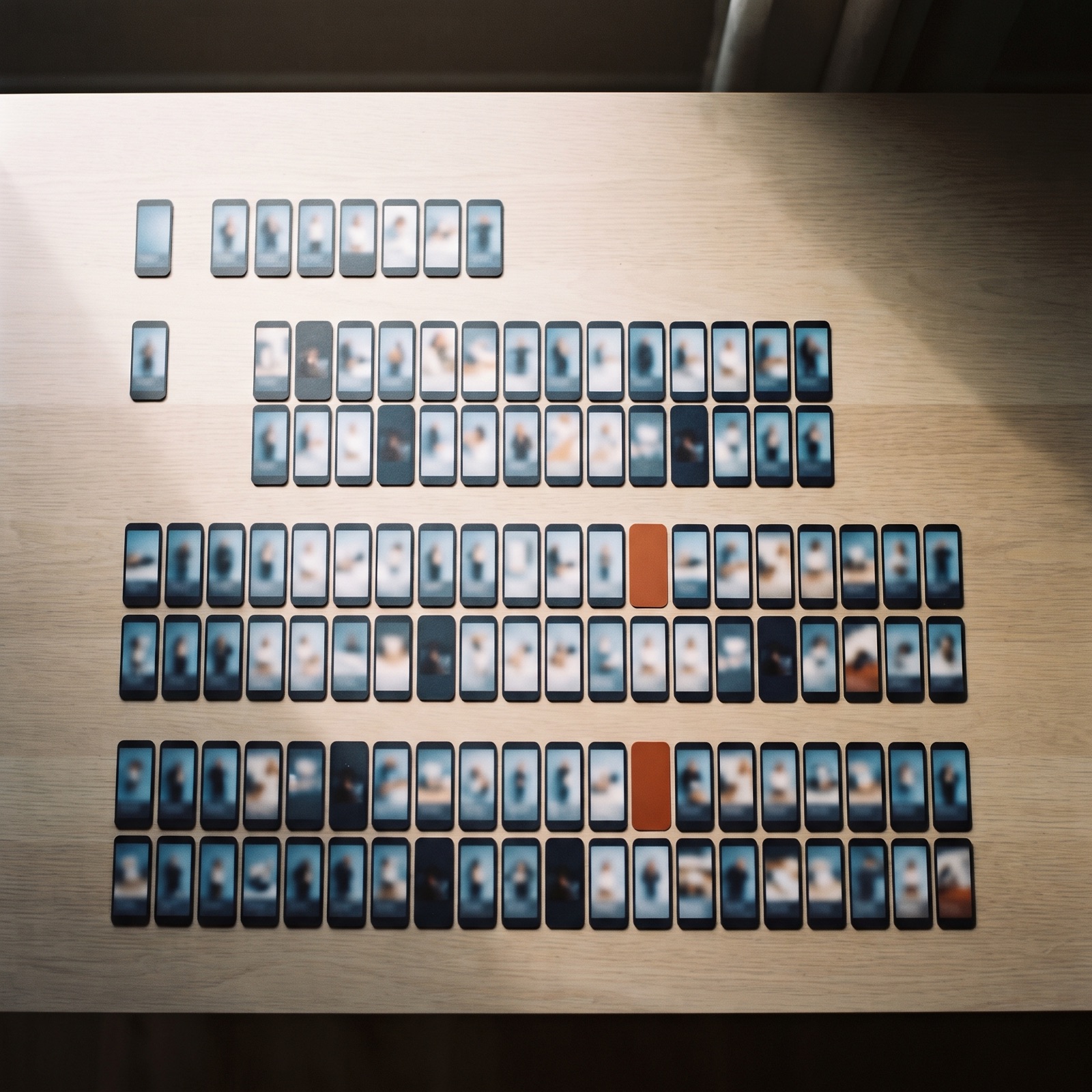
Overhead view of a warm white desk with small vertical ad frame cards arranged in four rows of increasing quantity, from a sparse first row to a dense final row with two cards tinted orange.
A month on retainer arrives as weekly batches of increasing size, and only a couple of cards in the whole month become ads worth real spend.

The questions that separate a studio from a reseller

A reseller takes your brief, runs it through the same self-serve generator your team could license directly, and marks up the output. A production studio owns a character system, a disclosure workflow, a revision model, and a defined relationship to your ad account. The table below is the engagement diagnostic: six questions, the answer a real studio gives, and the answer that should end the call.

Question to askWhat a strong answer sounds likeWarning signWhat it decides
Who owns the character system?The brand owns the locked character set and its reference assets, written into the contract before the first render.Ownership is not addressed, or the characters live only inside an account the vendor controls.Your switching cost
What is your disclosure workflow per platform?An AI info label applied at Meta upload, TikTok synthetic media rules checked at script stage, EU AI Act Article 50 disclosure on EU delivery.Disclosure is described as your legal team's problem, or answered with one generic yes.Takedown and enforcement risk
How does the revision model work?Revision rounds scoped per batch with a turnaround quoted in business days, and re-briefs folded into the next batch.Unlimited revisions with no turnaround commitment anywhere in the contract.Real delivery speed
Who holds the ad account relationship?The brand holds the ad account; the studio delivers ad-ready files and reads results with your media buyer.Admin control of the ad account is required before creative work starts.Control and exit
What does the monthly number include?A variant count, a weekly cadence, named ratios, and a winners report per cycle.A monthly hour bucket, or a content package with no countable output.Whether the volume is real
What happens in month two?The month-two brief is built from month-one winners, with a review date already in the calendar.Month two repeats month one because nothing from month one was measured.Whether results compound

Character ownership is the true switching cost in AI UGC. A locked character set is what keeps a presenter recognisable across 200 ads, so if that set lives inside a vendor-controlled account, leaving the vendor means restarting the face of the brand. Settle ownership and usage rights in writing before the first render, at any price point.

Disclosure is now a per-platform workflow rather than a legal footnote. Meta requires an AI info label on photorealistic AI-generated ad content, mandatory since July 2026, and labels compliant content rather than rejecting it. TikTok bans AI-generated public figures endorsing products outright. In the EU, the transparency obligations in AI Act Article 50 took effect on 2 August 2026. In the US, FTC rule 16 CFR 465.2 draws the line at truth: an AI character presenting a real customer's real testimonial with disclosure is lawful, while an AI character posing as a fake customer with a fabricated experience is an illegal fake testimonial. Ask any AI UGC vendor who owns the character system, and what their disclosure workflow is per platform.

The revision model and the ad account question decide how the engagement feels in month three. Unlimited revisions without a turnaround commitment run slower in practice than two scoped rounds with a named number of business days, because unlimited usually means unqueued. A vendor that asks for admin control of the ad account before any creative exists has made your account part of its retention plan. The AI Vidia position is that the brand holds the account and the studio ships against it.

Want a structured plan for your AI creative pipeline?
20-minute call, no pitch deck.
Book a call

The Agency Fit Test

The Agency Fit Test is the strategic framework the AI Vidia team runs before quoting, and it is built to disqualify. It scores five variables. A brand that fails two of them should not hire an AI UGC ad agency yet, including this one. Run it before the first demo call. If the outcome is a hire and the shortlist is still open, the vendor-by-vendor view sits in the AI Vidia comparison of AI UGC agencies by sourcing model.

  1. Monthly variant demand. Count the net-new UGC variants the media plan needs each month to hold CPA steady, not the variants you produced last month. Under 10 per month, a done-for-you retainer is oversized and a tool or a single creator will do. From 30 per month on a weekly cadence, human production schedules become the bottleneck and an agency starts to pay for itself.
  2. Internal capacity. Count the honest weekly hours a senior person can spend briefing, reviewing, and handling per-platform disclosure. Operating a generation tool at volume consumes 5 to 10 of those hours per week. An agency consumes a review window instead, typically one scheduled hour per batch, which is the entire reason done-for-you exists.
  3. Brand-control stakes. Decide how much consistency the ads have to carry. A single seasonal push tolerates drift. A presenter who must look like the same person across hundreds of ads, in three markets, needs a locked character system with a documented pass rate rather than fresh generations each week.
  4. Compliance exposure. Map where the ads will run and which claims they carry. EU delivery, testimonial-led scripts, regulated categories, and any use of recognisable public figures all raise exposure. High exposure makes the disclosure workflow a selection criterion of equal weight to creative quality, not a clause reviewed after signature.
  5. Budget floor. Check the number against published tiers before booking calls. AI Vidia starts at EUR 4,900 for a 14-day Pilot Sprint and EUR 8,500 per month for a weekly-cadence retainer. Below roughly EUR 3,000 per month, funding a locked character system and a weekly cadence at the same time is difficult at any studio, and the honest answer is usually to stay on a tool until spend grows.

Kevin's take

That reframe changes what a buyer asks for in a pitch. Instead of requesting more samples, ask for the batch-two plan from a live account with the client name removed: how many variants, which hooks were kept, what was cut, and how long the turnaround ran in business days. A studio that runs a real production system can produce that in an afternoon. A reseller cannot produce it at all, because nobody wrote it down.

The First 90 Days

The First 90 Days is the tactical framework for the engagement itself. It covers the onboarding sequence and the three review gates that decide whether the retainer renews. Each gate has one question attached, and each question has a number rather than a feeling behind it.

  1. Days 1 to 3, kickoff and character lock. Kickoff covers approved product claims, the hook angles to test, the ratio spread, and the character or presenter profile. The character set is locked and ownership is confirmed in writing before anything renders, and the per-platform disclosure workflow is agreed at the same table. AI Vidia puts the first creative in the client's hands within 72 hours of that meeting.
  2. Weeks 1 to 3, the ramp. Week one ships 12 variants against a control so the account reads hook-level signal without starving any single variant. Week two moves to 30 to 50 as the winning angles emerge. From week three the pipeline holds 80 to 150 variants, which is the point where a retainer is running at full production rather than still calibrating.
  3. Day 30 gate, does the pipeline hold? The question at 30 days is operational, not commercial. Expect the full first-month variant count delivered on schedule, ratio cuts complete, a winners report naming the hooks that beat control, and zero platform rejections. If volume slipped in month one it will slip in every month after, and that is the moment to renegotiate rather than wait.
  4. Day 60 gate, is the account learning? By 60 days the month-two batch should be visibly built from month-one winners: fewer new angles, more variants on the angles that worked, and a control that has been beaten at least once. Roughly 5 percent of creatives become durable winners, so a 40-variant month should have produced about two ads carrying real spend. A month-two batch that looks like a fresh start means nothing was measured.
  5. Day 90 gate, has an economic number moved? Ninety days is the first fair point to judge outcomes rather than output. Look for a directional move in CTR, CPA or ROAS on the tested cohorts, plus a repeatable weekly cadence and a character system that still looks like one brand. The IndianBites engagement reached and 2.4x ROAS on winning cohorts inside 11 weeks, which is a reasonable shape to hold a studio to.
  6. Renew, re-scope or exit. Three outcomes are legitimate at 90 days: renew at the same tier, step up a tier because the media plan now needs more variants, or exit. Exit is only clean if character ownership and asset delivery were settled at kickoff, which is why step one is step one.
A kickoff table holding a printed character reference sheet with six poses of the same presenter, an empty ruled production schedule grid, a smartphone on a small tripod and a ring light.
Kickoff produces two artifacts before any video renders: the locked character reference set and the production schedule the first 90 days runs against.

Proof: what a running retainer looks like

AI Vidia has shipped more than 1,000 AI ads for named client accounts like Andy Okay and IndianBites, with live ad spend optimized behind them. The brand-safe pass rate is near-total. IndianBites returned 2.4x ROAS on the winning cohorts of its tested variants. Retainer accounts ship 30+ variants each week, with the client accounts in flight at any time.

The live public case is the IndianBites case study, a DTC food brand whose traditional food photography could not keep up with the weekly testing cadence. Over 11 weeks the account received 142 AI ads built from 18 hero concepts, each tested in 6 to 10 variant cuts, reaching and 2.4x ROAS on winning cohorts. The mechanics of cutting concepts into that many tested variants are set out in how a creative testing matrix scales from 4 to 35 variants.

A retainer is not a subscription to videos. It is a subscription to a cadence, and the cadence is the only thing a media buyer can actually plan around.

When to hire, and when not to

Hire an AI UGC ad agency when the media plan needs 30 or more net-new variants per month, nobody internal has 5 to 10 weekly hours to operate a tool, and brand consistency has to survive hundreds of ads. That combination is where done-for-you production is cheaper than the internal alternative, because the alternative is a hire, and recruiting a senior creative takes 3 to 4 months.

Do not hire one when variant demand sits under 10 per month, when a capable operator already sits in the team and enjoys the work, or when the budget cannot clear roughly EUR 3,000 per month. Also do not hire one to fix a positioning problem. An agency multiplies whatever the offer already does in the feed, so a weak offer simply gets tested faster and disproved sooner.

One more case for waiting: if the ad account has no control creative and no recent test history, spend two weeks establishing a baseline first. A studio that starts against a known control can report at day 30. A studio that starts against nothing can only report activity.

The next step

The AI Vidia service surface for this work is the AI UGC ads service, with all three retainer tiers published in euros. Bring the Agency Fit Test scores and the six diagnostic questions to any vendor call, including this one. A 30-minute scoping call books at the AI Vidia booking page, and the first creative lands within 72 hours of kickoff.

Frequently asked questions

01What does an AI UGC ad agency actually deliver each month?
A monthly variant count delivered on a weekly cadence, in 9:16 the channels need, plus a winners report that names which hooks beat control. AI Vidia ships 40 on-brand videos per month on the Performance Retainer and 70 per month on the Brand System, in weekly batches rather than one drop. Delivery is 9:16 vertical, the format Reels, TikTok and Shorts run. If a proposal quotes hours or a content package instead of a countable variant number, the volume is not defined.
02How much does an AI UGC ad agency cost?
AI Vidia publishes three tiers in euros: EUR 4,900 for a 14-day Pilot Sprint of 18 videos, EUR 8,500 per month for the Performance Retainer at 40 videos per month, and EUR 18,000 per month for the multi-market Brand System. Below roughly EUR 3,000 per month, no studio can hold both a locked character system and a weekly cadence. The number to compare against is not cost per video but cost per tested winner, since roughly 5 percent of creatives become durable winners. Forty variants a month is about two ads worth real spend.
03Who owns the AI characters an agency creates for my brand?
That depends entirely on the contract, which is why it is the first thing to settle. A locked character set is what keeps a presenter recognisable across hundreds of ads, so if it lives only inside a vendor-controlled account, changing vendors means restarting the face of the brand. Agree ownership and usage rights in writing before the first render. Ask any AI UGC vendor who owns the character system, and what their disclosure workflow is per platform.
04How long does onboarding take before the first ads run?
Kickoff covers approved claims, hook angles, ratio spread and the character lock, and AI Vidia delivers the first creative within 72 hours of that meeting. Volume then ramps: 12 variants in week one, 30 to 50 in week two, and 80 to 150 from week three. Full monthly volume in week one is not realistic for any studio that locks characters and reviews claims properly. Plan the media calendar against the ramp rather than against the headline monthly number.
05How do I judge an AI UGC agency at 30, 60 and 90 days?
At 30 days the question is operational: was the first month's variant count delivered on schedule, with ratio cuts complete and zero platform rejections. At 60 days the question is whether the account is learning, which shows as a month-two batch built from month-one winners rather than a fresh set of angles. At 90 days the question is economic: a directional move in CTR, CPA or ROAS on the tested cohorts. For reference, the IndianBites engagement reached and 2.4x ROAS on winning cohorts within 11 weeks.
06Do I need to disclose AI-generated UGC ads on Meta and TikTok?
Yes, and the rules differ per platform, so disclosure is a workflow rather than a checkbox. Meta requires an AI info label on photorealistic AI-generated ad content, mandatory since July 2026, and labels compliant content rather than rejecting it. TikTok bans AI-generated public figures endorsing products outright. In the EU the transparency obligations in AI Act Article 50 took effect on 2 August 2026, and in the US FTC rule 16 CFR 465.2 makes a disclosed AI character presenting a real customer's real testimonial lawful while a fabricated customer experience is an illegal fake testimonial.

Next step

Get your first 12 on-brand AI variants in 14 days.

Book a 20-minute strategy call with the AI Vidia team. No pitch deck, just a structured plan for your creative output.

Book a call

Read next