AI/Vidia
All insights

AI Creative Iteration Loop Framework

An ai creative iteration loop framework turns live ad performance into the next batch of creative every week, so AI Vidia ships tested winners at 2.4x ROAS.

Founder, AI Vidia
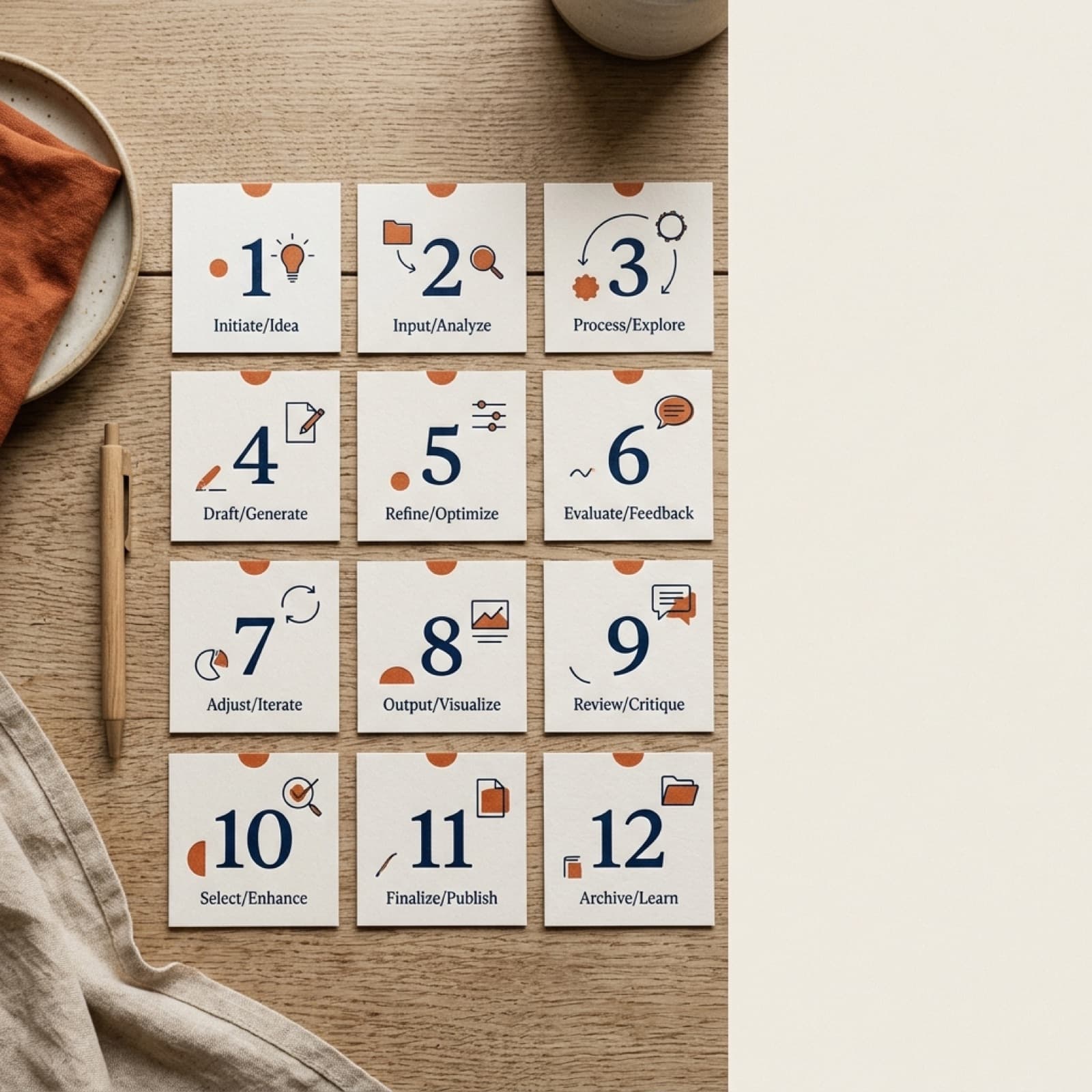
Overhead flat lay of numbered paper cards arranged as a repeating loop on a warm off-white Nordic surface.
On this page8 sections

AI Vidia runs an ai creative iteration loop framework that turns live ad performance into the next batch of creative on a fixed weekly cycle, so paid social spend keeps meeting fresh variants instead of fatigued ones. An ai creative iteration loop framework is the repeatable system that reads the signal from tested ads, decides what to change, and ships the next round, without waiting on a quarterly refresh or a new photo shoot. AI Vidia has shipped 1,834 AI videos and 70,342 AI images across 48 brands in 14 countries, iterating on real spend rather than guesses, and the tested winners return a median 2.4x ROAS. The loop is not a dashboard you stare at. It is a closed circuit: test, read, iterate, ship, then read again, with each cycle feeding the brief for the next one.

What a stalled iteration loop costs

2.4xROAS ON WINNERS
+38%AVG CTR LIFT ON VIDEO
12xWEEKLY TEST VELOCITY
99.2%BRAND-SAFE PASS RATE

The iteration loop is where paid social either compounds or stalls. Meta ad sets need 30 to 50 conversion events per week to exit the learning phase, and they only reach it when fresh, relevant creative keeps entering the account. A brand that refreshes creative once a quarter starves most ad sets of signal, because the winning ad fatigues long before the next batch arrives. Wyzowl reported in 2025 that 91 percent of businesses use video marketing and 30 percent name production cost as the top barrier to making more of it, which is why so many teams iterate slowly.

Creative fatigue makes the slow loop worse. A winning ad does not hold its performance; frequency climbs, click rate falls, and CPA rises, usually inside two to four weeks on a scaling budget. A quarterly loop means the account runs fatigued creative for most of every quarter, paying a rising CPA while it waits for the refresh. The loop speed, not the quality of any single ad, is what decides how long the account spends in that fatigued state.

The cost is concrete. A brand spending EUR 40,000 a month on paid social with a quarterly refresh tests 5 to 15 concepts a quarter, while a weekly loop tests 30 or more in the same window. Forrester reports a 20 to 35 percent paid media ROAS improvement when creative volume rises, and that lift is exactly what a slow loop leaves on the table. The Content Marketing Institute reported in 2025 that 73 percent of B2B marketing teams cite producing enough content as their biggest challenge, and iteration speed is the part of that number most teams never measure.

External research points the same way. McKinsey reports that AI in creative production drives a 3 to 5x output increase, but only when the loop around it can turn results into new briefs fast enough to use them. Deloitte reports 67 percent faster time to market for AI-enabled creative teams, and in paid social, time to market is really iteration cycle time. When the loop is manual, the reporting, the brief, and the render each add days, so the winning insight is stale by the time the next ad ships.

Four ways teams iterate creative, compared

Most brands run one of four iteration models, and the model decides how fast a result becomes a new ad. The right choice depends on monthly spend, how the team reads signal, and how much creative it can produce per cycle. The table below compares the four on the metrics that decide whether the loop compounds.

Iteration modelLoop cycle timeSignal it acts onWeekly variants shippedROAS trajectory
Gut-feel refreshNo fixed scheduleOpinion in a meeting0 to 3Flat to declining
Quarterly agency refresh8 to 12 weeksLast quarter report5 to 15 per quarterSawtooth, decays between refreshes
Manual dashboard and brief2 to 4 weeksCTR and CPA pulled by hand6 to 12Slow climb
AI Vidia closed-loop iteration5 to 7 daysHook rate, hold, CTR, CVR30 to 150Compounding

Gut-feel refresh has no loop at all; creative changes when someone dislikes the current ad, so spend rides fatigued creative for weeks. Quarterly agency refresh produces a sawtooth: performance jumps at each drop, then decays for two months while the team waits for the next one. A manual dashboard and brief process is the honest middle, but pulling numbers by hand and writing briefs one at a time caps the loop at a fortnight, which is slower than most creative fatigues. AI Vidia closed-loop iteration wins because it fixes the cycle time first: results from last week become briefs this week, render in a batch, and re-enter the same ad sets within days, so each cycle sharpens the next instead of restarting from cold.

The gap between the models is not talent; it is cycle time. A team on a two week manual loop and a team on a five day closed loop can brief the same quality of creative, but the faster loop reads roughly three times as many verdicts per quarter, so it finds and scales winners while the slower team is still writing its second brief.

Want a structured plan for your AI creative pipeline?
20-minute call, no pitch deck.
Book a call

The AI Vidia Iteration Signal Ladder

This is the strategic model that decides which signal to act on and in what order. The principle is that ad metrics fail in sequence, so you read them in sequence and fix the earliest failure first. AI Vidia climbs this ladder for every tested ad before writing a single new brief.

  1. Read the hook rate first. The first metric is how many people stay past the first three seconds, because a weak hook caps everything downstream. If hook rate is low, the body, the offer, and the landing page never get a fair test, so the only valid change is a new opening.
  2. Then read hold and completion. If the hook holds but viewers drop in the middle, the problem is pacing or proof, not the opening. Iterate the middle beats, the demo, or the sequence, and leave the hook that is already working alone.
  3. Then read click and conversion. Strong hold with weak clicks points at the call to action or the offer, and weak conversion after a strong click points past the ad at the landing page. Naming the exact layer keeps the team from rebuilding parts that already perform.
  4. Separate signal from noise. No verdict is valid until the ad has cleared a minimum threshold, and AI Vidia uses at least 1,000 impressions or 30 to 50 conversion events per ad set before it reads a result. Acting on 200 impressions is guessing with extra steps.
  5. Assign the verdict: iterate, scale, or kill. Every ad leaves the read with one of three labels, never a maybe. Winners get more budget and ratio cuts, near-misses get one targeted iteration at the failed layer, and clear losers are killed so they stop taxing the account.

The ladder matters because it stops the most expensive iteration mistake, which is rebuilding a whole ad when only one layer failed. When the team knows the hook was the problem, it ships ten new hooks on the proven body instead of ten entirely new ads.

Kevin's take

This reframe is why volume alone does not fix performance. Ten random new ads a week will lose to three precise iterations on a proven winner, because the precise iterations carry forward everything that already tested well. The loop is not about making more; it is about making the next thing measurably better than the last.

The AI Vidia Weekly Iteration Loop

This is the tactical sequence that runs the ladder every week. It fixes each day of the loop so a result never waits for an open calendar slot, and the full cycle closes in five business days.

  1. Monday, read the board. The week opens with every live ad scored on the signal ladder, sorted into iterate, scale, or kill. This read is fast because the thresholds are fixed, so no one argues about whether a number is real yet.
  2. Tuesday, brief the changes. Each near-miss becomes a brief that names the failed layer and the specific change, not a blank creative request. A brief that says new hook, same body is faster to produce and far easier to read next week.
  3. Wednesday, batch render. All changes render in one brand-locked batch, so the new variants match the approved style and only the intended layer moves. Batching is what makes 30 to 150 variants a week possible without a bigger team.
  4. Thursday, launch into live ad sets. New variants enter the same ad sets as their parents, so the comparison is clean and the learning phase is not reset for the whole account. Winners scale in place while iterations start their own test.
  5. Friday, log the verdicts. Every result is logged against the concept it came from, so next Monday the board reads faster and the winning patterns are visible. The log is the memory that makes the loop compound instead of repeat.

Proof from live accounts

AI Vidia built this loop on real spend, not a slide. Across 48 brands, 14 countries, and EUR 2.4M or more in optimized ad spend, the closed-loop model holds a 99.2 percent brand-safe pass rate while shipping 1,834 AI videos and 70,342 AI images. For IndianBites, a fast-growing DTC food brand, the AI Vidia team ran 18 hero concepts through the loop, testing each in 6 to 10 variant cuts, and shipped 142 AI ads in 11 weeks. The result was 2.4x ROAS on winning cohorts, a 62 percent cut in creative production cost, and a 12x jump in weekly test volume, because iteration replaced the weekly photo shoot the brand could not sustain.

Winners do not come from a lucky first ad. They come from the tenth iteration of a concept the data told us to keep pushing.

You can see how the variant math works in the AI Vidia creative testing matrix that runs 4 to 35 variants per concept, which feeds the loop with enough cuts to read a real verdict. The same loop also catches decline early, which is the job of the AI Vidia method for detecting Meta ad creative fatigue before ROAS drops. For the full account-level breakdown, read the IndianBites case study and its 11 week results.

A second pattern shows up on a Nordic ecommerce brand that ran the same loop with a three person team. Asset output moved from 20 a month to 210 a month, cost per asset fell from 2,200 DKK to 320 DKK, and campaign launch compressed from three weeks to five business days. Variants per campaign rose from 4 to 35, and ROAS lifted 28 percent in 90 days across three languages. The weekly loop, not a bigger team, was the change that let the brand act on its own results in time to matter.

When to iterate, scale, or kill

Match the action to the signal, not to a feeling. The rules below are concrete.

Iterate when a concept shows a strong hook but weak hold or clicks, because the data says the idea works and one layer needs a fix. Scale when an ad beats account average on CTR and conversion past the minimum threshold, and expand it with ratio cuts and fresh budget before it fatigues. Kill when hook rate stays below account average across two iterations, because a concept that cannot earn attention at the top will not earn it lower down. Stop iterating a single concept once it has had three targeted passes without clearing the bar, and move that budget to a new concept rather than a fourth pass. A good rule of thumb: if you cannot name the layer you are changing and why, you are refreshing, not iterating, and refreshing is what a quarterly loop already does badly.

Next step

If your creative changes on a calendar instead of on signal, the fastest fix is to set a weekly loop and read every ad on the same ladder. AI Vidia runs this iteration loop as part of every AI video ad production engagement, so the cadence and the signal reads ship with the creative. To map where your current loop is losing time and see what a weekly cycle would change, book a Performance Retainer call with the AI Vidia team.

Frequently asked questions

01What is an AI creative iteration loop framework?
An AI creative iteration loop framework is the repeatable weekly system that turns live ad performance into the next batch of creative. It reads the signal from tested ads, decides which layer to change, ships new variants, and reads the result again. The point is to compound on what already works instead of refreshing the whole ad on a calendar. AI Vidia runs this loop with a five to seven day cycle time across 48 brands.
02How often should you iterate ad creative?
For a brand scaling paid social, the iteration loop should close every week, not every quarter. Meta ad sets need 30 to 50 conversion events per week to exit the learning phase, so weekly fresh creative keeps the account fed. A quarterly refresh leaves most ad sets running fatigued creative for weeks while CPA climbs. If rendering a new batch is faster than your reporting and briefing, the loop, not the production, is what needs to speed up.
03Which creative metric should you iterate on first?
Read the hook rate first, because the first three seconds cap everything downstream. If viewers do not stay past the hook, the body, the offer, and the landing page never get a fair test, so the only valid change is a new opening. Once the hook holds, read hold and completion, then click and conversion, in that order. Fixing the earliest failure first stops the team from rebuilding layers that already perform.
04How is an iteration loop different from creative testing?
Creative testing is running variants against each other to find a winner in a single round. An iteration loop is the system that takes that result and feeds it into the next round, so each cycle starts smarter than the last. Testing without a loop produces winners you never build on, and a loop without enough variants per round produces verdicts you cannot trust. AI Vidia pairs a testing matrix of 4 to 35 variants per concept with a weekly loop so both problems are covered.
05When should you stop iterating on a concept and kill it?
Kill a concept when its hook rate stays below account average across two full iterations, because a concept that cannot earn attention at the top will not earn it lower down. Stop after three targeted passes that fail to clear the bar, and move that budget to a new concept rather than a fourth pass. Scaling, not endless iteration, is the reward for a concept that beats average on CTR and conversion. The log of past verdicts is what tells you whether you are on iteration two or iteration five, so keep it.

Next step

Get your first 12 on-brand AI variants in 14 days.

Book a 20-minute strategy call with the AI Vidia team. No pitch deck, just a structured plan for your creative output.

Book a call

Read next