All insights

Branded micro dramas: what nine brand series show about making one

Nine brand micro-drama series, from Maybelline to 7-Eleven, show how many episodes a brand runs, where they run, what the product does in the plot, how long they take to make and what results have been published.

Kenneth Dosanjh
Co-founder / Creative Director, AI Vidia · Lecturer, Business Academy Copenhagen

Branded micro-drama series are short scripted vertical episodes a brand pays for, with its product in the plot. Of the nine brand series AI Vidia compared, reported between December 2025 and November 2026, six ran 4 to 7 episodes, and episodes ran about one to two minutes where a length was given. Only KFC Arabia's was reported as AI-generated, and none of the nine has published sales.

A candlelit dinner table set for a shoot, with a ring box, an empty glass jar with an orange lid, a paper shopping bag and a phone on a small tripod at the far end
Image generated with AI: the props a brand series can build its plot around, staged on an empty dinner set.
On this page8 sections
  1. 01Eight consumer brands released nine micro-drama series in a year
  2. 02Most brand series run 4 to 7 episodes of about a minute
  3. 03In four of the nine series the product carries the plot
  4. 04Where brand series run: own accounts, a publisher's channels or a drama app
  5. 05Published brand series took a few weeks to eight weeks, and none published its cost
  6. 06Brand series have published views; the one sales figure is from a reality series
  7. 07TikTok requires an AI label, Meta adds one, and the law requires it in more places
  8. 08Is your product a fit for a drama series?

A branded micro-drama series is a run of short, scripted vertical episodes that a brand pays for and builds around its product. AI Vidia compared nine scripted series that eight consumer brands made for their own campaigns, as the trade press reported them between December 2025 and November 2026 and as they are listed on its AI drama ads page: Maybelline New York, Crocs (twice), Marc Jacobs, Dr Pepper, KFC Arabia, Nuuly, Sol de Janeiro and 7-Eleven. The set is not exhaustive; other brand series, such as JCPenney's and Procter & Gamble Native's, fall outside it. Their choices on episode count, length, channel and the product's part in the plot are the nearest thing to a brief template a marketing team has today.

Each figure below was read again at its source on 7 November 2026. Results the brands reported about themselves are labelled company-reported. Where the drama apps are the comparison, the numbers come from AI Vidia's own coding of 39 drama-app ads in the Meta Ad Library.

Eight consumer brands released nine micro-drama series in a year

Nine brand micro-drama series, as reported between December 2025 and November 2026
Brand and seriesReportedEpisodesWhere it ranThe product in the plotTime to makePublished result
7-Eleven, A Convenient LoveTubefilter, 1 Nov 20267 of 60 seconds7-Eleven's TikTok and Instagram, through NovemberThe food at every turning point, a discount in each episodeNot reportedNone yet
Sol de Janeiro, The Guest List (with Channel 4)VideoWeek, 14 Oct 20265Channel 4's Meta, TikTok and YouTube channelsEach character draws on its Intense Mist rangeNot reportedNone yet
Nuuly, Heart On My SleeveMarketing Dive, 20 Aug 202612, about 12 minutes in allTikTok, Instagram Reels and YouTube Shorts, in batches of threeSupplies the outfits, a supporting partA few weeksNone published; judged on awareness and shareability
Crocs, Déjà ShoeMarketing Dive, 7 Jul 20267TikTok Shop, as a shoppable seriesShoppable in the seriesUnder 4 weeksSales not published
Dr Pepper, It's a Pepper FlingMarketing Dive, 18 May 20264, with weekly dropsSocial mediaA can of Creamy Coconut stars in a love affairNot reportedNone published
KFC Arabia, The Missing Chedrawi Cheese (AI-generated)Communicate Online, 20 May 20263TikTok and MetaMenu items are the charactersNot reported4M+ views without paid promotion (company-reported)
Marc Jacobs, The SceneMarketing Dive, 24 Apr 2026First of an ongoing seriesSocial, platform not namedSpotlights the Scene BagNot reportedNone published
Crocs, Charmed to Meet YouChief Marketer, 26 Mar 20265 of 1 to 2 minutesReelShort and Crocs' YouTube channelJibbitz charms on a neighbor's shoes8 weeksAbout 10M (Chief Marketer: 10M+ viewers; Marketing Dive: nearly 10M views)
Maybelline New York, Maybe This ChristmasMarketing Brew, 16 Dec 20255 of 1 minuteAlso debuted on ReelShort, with placements on TikTok and the Macy's parade stream on PeacockSpotlighted as the couple navigates a mystery plotUnder 6 weeksNone published

The nine took different routes. 7-Eleven and Sol de Janeiro went live in the autumn of 2026 and had no results yet on 7 November. Two series, Crocs' first and Maybelline's, also ran on ReelShort, a drama app; the rest ran on social platforms where the source names one.

Only one was reported as AI-made. Communicate Online reported on 20 May 2026 that "KFC Arabia launched a three-episode AI-generated drama series on social media", with menu items as the characters, and none of the other eight sources describes AI production.

Most brand series run 4 to 7 episodes of about a minute

Six of eight brand micro-drama series ran 4 to 7 episodes
ItemValue
KFC Arabia3
Dr Pepper4
Maybelline5
Crocs, Charmed to Meet You5
Sol de Janeiro5
Crocs, Déjà Shoe7
7-Eleven7
Nuuly12

Episode counts as reported by Tubefilter (1 Nov 2026), VideoWeek (14 Oct 2026), Marketing Dive (20 Aug, 7 Jul and 18 May 2026), Communicate Online (20 May 2026), Chief Marketer (26 Mar 2026) and Marketing Brew (16 Dec 2025). Marc Jacobs published no count.

Six of the eight series with a published episode count ran 4 to 7 episodes. KFC Arabia's three were the shortest run and Nuuly's 12 the longest; Marc Jacobs called The Scene the first installment of an ongoing series and gave no count. Where a length was reported, an episode ran about one minute: 60 seconds for 7-Eleven, one minute for Maybelline, about 12 minutes across Nuuly's 12 parts and one to two minutes for Crocs.

Drama apps buy ads to a different brief. In AI Vidia's study of 39 English-language ads from 12 short-drama apps in the Meta Ad Library, pulled on 14 October 2026, the median ad ran 18.9 minutes and 29 of the 39 ran 10 minutes or more. An app is selling the next episode, so a long ad doubles as a free sample of the show; a brand is selling a product, and the brand series kept each episode to about a minute.

Length decides the channel too. Crocs did not post Charmed to Meet You on TikTok "because of its longer length", Chief Marketer reported, and ran it on ReelShort and its YouTube channel instead.

The length question is open. An agency executive put the dilemma to Marketing Brew in May 2026: a full run is "a massive investment for a brand", so does a brand "do only a few episodes", and is that "not authentic or true to the format"? Marketing Dive leaned toward shorter runs in July: "Betting on a 50-episode feature upfront might not be the right move", even though Procter & Gamble's Native did run a 50-part show. If the series is your first, plan a run you can finish and judge.

In four of the nine series the product carries the plot

In four series the story runs on the product. Dr Pepper cast a can of Creamy Coconut "as the star of a fleeting love affair" (Marketing Dive). KFC Arabia turned fries, pickles, chicken strips and the missing Chedrawi sauce into characters. In Crocs' first series a character puts Jibbitz charms on a neighbor's shoes, and 7-Eleven shot its episodes in a real store "with the food at every turning point", Tubefilter reported.

In two more the product is spotlighted rather than plotted. Maybelline's series "spotlights" its Instant Eraser Concealer "as the couple navigates a mystery and deception plot", according to Marketing Brew, and Marc Jacobs' series "spotlights the titular Scene Bag" from its pre-fall 2026 collection (Marketing Dive).

The other three used the product another way. Sol de Janeiro built each character on its Intense Mist fragrance range. Nuuly chose to "play a supporting part in a larger narrative" by supplying the outfits, and judged the series on awareness and shareability, per Marketing Dive. Crocs ran Déjà Shoe as a shoppable series on TikTok Shop, so viewers could buy from the episodes.

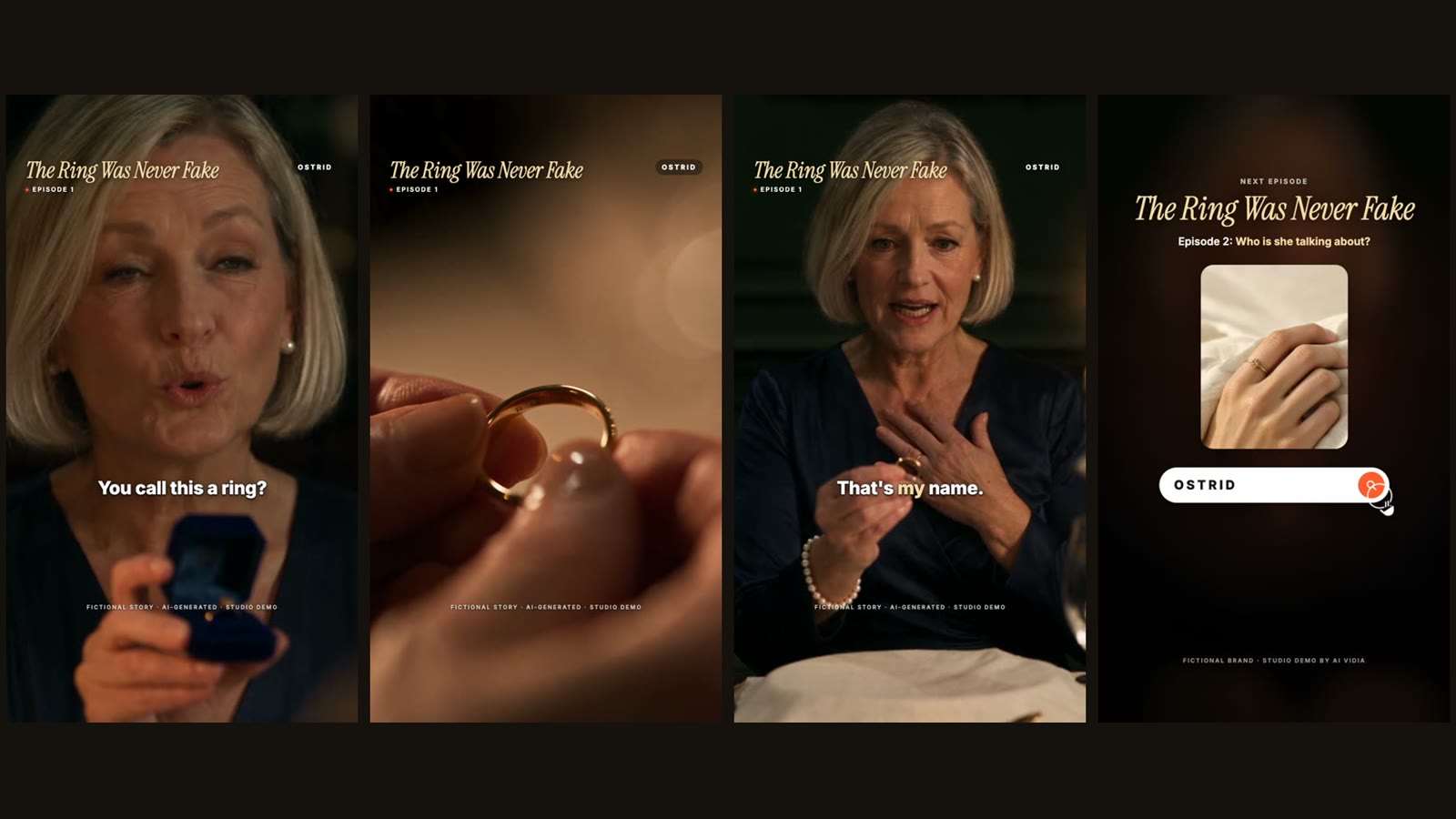
Drama apps reach for objects as well: 14 of the 39 app ads in AI Vidia's study turned on a physical object. The Ring Was Never Fake, an AI-generated 48-second AI Vidia studio demo for OSTRID, a fictional jewelry brand, shows the structure in one episode. At 0:00 a mother-in-law holds up a ring box at an engagement dinner: "You call this a ring? It's fake, darling." At 0:15 fingers turn the gold band toward a candle, she reads the engraving inside and finds her own name. At 0:35 her son asks who his fiancée is talking about, and an end card shows the next episode and a search bar for the brand. You can watch The Ring Was Never Fake scene by scene.

Four vertical frames: a woman holds up a ring box at a dinner table, fingers turn a gold ring toward a candle, the woman presses a hand to her chest, and an end card with a search bar reading OSTRID
The opening scene, the turn on the ring, the reveal and the end card of The Ring Was Never Fake. AI Vidia studio demo for OSTRID, a fictional jewelry brand; every frame is AI-generated.

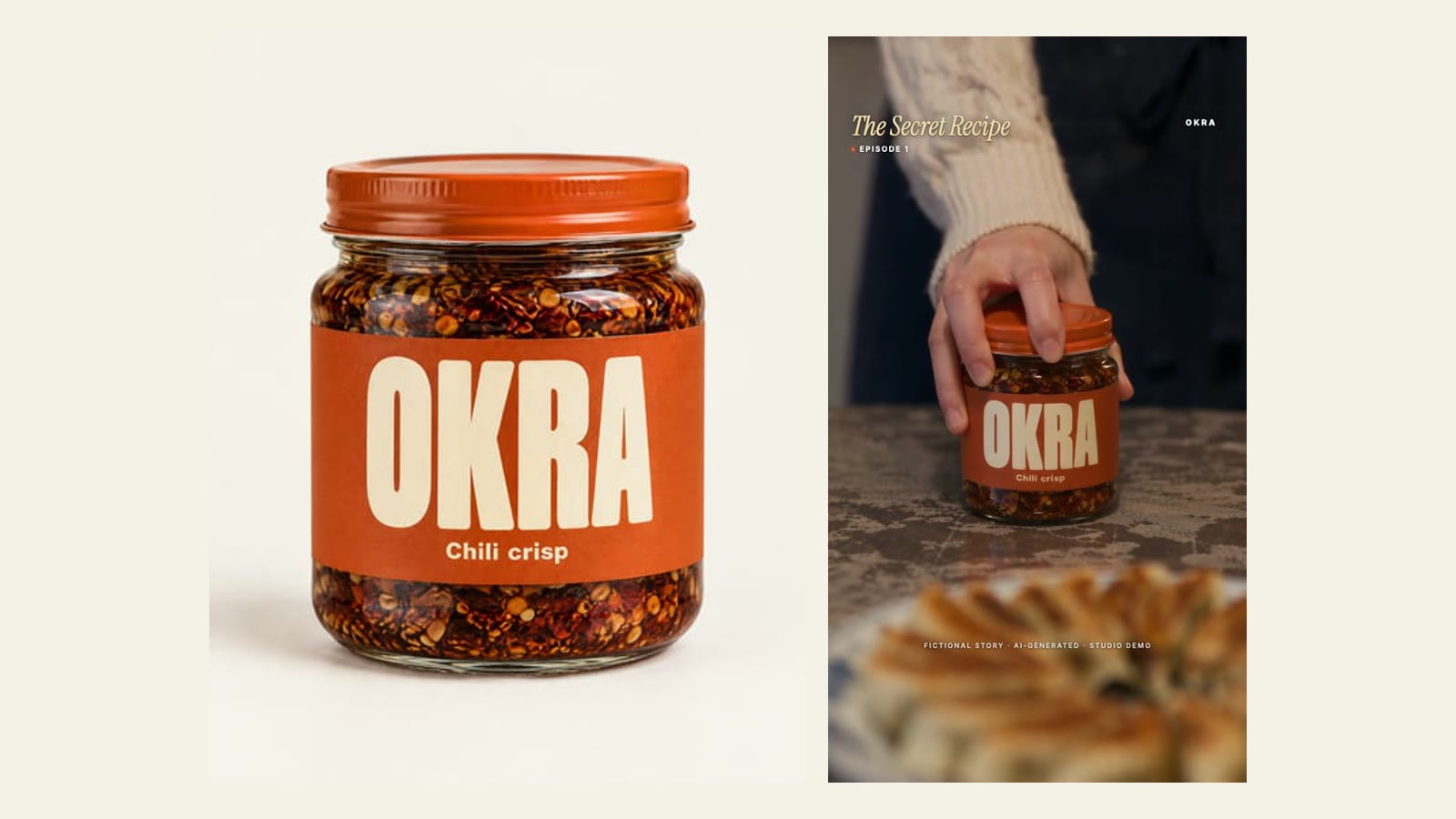
The product has to look the same in every shot it carries the plot. In The Secret Recipe, an AI Vidia studio demo for the fictional chili crisp OKRA, the family argument turns when a hand sets the jar on the table, and the jar in that shot matches its AI-made reference image, lid and label included.

Left, a reference image of a glass jar of chili crisp with an orange lid and an orange OKRA label; right, a vertical frame in which a hand sets the same jar on a stone table beside a plate of dumplings
Reference and episode frame for OKRA, a fictional chili crisp: the jar in The Secret Recipe matches its reference. AI Vidia studio demo with a fictional brand, AI-generated.
Need new ads?
Describe your product and what you want to test.
Send your brief

Where brand series run: own accounts, a publisher's channels or a drama app

Three routes appear in the nine. The brand's own accounts carried 7-Eleven and Dr Pepper, and Nuuly ran its series on TikTok, Instagram Reels and YouTube Shorts, "amplified by the talent involved". A publisher carried Sol de Janeiro's The Guest List: its five episodes run on Channel 4's Meta, TikTok and YouTube channels from 24 October 2026, per VideoWeek. ReelShort, a drama app, carried Crocs' first series alongside Crocs' YouTube channel, and Maybelline's also debuted there, with placements on TikTok and the Macy's Thanksgiving Day Parade stream on Peacock.

Release rhythm follows the route. Nuuly dropped its 12 episodes in batches of three through 25 August and supported them with trailers and sponsored social posts. Dr Pepper added content weekly, and 7-Eleven releases A Convenient Love throughout November.

TikTok now sells a route of its own. TikTok for Business wrote on 29 June 2026 that "Micro-series combine short-form episodic storytelling with TikTok Growth Max", its new ad solution, which uses advertising automation, and that a brand can publish a series in the Minis Center, "a dedicated in-app viewing experience" in 10 markets, or "through the TikTok Drama Center to host it natively in your TikTok Account" worldwide.

YouTube's numbers argue for patience. Microdramas on YouTube "surpassed 6.5 billion views in the first half of 2026 alone", with watch time growing by over 50% year on year, and "40% of views and 30% of clicks occurred more than 30 days after the video goes live", the YouTube Official Blog said on 27 October 2026 (platform-reported). A series keeps working after launch week. Keep every episode up and link each one to the next.

Published brand series took a few weeks to eight weeks, and none published its cost

Four series from three brands published a production time, and the range is a few weeks to eight weeks. Crocs' Déjà Shoe "was developed and produced in under four weeks". Nuuly's series "came together in just a few weeks". Maybelline went "from initial idea to finished product" in under six weeks. Crocs' first series took eight weeks from concept to go live.

No brand has published what its series cost. The numbers in print describe entertainment shows. One producer told Marketing Brew that costs "can range from $30,000 to more than $300,000 for entire shows". MIT Technology Review reported in May 2026 that "Producing a short drama in North America once cost roughly $200,000", and an executive at a short-drama app said AI can cut that by 80% to 90%. For scale, Marketing Dive noted that "a conventional commercial shoot can cost millions of dollars" and that microdrama productions "often carry a smaller price tag".

None of these is a brand's fee. A brand series also carries what a show does not: product approvals, claims review, a label and a media plan. AI Vidia publishes no price for a drama series and quotes each one as a single custom proposal, set by the episode count, the episode length, the cast and the locations; the scope and the demo episodes are on the page for AI drama ads made for your product.

Brand series have published views; the one sales figure is from a reality series

Published results are mostly reach. Chief Marketer reported in March 2026 that "more than 10 million consumers have watched" Charmed to Meet You; Marketing Dive put it at "nearly 10 million views" and noted it "quickly spawned a sequel". The show was among the top four series on ReelShort's daily rankings on Valentine's Day, according to Crocs, Marketing Brew reported. KFC Arabia's episodes "generated more than 4 million views, 85,000 likes, 2,800 comments and 130,000 shares" across Meta and TikTok "without paid promotion" (company-reported). JCPenney's five-part series, outside the nine, "drove over 16 million impressions and 5.6 million video views", Marketing Dive reported.

The one sales figure comes from a reality series. Bob's Discount Furniture said season 1 of its six-episode show "drove $9 million in attributed sales", alongside more than 152 million video views and 223 million impressions, Chief Marketer reported on 14 October 2026. Digiday put the sales at "nearly $9 million in attributable sales, per the company", and neither publication describes the attribution method.

The trade is cautious about proof. An agency chief executive told Digiday in September 2026 that "there isn't clear cut evidence quite yet"; the founder of the agency that helped produce Nuuly's series said direct conversion "isn't there, per se, exactly"; and an agency head of entertainment said "Traditional metrics are misleading." Nuuly, Digiday added, spent a "significant amount" boosting its series.

So set the metric before episode 1 and keep it. Marketing Dive's advice was that "Outlining and sticking to concrete KPIs can ensure these stories won't fizzle before they reach their conclusion." If the question is whether a story beats the ads you already run, test the story idea against your best ad before you commit to a series: the First Batch is one concept made as 4 videos and 4 image ads, finished by day 7, for EUR 999 one-time.

TikTok requires an AI label, Meta adds one, and the law requires it in more places

KFC Arabia's was the only series of the nine reported as AI-generated, and the audience is warier than marketers think. In IAB's survey of 505 US Gen Z and millennial consumers and 104 ad executives, published in January 2026, 82% of executives believed these consumers felt positive about AI-generated ads, while 45% of the consumers did. Yet 73% said knowing an ad was made with AI would increase or make no difference to their likelihood to buy, and more than half want an ad disclosed when it is 100% AI-generated.

TikTok requires a label; Meta adds one itself. TikTok's ad policy (updated April 2026) asks advertisers to "Apply the AIGC label, or" add "a clear disclaimer, caption, watermark, or sticker of your own", and warns: "If we identify AI-generated content that has not been disclosed, your ad will be rejected or restricted." Meta shows its disclosure under "About this ad" and detects third-party AI with methods "such as C2PA", a content-credentials standard, Social Media Today reported in July 2026.

The law is catching up by market. New York's governor announced on 9 June 2026 that a law requiring whoever produces an ad "to identify if it includes AI-generated synthetic performers" "is now in effect". California followed on 16 September 2026 with SB 1050, which requires "explicit disclosure on any video or audio advertisement that uses AI-generated performers" and takes effect on 1 January 2027, per Skadden. In the EU, Article 50 of the AI Act applies from 2 August 2026 and requires whoever uses the AI system to disclose that a deepfake has been artificially generated or manipulated, as Lewis Silkin sets out. The detail is in the AI disclosure rules for ads on each platform, synthetic performer disclosure in New York and California and who labels AI ads under EU AI Act Article 50.

The drama apps show the gap. None of the 39 app ads in AI Vidia's study showed an AI label in the 16 frames coded per ad, though 14 of them used AI footage. A brand series carries the brand's name, so label every AI episode and agree in writing who owns AI-made episodes and who labels them.

Is your product a fit for a drama series?

Answer four questions about the one product you would put in a series.

Decision treeIs your product a fit for a drama series?

Question 1

Can a character hold, wear, eat or use the product on screen?

See every path

Can a character hold, wear, eat or use the product on screen?

  • Yes

    Does the ad have to prove a health, results or before and after claim?

    • Yes

      Result: Use proof, not a story. A claim needs a study or a named customer behind it. A fictional scene cannot carry it. Which products are hard for AI video

    • No

      Is there a dated moment to release on, such as a launch, a return, a holiday or a menu drop?

      • Yes

        Can your team approve a script, a cast and 3 to 5 episodes before that date?

        • Yes

          Result: Brief a short series. Bring the product, the claims you have approved and the release date. AI Vidia drama series run 3 to 5 episodes per concept. AI drama ads made for your product

        • No

          Result: Test the story idea first. Test the story idea against your best current ad on a metric you set before you commit to a series. How the First Batch works

      • Not yet

        Result: Test the story idea first (described above)

  • No, it is a service or a logo

    Result: Pick another format. A plot needs an object people can argue over. Show the product working instead. AI product video ads

Write one line of dialogue in which your product settles an argument between two characters, and put the launch date it would ship against next to it. If the line still works with the product taken out, rewrite it.

Frequently asked questions

01What is the difference between a micro drama and a branded micro drama?
A micro drama is a scripted vertical series of short episodes that drama apps and channels sell to viewers; a branded one is paid for by a brand and built around its product. Drama apps advertise with long ads (a median of 18.9 minutes across 39 app ads in AI Vidia's Meta Ad Library study); the brand series compared here ran about one to two minutes an episode.
02How often should a brand release new episodes?
The published brand series released weekly or in small batches. Dr Pepper added content weekly, Nuuly dropped its 12 episodes in batches of three through 25 August, and 7-Eleven releases A Convenient Love throughout November. Release the last episode before the offer or launch ends.
03Can viewers buy straight from a micro-drama series?
Two of the nine built a purchase into the series. Crocs ran Déjà Shoe as a shoppable series on TikTok Shop, and each 7-Eleven episode carries a limited-time discount on the menu item it features. Neither brand had published sales from its series by 7 November 2026, so treat the shop link as a test to measure.
04Do micro-drama episodes keep getting views after they go live?
On YouTube a large share of views arrive after launch month. YouTube says 40% of views and 30% of clicks came more than 30 days after a video went live (platform-reported, October 2026). Keep every episode published and link each one to the next, so a late viewer can start at episode 1.

How we made this article

Every brand series, figure and rule was read at its source on 7 November 2026, and results the brands reported about themselves are labelled company-reported. The drama-app figures come from AI Vidia's own study of 39 ads from 12 short-drama apps in the Meta Ad Library, pulled on 14 October 2026 and coded by hand from 16 frames each. The nine series are the scripted brand series listed on AI Vidia's AI drama ads page, each reported by the trade press between December 2025 and November 2026; the set is not exhaustive. Counts such as six of eight are arithmetic on the numbers in the table.

We research and draft with AI assistance and check figures against the sources below.

Sources

  1. 01TikTok for Business: TikTok Growth Max for micro-series, 29 June 2026
  2. 02TikTok Ads policy: Misleading and false content, AI-generated content disclosure (updated April 2026)
  3. 03YouTube Official Blog: The evolution of web series on YouTube, microdramas, 27 October 2026
  4. 04Governor of New York: law requiring disclosure when advertisements include AI synthetic performers, 9 June 2026
  5. 05Governor of California: SB 1050 signed, disclosures on AI-generated advertising, 16 September 2026
  6. 06IAB with Sonata Insights: The AI ad gap widens, 15 January 2026
  7. 07Tubefilter: 7-Eleven A Convenient Love micro-drama, 1 November 2026
  8. 08VideoWeek: Channel 4 announces first branded microdrama, 14 October 2026
  9. 09Marketing Dive: Why Nuuly is betting on a microdrama for its social-first fall campaign, 20 August 2026
  10. 10Marketing Dive: Brands see content gold in microdramas, 7 July 2026
  11. 11Marketing Dive: Dr Pepper taps into microdrama trend for Creamy Coconut return, 18 May 2026
  12. 12Marketing Dive: Marc Jacobs puts luxury spin on microdrama content, 24 April 2026
  13. 13Communicate Online: KFC Arabia AI-led drama series, 20 May 2026 (company-reported results)
  14. 14Chief Marketer: Crocs CMO on microdramas, TikTok and Gen Z at Shoptalk, 26 March 2026
  15. 15Chief Marketer: Bob's Discount Furniture microdrama strategy after its first season, 14 October 2026 (company-reported results)
  16. 16Marketing Brew: Maybelline holiday microdrama strategy, 16 December 2025
  17. 17Marketing Brew: Microdrama content and advertising, 13 May 2026
  18. 18Digiday: R.I.P. Quibi, you would have loved microdramas, 23 September 2026
  19. 19MIT Technology Review: Chinese short dramas and AI, 15 May 2026
  20. 20Social Media Today: Meta adds updated disclosure tags for AI-generated ads, 7 July 2026
  21. 21Skadden: California joins New York in regulating AI in advertising, 5 October 2026
  22. 22Lewis Silkin: The new AI labelling rules for deployers in the advertising supply chain, 31 July 2026

Next step

Get a proposal for your next ads.

Tell us about your product, audience and ad production needs. We review your brief and reply with a proposed next step.

Send your brief

Read next