AI creative agencies in Europe (2026): seven partners compared on proof, brand control and EU AI Act readiness
Six AI creative agencies and one AI video platform for European brands, compared on the work they name, what they publish about AI governance and prices, with an Article 50 checklist.
Co-founder / Creative Director, AI Vidia · Lecturer, Business Academy Copenhagen
Share
Short answer
For a European brand in 2026, the AI creative partners with the most public evidence are DEPT, faith (VCCP), iO, Serviceplan Group with Silverside AI, Synima, The Official Agency and the AI video platform Synthesia. Pick by job, then test each on Article 50 of the EU AI Act: who labels the ad, whether provenance data survives export and how likeness consent is kept. AI Vidia wrote this guide and sits in its own section.
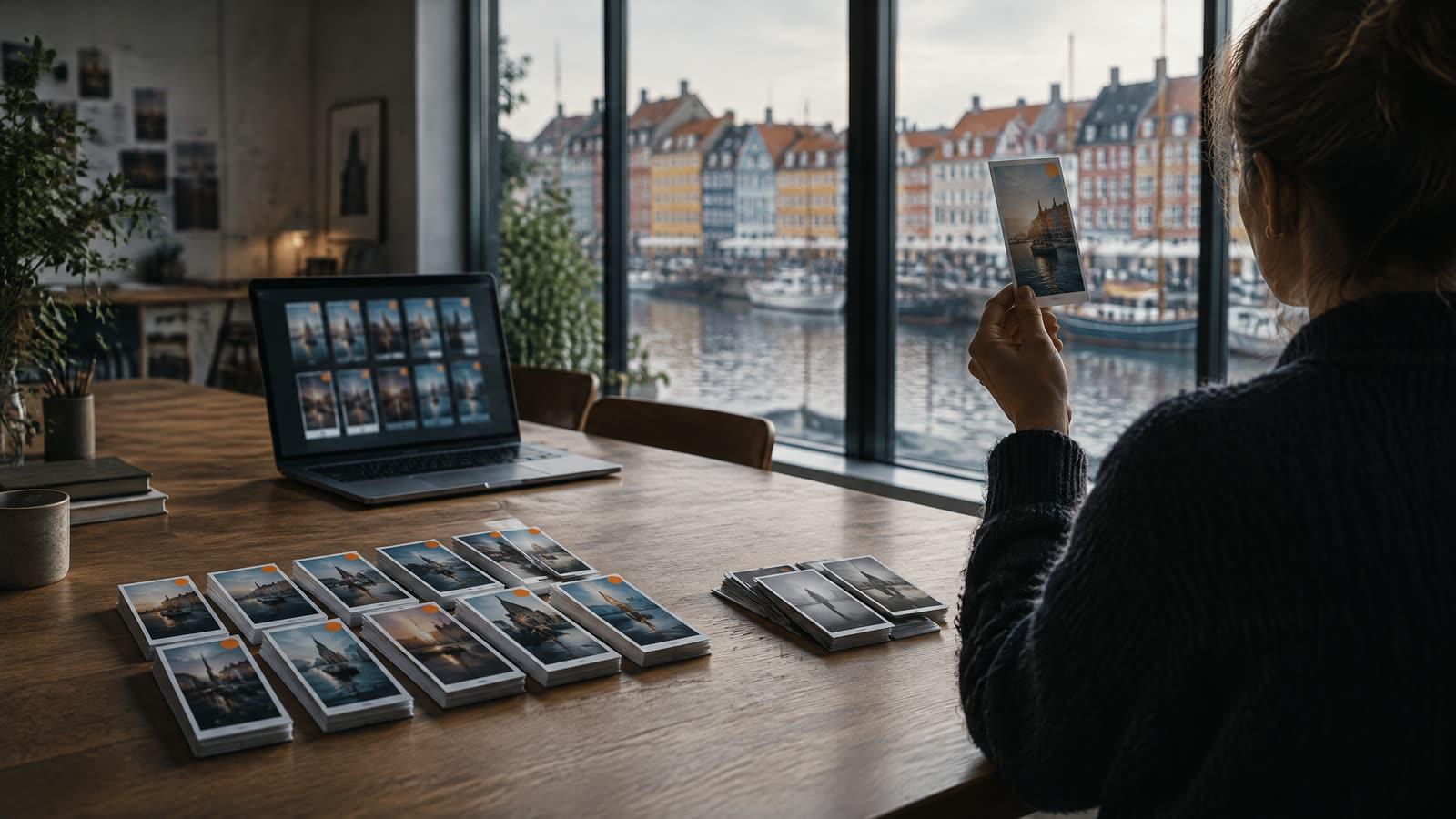
Image generated with AI: a reviewer picks the frames that ship, the step an AI-native agency should be able to show you.
An AI creative agency in Europe makes ads, films or brand content with generative AI models while people set the strategy and approve every file. For a European buyer the test goes further than craft: since 2 August 2026, Article 50 of the EU AI Act decides who must mark and label synthetic content, so the partner has to document how each asset was made.
Why do European brands need their own AI agency shortlist?
Most agency rankings are written for a US buyer and judge capacity, speed and client logos. A European buyer carries legal duties those lists leave out. Article 50 of the EU AI Act has applied since 2 August 2026. Providers of generative AI systems must mark their output in a machine-readable format (Article 50(2)), and deployers, meaning the brand or agency that publishes the content, must disclose deep fakes visibly (Article 50(4)). Breaches can be fined up to EUR 15 million or 3% of worldwide annual turnover, whichever is higher, under Article 99(4) (Regulation (EU) 2024/1689).
The Digital Omnibus, Regulation (EU) 2026/1744, postponed the high-risk rules and left Article 50 on schedule, with one grace period: providers whose systems were on the market before 2 August 2026 have until 2 December 2026 for the marking duty (who labels under Article 50). The platforms add their own layer. Meta shows "AI info" inside About this ad and says it detects ads made with third-party AI tools through industry-standard signals, with the experience varying by region (Meta, updated 1 June 2026). TikTok requires AI-generated ad content to carry its AIGC label or the advertiser's own clear disclaimer, caption, watermark or sticker (TikTok ads policy). How a file was made, and the metadata it carries, is now part of the deliverable.
Trust is the second reason. In IAB's January 2026 study, 83% of US advertising executives said their company had deployed AI in the creative process, and fewer than half of advertisers using generative AI always disclose it (IAB). The gap between what executives believe and what consumers feel is wide:
Executives think consumers like AI ads far more than consumers doShare of consumers who feel positive about AI-generated ads, and share of ad executives who believe consumers do
Consumers who feel positive45%
Executives who think consumers do82%
Executives think consumers like AI ads far more than consumers do. Share of consumers who feel positive about AI-generated ads, and share of ad executives who believe consumers do
Item
Value
Consumers who feel positive
45%
Executives who think consumers do
82%
IAB, The AI Ad Gap Widens, 15 January 2026: 505 US Gen Z and Millennial consumers, 104 US ad executives
Add production in several languages, and the fact that a real person's face and voice are personal data under the GDPR, and a European shortlist needs its own criteria.
What separates an AI-native agency from an AI-powered one?
An AI-powered agency uses AI tools inside a familiar delivery model. An AI-native agency rebuilds the model itself, using AI to gather context, write briefs, make assets, check quality and carry learning into the next project. I agree with the distinction, but in a pitch the label proves little, because any agency can claim it. When I assess an agency, I ask questions that are hard to bluff:
What share of the assets you delivered last quarter was generated or substantially edited with AI?
At which steps does a named person approve the work before it reaches the client?
Can you walk me through a real past brief, including the tools, the rejected outputs and the review notes?
An agency that answers all three with specifics is AI-native in a way that matters to you. Generative AI removes the production bottleneck, and the judgement stays human: a creative director still decides which of 80 variants goes live.
What does an EU AI Act ready agency show you?
An EU AI Act ready agency can show, for any asset, which tools made it, who approved it, whether it needs a visible label and whether the machine-readable provenance survives delivery. Most creative agencies are deployers of third-party models, and so is the brand that runs the ad. Bird & Bird lawyers point out that a compliant watermark added upstream by the model provider does not on its own discharge the deployer's disclosure duty under Article 50(4) (Conventus Law).
A photorealistic AI person presented as a real customer is the clearest example of a deep fake under Article 3(60): AI content that resembles real people, places or events and would falsely appear authentic. The Act has a lighter regime for evidently artistic, creative, satirical or fictional work. Whether a performance ad qualifies has not been tested, so I would not build a process on that exception. The Commission published a voluntary Code of Practice on marking and labelling AI-generated content on 10 June 2026, and the Commission and the AI Board have since confirmed it as an adequate tool (European Commission). Five things to ask to see on a past project:
An asset record. Which tools and which people made and approved each file.
Provenance that survives export. Content Credentials (C2PA) or similar signals still present after editing and upload, since Meta's detection relies on industry-standard signals.
A label decision made before production. Which assets need a visible AI label, per platform and market, and who applies it.
Written consent. For any real person's face or voice, with the agreed use.
Licences. The terms behind the models, avatars, voices and music in the file.
If an agency cannot show these on a past project, that work moves to your team. For the label rules platform by platform, read AI labels on ads in 2026.
Image generated with AI: the paper trail behind one ad, from the presenter and the signed consent to the file record and the label on the final frame.
How do Europe's AI creative partners compare?
The table compares six agencies and one platform on what each publishes. "None found" means we could not find the information on the company's own pages, which does not prove the company lacks it.
AI creative partners for European brands, read 18 November 2026 (alphabetical, not ranked)
Partner
Base
Suited to
Work it names
Published AI governance
Published prices
DEPT
Founded in Amsterdam; 4,000+ people in 30+ locations
Creative automation across many markets
Philips, Google, eBay (DEPT/AI launch)
None found on Article 50
None
faith (VCCP)
London
Campaign ideas and custom brand models
O2 Bubl Generator; Sage as first client
Data and IP legal advisers in the team
None
iO
Belgium, the Netherlands, Denmark, Sweden, Bulgaria
Localising campaigns with brand-trained assistants
BSH, Gazelle
ISO 27001
None
Serviceplan Group and Silverside AI
Munich; Silverside AI in San Francisco
High-profile campaigns built on characters
Coca-Cola, SVEDKA
Generate.AI built for transparency in data handling
None
Synima
Amsterdam; studios in London, Los Angeles and New York
ISO 42001; Code of Practice signatory; C2PA on eligible videos
Free plan; paid from USD 14 a month billed yearly
The Official Agency
Amsterdam, established 2025
AI film and content for events and series
bol, Pip Studio, COTY, Corona via WINK
None found
None
A company made the list only when its public record let us judge at least four of six criteria: documented client work, production capacity, brand control, EU AI Act readiness, clarity on usage rights and pricing transparency. Several new studios in Amsterdam and Stockholm publish too little to judge fairly, so they are left out. There are no scores, because a score built on uneven public information would suggest a precision we do not have.
Image generated with AI: three partners laid side by side and scored on the same six criteria, the way a shortlist should be built.
Need new ads? Describe your product and what you want to test.
DEPT was founded in Amsterdam in 2015 and says it has more than 4,000 people in over 30 locations (DEPT). Its DEPT/AI practice launched in February 2023 with more than 400 specialists and clients including Philips, Google and eBay (Marketech APAC), and its Creative Automation practice delivers creative assets at scale. It suits large brands that want creative, engineering and media under one roof across markets. We found no DEPT statement on Article 50, so ask for one.
faith (VCCP): an AI agency inside a challenger network
VCCP launched faith in May 2023 as a standalone AI creative agency, with Sage as its first client (The Drum). Its team includes data scientists and legal advisers who specialise in data and IP (IPA). Its best-known work is the Bubl Generator for O2, a model trained to create images of O2's mascot in line with the brand guidelines (Creative Salon). faith suits brands that want a campaign idea and a custom brand model they keep using. It publishes no prices.
iO: brand-trained assistants for localisation
iO builds AI creative production around an assistant trained on a brand's tone of voice, terminology and visual identity, and adapts campaigns across markets and languages (iO). iO says it delivered a two-minute brand film for BSH in three working days instead of eight weeks, and it built a content generator for Gazelle that sends copy and images to HubSpot. It has held ISO 27001 since November 2022 and has offices in Belgium, the Netherlands, Denmark, Sweden and Bulgaria. The speed figure is iO's own, so ask for a reference.
Serviceplan Group and Silverside AI: campaigns built on characters
Munich-based Serviceplan Group launched two AI labs in February 2024: AI Lab Munich and Silverside AI in San Francisco (Serviceplan Group). Serviceplan says Silverside AI made Coca-Cola's first all-AI holiday campaign and revived SVEDKA's robot characters, retired in the 1990s (TWELVE Mail), and The Coca-Cola Company's own release names Silverside AI among the production houses behind its AI holiday films (Coca-Cola). Serviceplan describes its Generate.AI tool as built for more transparency in data handling and more control over the generative process (Serviceplan Group). It suits global brands planning a campaign around a mascot or heritage asset. Ask which team, in Munich or the US, will deliver.
Synima: a production company that documents AI use
Synima is a video production company with its main studio in Amsterdam and studios in London, Los Angeles and New York (Synima). Its generative AI services cover commercials, social content, avatars, concept development and post-production. Its site commits to documented training-data provenance, consent processes for human likeness and full AI-use documentation for clients' own compliance records, the most detailed commitment of any agency here. The site shows client logos rather than described AI projects, so ask for a case in your sector.
Synthesia: an AI video platform with published governance
Synthesia is a platform, and it belongs here because many European teams weigh an agency against making AI video in-house. Founded in London in 2017, it says it serves more than 50,000 teams and calls itself the first generative AI company certified for ISO 42001, alongside ISO 27001, ISO 27701 and SOC 2 (Synthesia). It moderates content at the point of creation with filters and human oversight and sets consent requirements for avatars. On 29 July 2026 it announced that it had signed the Article 50 Code of Practice; eligible videos carry C2PA data by default, and users can add per-scene AI labels based on the EU icon (Synthesia). Synthesia says its tools help customers meet their deployer duties, which stay with the customer. Its pricing page shows a free plan, paid plans from USD 14 a month billed yearly (USD 19 billed monthly) and custom enterprise pricing (Synthesia pricing, read 18 November 2026).
The Official Agency: AI film for events and branded series
The Official Agency is an Amsterdam production agency established in 2025 that calls itself "AI-first, human-led" (The Official Agency). It has built AI content workflows for bol and Pip Studio, made a visual identity and AI film for COTY and produced work for Corona through the agency WINK. It names eight team members and publishes no compliance or rights statement on its homepage, so put those terms in the contract.
Which type of AI creative partner fits your job?
The job decides the partner more than the size of the agency. Answer two questions to see which kind of partner to call first.
Decision treeWhich kind of AI creative partner fits your job?Answer for the next six months of work. Built from what each company publishes, read on 18 November 2026. Not a ranking.
Question 1
What is the main job?
See every path
What is the main job?
The same campaign in many markets and languages
Do you also want engineering and media from the same partner?
Yes, one partner for all of it
Result: A network with creative automation. DEPT runs a Creative Automation practice inside a 4,000-person network, with engineering and media under one roof. Ask it for its Article 50 process in writing, since we found none published. In-house team or agency?
No, creative and localisation only
Result: A localisation studio with brand-trained assistants. iO trains an assistant on your tone of voice, terminology and visual identity, then adapts the campaign across markets. Ask for a reference on its speed claims.
One high-profile campaign or a brand character
Result: An agency that builds characters and campaign ideas. faith (VCCP) built the Bubl Generator for O2, and Serviceplan Group with Silverside AI worked on Coca-Cola and SVEDKA. Ask which team will deliver your work, and who owns the custom model.
Video for a regulated brand that needs a paper trail
Result: A production company that documents its AI use. Synima publishes commitments on training-data provenance, likeness consent and AI-use documentation for clients' compliance records. Make the asset record and the label decision contract deliverables. Who labels under Article 50
Presenter video for training or explainers
Can your own team write and produce the videos?
Yes
Result: A platform you run yourself. Synthesia has a free plan and paid plans from USD 14 a month billed yearly, signed the Article 50 Code of Practice and adds C2PA data to eligible videos. Your brand still makes the disclosure decision.
No, we need it made for us
Result: A production company that documents its AI use (described above)
New paid social ads every week
Will the ads be tested against real ad spend each week?
Yes
Result: A specialist performance creative studio. You need new on-brand variants every week at a cost per asset the media budget can carry. AI Vidia, which wrote this guide, is one such studio; test any studio you consider with the eight questions below. What the First Batch includes
No, it is branded content or event material
Result: An AI-first production agency. The Official Agency in Amsterdam makes AI film and content for events, activations and branded series. It publishes no rights or compliance terms, so put them in the contract.
Each result names the partners in this guide that publish work of that kind. Run the five checks above on any of them before you sign.
A regulated brand should put documentation ahead of speed and make the asset record, consent and label decisions contract deliverables. A brand planning a campaign around a mascot or heritage asset should look at faith or Serviceplan Group, which have shipped that kind of work. A consumer brand that lives on Meta and TikTok needs new tested variants every week at a cost the media budget can carry, which is the job specialist performance studios are built for.
Image generated with AI: one product ad made in five versions, the multi-market work that localisation partners are hired for.
Which questions should you send an agency before you sign?
These questions can go straight into an RFP. An agency that answers them in writing, with examples from past work, has done the operational work the AI-native label implies.
What share of the assets you delivered last quarter was generated or substantially edited with AI, and with which tools?
At which steps does a named person approve work before it reaches us?
Who decides whether an asset needs a visible AI label under Article 50(4), and how is that decision recorded?
Does provenance data such as C2PA Content Credentials survive your editing and export?
How do you obtain and store consent when a real person's face or voice is used?
Who owns the outputs, the custom models and the avatars, and which licences cover the models, voices and music?
Can you show a described case from our sector, with results, rather than a logo?
What does it cost per asset, and what is the minimum commitment?
Where does AI Vidia fit in this list?
AI Vidia is the Copenhagen performance creative studio I co-founded, so read this section as our own description. We make AI video and image ads for consumer brands on Meta, TikTok and YouTube. A creative director reviews every asset before delivery, and our in-house review covers English and Danish only. The AI label is agreed with each client per platform and market before delivery, the written agreement says who applies it, every ad with an AI presenter carries an on-screen AI label, and each file's usage note lists what in it is AI-generated. A real person's face or voice is used only with their written consent and an agreed use (how we handle AI labels and consent).
Our published proof is five named client case studies, for example 142 ads in 11 weeks for IndianBites with 2.4x ROAS on winning cohorts (IndianBites case study). We print our prices: the First Batch is EUR 999 for one concept made as 4 videos and 4 image ads, finished by day 7, and the monthly plans are on the pricing page. We are smaller than the networks above, and a single launch film is a better fit for them. For US-based studios, see our comparison of four AI creative agencies and the US studio guide.
Frequently asked questions
01Which AI creative agencies in Europe publish how they handle the EU AI Act?
As of 18 November 2026, Synima publishes the most detailed agency commitments: documented training-data provenance, consent for human likeness and AI-use documentation for clients' compliance records. Synthesia, a platform, has signed the Article 50 Code of Practice and adds C2PA data to eligible videos. faith has data and IP legal advisers in its team, and iO holds ISO 27001. We found no Article 50 statement from DEPT or The Official Agency, so ask them in writing.
02Which AI creative agencies have teams in both London and the US?
Synima has studios in London, Amsterdam, New York and Los Angeles. faith works inside VCCP, a London network with an office in New York. Serviceplan Group pairs its Munich headquarters with Silverside AI in San Francisco. Synthesia is headquartered in London. Ask any of them which team, and which country, will deliver your work.
03Is an AI video platform like Synthesia an alternative to an AI creative agency?
For some jobs it is. A platform such as Synthesia fits presenter-led video in many languages, such as training, onboarding and explainers, when your own team can write and produce it. An agency fits better when you need concepts, campaign ideas or a weekly flow of tested ad variants, where the value lies in strategy and review. Many brands use both.
04Does every AI-generated ad shown in the EU need a visible label?
No. Under Article 50(4) of the EU AI Act, the deployer must disclose content that is a deep fake: AI content that resembles real people, places or events and would falsely appear authentic. Providers must also mark synthetic output in a machine-readable format, with a grace period to 2 December 2026 for systems on the market before 2 August 2026. Meta and TikTok apply their own labels on top.
05How much does an AI creative agency cost in Europe?
Published prices are rare: DEPT, faith, iO, Serviceplan Group, Synima and The Official Agency print none. Synthesia, a platform, shows a free plan and paid plans from USD 14 a month billed yearly, read on 18 November 2026. AI Vidia's First Batch costs EUR 999 for one concept made as 4 videos and 4 image ads, and its monthly plans start at EUR 2,500. Ask every agency for the cost per asset and the minimum commitment.
06Can ad creative rely on the artistic exception in Article 50 of the EU AI Act?
Article 50(4) has a lighter regime for evidently artistic, creative, satirical or fictional works: the disclosure only has to be made in a way that does not hamper the display or enjoyment of the work. Whether a performance ad counts as such a work has not been tested. Plan as if your ads get the full disclosure duty, and agree the label decision with your agency before production.
How we made this article
Kenneth Dosanjh drafted this guide and AI Vidia's editors checked every company fact against the company's own pages, a client announcement or trade press, all read on 18 November 2026. Legal points come from the text of Regulation (EU) 2024/1689 and the European Commission. A company is included only when its public record covers at least four of the six criteria; there are no scores. The six agencies and one platform are listed alphabetically and not ranked. No agency was tested, and nothing here measures ad results. AI Vidia appears only in its own labelled section.
We research and draft with AI assistance and check figures against the sources below.