Best AI creative studios in the US for 2026, grouped by operating model: self-serve platforms, image tools, done-for-you studios, enterprise subscriptions.
Most pages ranking for best AI creative studios in the US are published by one of the studios on the list, and the publisher is almost always ranked first. This page is published by AI Vidia, a done-for-you AI creative studio in Copenhagen that ships ad creative for DTC and consumer brands across 14 countries, and it is built the other way round. It compares five options open to a US DTC or consumer brand in 2026, grouped by operating model instead of by rank, and applies the same five criteria to every entry, including the AI Vidia entry.
Disclosure, before anything else. AI Vidia published this page, and AI Vidia appears on it. Identical criteria apply to every entry, so the AI Vidia row is spared no question the other four have to answer. AI Vidia is not ranked first and is not called the best AI creative studio in the US, because that claim would depend on facts about your ad account that this page does not have. The list is organised by use case, so your monthly variant demand, your brand-control stakes and your compliance exposure pick the winner, not the publisher.
What US brands are actually choosing between
5OPTIONS COMPARED
30 to 50%LOWER CPA AT 5+ VARIANTS
5%TYPICAL WINNER RATE
2 AUG 2026EU AI ACT ART. 50 IN FORCE
The expensive mistake is picking a vendor before picking an operating model. Meta for Business reports that campaigns with 5 or more creative variations see 30 to 50 percent lower CPA, which is why US growth teams keep raising their monthly variant target. Roughly 5 percent of creatives become winners, so a brand that needs 2 durable winners a month has to ship around 40 variants a month to find them. The question that decides the budget is not which studio has the better showreel. It is who holds the production hours: your own team, a platform your team operates, or an outside studio that delivers finished ads.
The second mistake is buying volume without a disclosure workflow. Since July 2026, Meta requires an AI info label on photorealistic AI-generated ad content, and Meta labels that content rather than rejecting it. TikTok bans AI-generated public figures endorsing products outright. A US brand running AI creative into both platforms is buying a compliance process along with the files, which makes compliance a selection criterion rather than a footnote.
At a 5 percent winner rate, roughly 40 shipped variants a month produce the 2 durable winners a media plan needs.
The five options, grouped by operating model
Every entry below is scored on the same five columns: the operating model, who it fits, the realistic monthly volume ceiling, and how brand control is held. Third-party entries are described at category level only, with no pricing, feature or performance claims attached to any name. Those details change monthly, and a roundup that guesses at them is worse than one that says less.
Option
Operating model
Best for
Monthly volume ceiling
Brand control
Self-serve AI ad platforms (AdCreative.ai, Creatify, Arcads, Pencil, Omneky)
Self-serve AI ad platforms are software your own team operates. AdCreative.ai, Creatify, Arcads, Pencil and Omneky all sit in this category: your team writes the brief, generates the output, reviews it, and handles platform disclosure. The category is the right answer when someone senior has real weekly hours to run it, because the ceiling is set by operator time rather than by the software. It is the wrong answer when that same person also owns media buying, since generation is the task that quietly slips. Where the platform model ends and the studio model begins is covered in the AI Vidia comparison of AI ad creative tools and a done-for-you studio.
Product-image tools
Product-image tools handle stills, and Photoroom, Pebblely and Flair.ai are commonly grouped here. The category output is product imagery, which covers a catalog refresh, a marketplace listing set, or a seasonal still campaign, often as the cheapest correct answer and the shortest path to shipped assets. A still-image category does not solve a paid social video problem, so a brand whose CPA problem is video creative fatigue will not fix it here. Treat product-image tools as a complement to whichever option handles video, never as a substitute for it.
Done-for-you AI creative studios
Done-for-you AI creative studios take the brief and return finished, ad-ready files. AI Vidia is one of them, and this is where the AI Vidia entry belongs on the page: the AI Vidia team runs brand-locked style systems, hook matrices and weekly drops shipped straight into Meta, TikTok and YouTube ad accounts. The published tiers are Pilot Sprint at EUR 4,900 for 14 days and 12 to 18 variants, Performance Retainer at EUR 8,500 a month for 40 videos, and Brand System at EUR 18,000 a month for 70 videos. AI Vidia is based in Copenhagen and works with US brands remotely, which is a real trade to weigh: no local crew, no US time-zone standup, and a review window instead of a shared office. Other studios in this category should be scored on the same five columns, and the equivalent list for UGC-led work sits in the AI Vidia roundup of AI UGC agencies.
Enterprise creative subscriptions
Enterprise creative subscriptions sell an outside creative team on a recurring plan. Superside operates in this category. The fit is a larger organisation with design needs that run past paid social, where brand systems, web, packaging and campaign work all sit in one relationship. For a brand whose only bottleneck is weekly ad variant volume, that breadth is capacity spent outside the bottleneck. Score this category on one question: is the scope you need ads-only, or organisation-wide?
Want a structured plan for your AI creative pipeline? 20-minute call, no pitch deck.
Compliance is a buyer criterion, and it applies to AI Vidia exactly as it applies to the other four options. Four rules define the 2026 baseline for a US brand running AI creative.
Meta requires an AI info label on photorealistic AI-generated ad content, mandatory since July 2026. Meta labels that content rather than rejecting it.
TikTok bans AI-generated public figures endorsing products outright.
The transparency obligations in EU AI Act Article 50 came into force on 2 August 2026, which reaches any US brand advertising into the EU.
US FTC rules under 16 CFR 465.2 distinguish a disclosed real testimonial from an illegal fabricated one.
The practical test is identical for every entry. Ask who applies the label, who keeps the record of which assets are AI-generated, and who is accountable when a platform reviewer looks twice. A self-serve platform puts all three on your team by design. A studio, AI Vidia included, should answer all three in writing before the first render.
The US Studio Selection Grid
The US Studio Selection Grid is the strategic framework the AI Vidia team uses to route a brand to one of the five options before any demo call. It scores five variables in order, and each one eliminates categories rather than ranking vendors. Run it in an afternoon.
Score monthly variant demand. Count the net-new ad variants your media plan needs each month to hold CPA steady. Under 15 a month, every option works and cost decides. Above 40 a month on a weekly cadence, the operator-hours ceiling on self-serve platforms becomes the binding constraint.
Score brand-control stakes. Rate how much damage one off-brand ad does. A regulated category, a strict identity system, or a spokesperson who must look identical across hundreds of ads all raise the stakes. High stakes favour a locked style system with a documented pass rate over ad hoc generation, whoever runs it.
Score internal capacity. Count the honest weekly hours a senior person can spend briefing, generating, reviewing and disclosing. Self-serve platforms consume 5 to 10 of those hours a week at volume. A done-for-you studio consumes a review window instead, typically 1 to 2 hours a week.
Score compliance exposure. List the platforms you run on and the markets you sell into. A US brand advertising into the EU carries Article 50 obligations on top of Meta and TikTok policy. Higher exposure raises the value of an entry that owns a documented disclosure workflow, and lowers the value of one that hands it back to you.
Score budget against the volume from step one. Convert every option to cost per shipped variant at your real monthly volume, not at demo volume. A platform looks cheapest until the operator hours are priced at a senior salary. A studio looks expensive until the retainer is divided by the monthly variant count.
Kevin's take
That reframe changes the shortlist before any call is booked. A growth team that scores the grid first usually eliminates three of the five options in one sitting, then runs a single structured trial with one option from the surviving category. The trial below is the one the AI Vidia team runs, and it works on any of the five.
The 30-Day Studio Trial
The 30-Day Studio Trial is the tactical framework for testing one option without letting the comparison drift. Everything is matched on purpose, because an unmatched trial measures the brief rather than the vendor.
Write the decision rule first. Before any output exists, write down what result makes you sign and what result makes you walk. A rule such as "2 variants beating control CPA by 15 percent inside 30 days" is testable. A rule such as "creative that feels premium" is not, and it gets rewritten after the fact to match whatever arrives.
Issue one matched brief. Same product, same offer, same approved claims, same hooks, same ratios. If two options run in parallel, they receive the identical document on the same day. Anything you tell one and not the other invalidates the comparison.
Fix a matched variant count. Twelve variants in the first live week is enough to read hook-level signal without starving any single variant of budget. Hold that number constant across options. An option that ships 12 in three days and an option that ships 12 in three weeks have just told you the most useful thing in the trial.
Score everything on one review rubric. Use a single sheet with four yes-or-no columns: on-brand, claim-safe, platform-spec correct, disclosure handled. Score the first-pass output, not the revised version, because first-pass accuracy is the thing you are actually buying.
Hold one reading window. Pick one date to read results and do not read early. Meta needs conversion volume before variant-level CPA means anything, and a day-4 read produces confident nonsense that then gets acted on.
Decide against the rule, then re-brief. Apply the rule from step one, unchanged. Then feed the winners into cycle two and judge the option on the quality of cycle two, because the second brief is where a real production system separates itself from a good first impression.
Proof: the AI Vidia entry under its own criteria
Held to the same columns as the rest of the list, here is what the AI Vidia entry shows. AI Vidia has shipped 1,834 AI videos and 70,342 AI images for 48 brands across 14 countries. The brand-safe pass rate is 99.2 percent, and 30+ variants ship each week on retainer accounts. The first creative lands within 72 hours of kickoff, and the standard ramp is 12 variants in week one, 30 to 50 in week two, and 80 to 150 from week three.
The live public case is IndianBites, a DTC food brand with a Meta account starving for fresh creative. Over 11 weeks that account shipped 142 AI ads at 12x weekly test volume, with 18 hero concepts each tested in 6 to 10 variant cuts, 62 percent lower creative production cost, and 2.4x ROAS on winning cohorts. The full numbers sit in the IndianBites case study. Apply the same skepticism to those figures as to any other entry on this page: ask what the control was, ask over what window, and ask who owns the style system when the contract ends.
A studio that cannot tell you its first-pass on-brand rate is asking you to buy revision rounds, not creative.
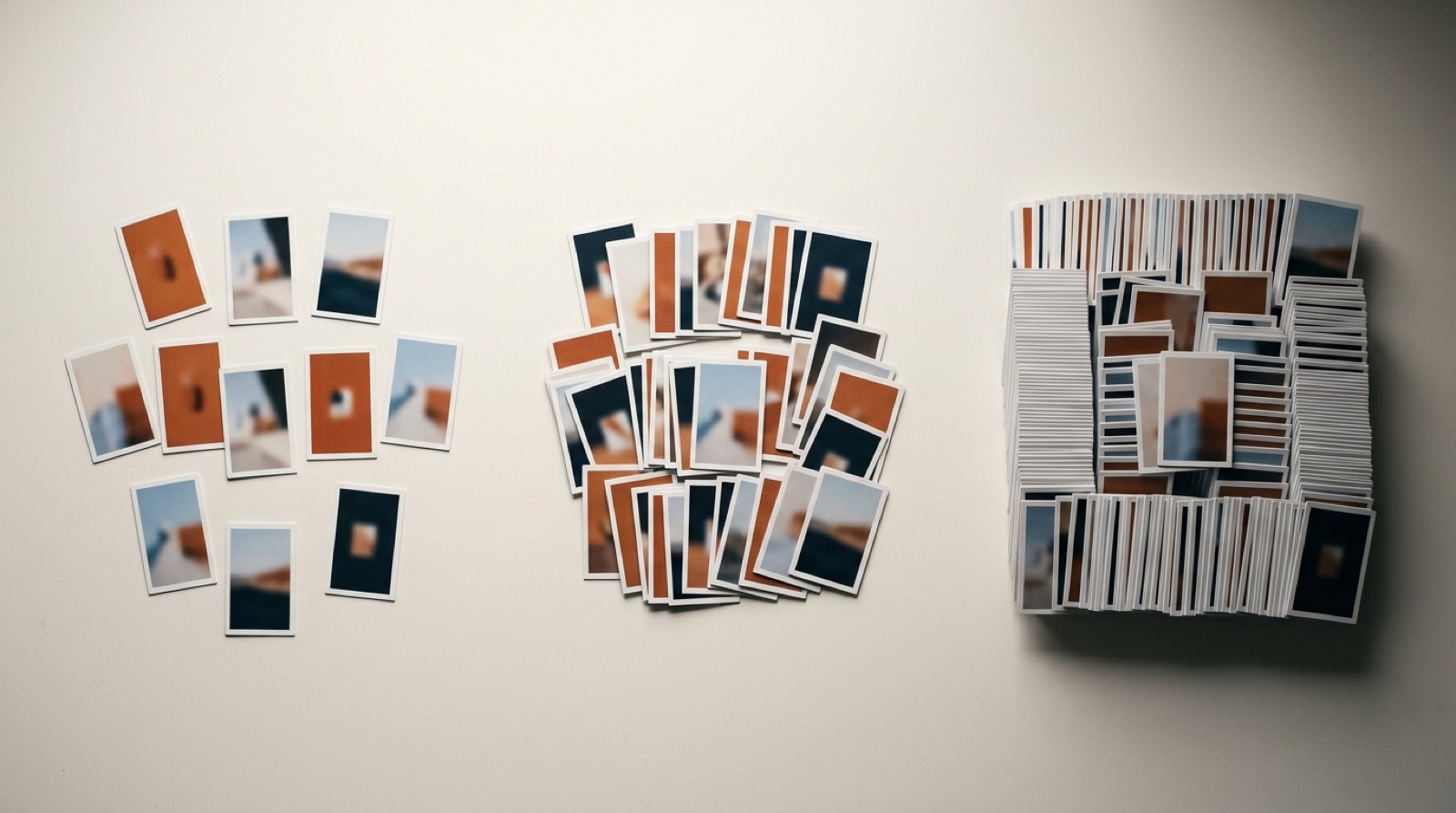
The published AI Vidia ramp is visible as three batches: 12 variants in week one, 30 to 50 in week two, and 80 to 150 from week three.
When each option wins
Self-serve AI ad platforms win when a senior person has 5 to 10 weekly hours to operate them, the category is not heavily regulated, and monthly variant demand stays under roughly 30. This category rewards teams that treat generation as a craft and punishes teams that treat it as a side task.
Product-image tools win when the job is stills: catalog refreshes, marketplace listings, seasonal product scenes. They lose when the bottleneck is video creative fatigue, which is a different production problem with a different fix.
Done-for-you AI creative studios, AI Vidia among them, win when the media plan needs 30+ variants a week, brand control has to survive hundreds of ads, and nobody internal has operator hours. Enterprise creative subscriptions win when the need runs past ads into brand, web and packaging work at organisation scale. If two categories both look like a fit, the grid was scored too generously on internal capacity, which is the variable teams overstate most.
The next step
If the grid points at the done-for-you category, the AI Vidia service surface for this work is the AI video ads service, with all three tiers published rather than quoted on request. A 30-minute scoping call books at the AI Vidia booking page, and the first creative lands within 72 hours of kickoff. If the grid points somewhere else, take the 30-Day Studio Trial to whichever option it picked, because the trial is written to work on all five.
Frequently asked questions
01What is the best AI creative studio in the US in 2026?
There is no single best AI creative studio for every US brand, and this page deliberately does not name one. The right answer is set by four things: how many ad variants you need each month, how much damage one off-brand ad does, how many operator hours your team really has, and which platforms and markets you run in. Under roughly 30 variants a month with spare internal hours, a self-serve AI ad platform usually wins on cost. Above 30 variants a week with high brand-control stakes and no spare hours, a done-for-you studio usually wins.
02Is this list neutral, given that AI Vidia published it?
It is disclosed rather than neutral, and the difference matters. AI Vidia wrote this page and appears on it, which is stated in the second paragraph instead of being hidden. AI Vidia is not ranked first, is not called the best, and is scored on the same five columns as the other four entries, including the compliance criterion. The list is organised by use case so the reader's own situation selects the winner, and every third party is described at category level with no invented pricing or performance claims.
03What is the difference between a self-serve AI ad platform and a done-for-you AI creative studio?
A self-serve AI ad platform is software your own team operates: your team briefs, generates, reviews and handles platform disclosure. A done-for-you AI creative studio takes the brief and returns finished, ad-ready files, so the production hours sit outside your team. The practical difference is where the operator time lands, not the underlying models. Platforms trade money for internal hours, and studios trade internal hours for money.
04How much does a done-for-you AI creative studio cost?
AI Vidia publishes its own tiers, which is the only pricing this page states. Pilot Sprint is EUR 4,900 for 14 days and 12 to 18 variants, Performance Retainer is EUR 8,500 a month for 40 videos, and Brand System is EUR 18,000 a month for 70 videos. Other studios quote per brief, so the comparable number to ask any vendor for is cost per shipped variant at your real monthly volume. Compare that figure against a platform subscription plus the senior salary hours needed to operate it.
05Do AI-generated ads need to be labeled in the US in 2026?
Meta requires an AI info label on photorealistic AI-generated ad content, mandatory since July 2026, and Meta labels that content rather than rejecting it. TikTok bans AI-generated public figures endorsing products outright, which is a hard prohibition rather than a labeling rule. US FTC rules under 16 CFR 465.2 separate a disclosed real testimonial from an illegal fabricated one, so the truth of the claim matters more than the technology behind the visual. A US brand advertising into the EU also carries the transparency obligations in EU AI Act Article 50, in force since August 2026.
06How many variants should a 30-day studio trial include?
Twelve variants in the first live week is the number the AI Vidia team briefs, and it is enough to read hook-level signal without starving any single variant of budget. Hold that count identical across every option being trialled, or the comparison measures brief size instead of vendor capability. Plan on roughly a 5 percent winner rate, which is about 1 durable winner per 20 variants shipped. Judge the option on cycle two, after the winners have been fed back into a second brief.
Next step
Get your first 12 on-brand AI variants in 14 days.
Book a 20-minute strategy call with the AI Vidia team. No pitch deck, just a structured plan for your creative output.