AI/Vidia
All insights

AI Product Photography vs Studio Shoot

AI product photography vs traditional shoot: per-image cost, turnaround, and brand-lock fidelity compared for DTC brands scaling paid social in 2026.

Founder, AI Vidia
Side-by-side flat lay comparing a traditional studio product shot with an AI generated variant set on a warm off-white Nordic surface
On this page8 sections

AI Vidia is a Denmark-based AI content production studio that delivers campaign-ready product images, videos, and avatars for brand teams. On the question of AI product photography vs traditional shoot, the short answer is this: AI product photography costs EUR 10 to EUR 40 per usable image and lands in 2 to 5 business days, while a traditional studio shoot costs EUR 80 to EUR 250 per usable image and takes 2 to 4 weeks. AI Vidia has shipped 70,342 AI images across 48 brands in 14 countries, with a 99.2% brand-safe pass rate. For a DTC brand running weekly creative tests, the cost and turnaround gap decides whether your Meta account gets fresh creative or starves.

Why the production math breaks for consumer brands

EUR 10 to 40AI COST PER IMAGE
2 to 5 daysAI TURNAROUND
70,342AI IMAGES SHIPPED
99.2%BRAND-SAFE PASS RATE

A traditional product shoot is a fixed, lumpy cost. You book a studio, a photographer, a stylist, and a retoucher, you pay for a half or full day, and you walk away with a fixed set of frames. If a frame misses, or a media buyer wants a new background for a TikTok placement, you reshoot. That reshoot is another booking, another invoice, and another two weeks.

The bottleneck is not quality; studios produce excellent single images. The bottleneck is throughput at a testing cadence. A team of three designers cannot produce 200 assets per month when they are already stretched at 40, and a studio booked once a month cannot feed a paid social account that needs 30-plus fresh variants every week. When creative volume stalls, ROAS decays from fatigue, and the cost of that decay dwarfs the line-item cost of any single shoot.

The studio invoice also hides costs that never appear on the quote. Scheduling a shoot consumes two to three weeks of calendar lead time, model and prop sourcing eats internal hours, and a single missed angle can stall a whole campaign launch. McKinsey estimates AI in creative production cuts cost 30 to 50% and lifts output 3 to 5 times, which matches what brands see once they stop paying the reshoot tax. The point is not that studios are bad value; it is that they are priced per shoot in a world that now buys creative per week.

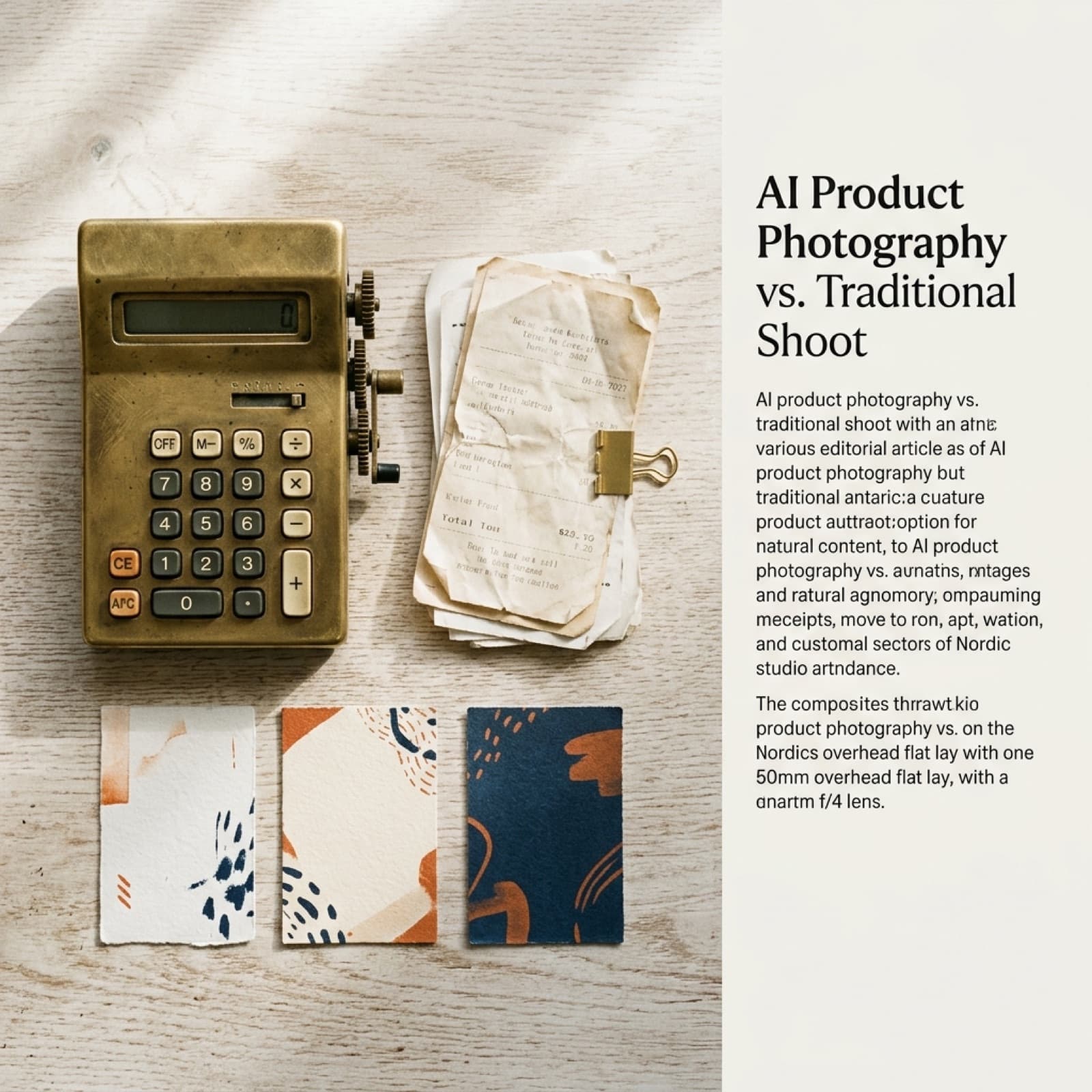
Flat lay of studio invoices and product cards on a warm off-white Nordic surface
A single studio day is a fixed cost; a starving ad account is a recurring one.

AI product photography vs traditional shoot: the cost and turnaround table

The table below compares the two production methods on the dimensions a performance team actually budgets against: cost per usable image, turnaround, variant volume, and brand-lock fidelity. Figures for the traditional column reflect typical Nordic and EU studio rates; figures for the AI column reflect AI Vidia retainer economics amortized across a month of output.

DimensionTraditional studio shootAI product photography (AI Vidia)
Cost per usable imageEUR 80 to EUR 250EUR 10 to EUR 40
Turnaround to first asset2 to 4 weeks72 hours from kickoff
New variant or backgroundReshoot, 2 weeksSame batch, same week
Variants per SKU per month4 to 1030 to 150
Brand-lock fidelityPhysical, hard to repeat99.2% brand-safe via style lock
Marginal cost of one more cutHighNear zero

Read the table as a unit-economics statement, not a quality claim. A studio wins on a single, physically perfect hero. AI product photography wins on the second, third, and fortieth cut of that hero, because the marginal cost of one more variant is close to zero once the brand style is locked. The Nordic ecommerce brand the AI Vidia team works with moved cost per asset from 2.200 DKK to 320 DKK, an 85% drop, while lifting monthly output from 20 assets to 210.

Run the month-level math to see why the per-image number understates the gap. A brand that needs 40 fresh product variants a month would book three to four studio reshoots to cover new backgrounds, ratios, and seasonal versions, landing near EUR 6,000 to EUR 9,000 once styling and retouching are counted. The same 40 variants on an AI Vidia retainer amortize to roughly EUR 400 to EUR 1,600, and the team can push the count to 150 without a new invoice. The line-item price per image is the small story; the recurring reshoot cost is the large one.

Traditional studio product shot of a single SKUAI generated variant set of the same SKU across backgrounds and ratios
One studio frame on the left; a brand-locked AI variant set on the right, built the same week.
Want a structured plan for your AI creative pipeline?
20-minute call, no pitch deck.
Book a call

The AI Vidia Shoot-or-Synthesize Decision Model

Use this strategic model to decide, per asset class, whether to book a studio or synthesize. It is a diagnostic, not a blanket rule.

  1. Score the testing cadence. If you ship fewer than four creative variants per week, a studio shoot is fine. If you test weekly or faster, the reshoot tax makes traditional photography the bottleneck, and AI product photography becomes the default.
  2. Separate hero from volume. Decide which images are brand-defining heroes that justify a physical shoot and which are the high-volume variant cuts that feed placements. Most brands need one to three true heroes and dozens of variants.
  3. Check the brand-lock requirement. If your product has a strict material, finish, or texture that an AI model renders inconsistently, shoot the hero physically, then use that frame as the style reference for synthesized variants.
  4. Price the reshoot risk. Estimate how often a media buyer will request a new background, ratio, or seasonal version. Multiply by the studio reshoot cost. That number is usually larger than a full month of AI variant production.
  5. Set the brand-safe gate. Decide the pass rate you will accept before an asset reaches an ad account. AI Vidia holds a 99.2% brand-safe pass rate, which is the threshold that makes synthesis safe to scale.

Kevin's take

The contrarian position is simple: stop comparing single images and start comparing supply. A studio is a vendor you hire per shoot; a brand-locked system is infrastructure you own at a predictable spend. Once you price creative as supply, the comparison stops being aesthetic and starts being operational.

The AI Vidia Brand-Lock Production Sprint

This is the tactical sequence the AI Vidia team runs to stand up AI product photography for a new brand inside three weeks.

  1. Week zero, style lock. The team tunes a brand-locked style system against your existing hero imagery: lighting, surface, plateware or packaging, garnish or prop language, and shot framing. This produces the reference set every later asset is measured against.
  2. Week one, first batch. Twelve variants ship for review across your priority SKUs and ratios, with the first creative in your hands within 72 hours of kickoff. You approve, reject, and note what is on-brand on the first pass.
  3. Week two, scale the winners. Output rises to 30 to 50 variants as the winning cohort from week one is cut into 9:16, 1:1, and 4:5 for Meta and TikTok placements.
  4. Week three, full cadence. The pipeline reaches 80 to 150 variants, feeding the test matrix every week without a reshoot. Brand-safe QA gates every asset before it touches an ad account.

Proof: what the numbers look like in production

AI Vidia has shipped 1,834 AI videos and 70,342 AI images for 48 brands across 14 countries, optimizing EUR 2.4M+ in ad spend. The clearest public case is IndianBites, a fast-growing DTC food brand with a limited production budget and a Meta account starving for fresh creative, where traditional food photography could not keep up with the weekly testing cadence.

The AI Vidia team built a brand-locked style system tuned to their hero imagery, then shipped a weekly 12-variant batch of food hero shots and UGC-style frames. Over 11 weeks the brand shipped 142 AI ads, cut creative production cost by 62%, and held 2.4x ROAS on winning cohorts at 12 times their previous weekly test volume.

AI Vidia cut our creative production cost 62% in 90 days, and our win rate in paid social is higher than when we paid 10x more.

The pattern repeats outside food. A Nordic ecommerce brand running a three-person team moved from 20 assets a month to 210, cut cost per asset from 2.200 DKK to 320 DKK, and lifted ROAS 28% in 90 days while adding two languages. The lever in both cases was the same: a locked brand style that turns one approved look into a renewable supply of variants across markets and placements.

You can read the full breakdown in the IndianBites performance creative case study, and the line-item math in our 2026 AI product photography cost breakdown. For benchmark figures across formats, see the cost per AI ad asset benchmarks.

Receipt-style flat lay comparing per-asset cost of studio versus AI production
The receipt math: per-asset cost falls as variant volume rises.

When each option wins

Book a traditional studio shoot when you need one physically perfect hero image, when the product has a material or texture that AI renders inconsistently, or when you ship fewer than four creative variants per week. In those cases the reshoot tax is small and the physical fidelity is worth the cost and the wait.

Choose AI product photography when you test weekly or faster, when you need the same SKU across many backgrounds and ratios, or when your paid account needs 30-plus fresh variants every week. The decision is rarely all or nothing; most brands shoot one to three heroes physically and synthesize every variant from there.

Here is a simple threshold to settle the call. If your monthly reshoot count times the studio reshoot cost exceeds one month of AI variant production, synthesize. For most brands testing weekly, that line is crossed by the second reshoot, which is why the cost comparison usually resolves in favor of a brand-locked AI pipeline once the testing cadence is honest.

Next step

If your Meta or TikTok account is scaling faster than your creative throughput, the fastest way to see the cost and turnaround difference is on your own SKUs. Book a call to scope a pilot on the AI Vidia performance retainer booking page, or read how the AI product photography service locks your brand style before the first batch ships.

Frequently asked questions

01Is AI product photography cheaper than a traditional studio shoot?
Yes, on a per-usable-image basis AI product photography is cheaper at scale. AI product photography runs about EUR 10 to EUR 40 per usable image, while a traditional studio shoot runs about EUR 80 to EUR 250 per usable image once you amortize the day rate, styling, and retouching. The gap widens with every variant, because the marginal cost of one more AI cut is near zero while a studio reshoot is a fresh booking. For a single physically perfect hero image, a studio can still be the better spend.
02Does AI product photography look as good as a real photo shoot?
For most ecommerce and paid-social use cases the difference is not visible to the buyer, which is why AI Vidia holds a 99.2% brand-safe pass rate across 70,342 images. The quality depends on a brand-locked style system tuned to your existing hero imagery, not on the raw model. Products with strict materials, finishes, or textures can still render inconsistently, so those heroes are best shot physically. The common pattern is to shoot one to three heroes and synthesize the variants from those references.
03How fast is AI product photography compared with a studio shoot?
AI product photography delivers the first asset within 72 hours of kickoff, while a traditional studio shoot takes 2 to 4 weeks to the first usable asset. The speed gap is largest on revisions, because a new background or ratio is a reshoot for a studio and the same batch in the same week for AI. AI Vidia ramps a new brand to 30 to 50 variants by week two and 80 to 150 variants by week three. That cadence is what keeps a paid social account supplied with fresh creative.
04When should a brand still book a traditional product shoot?
Book a traditional shoot when you need one physically perfect hero image, when the product has a material or texture an AI model renders inconsistently, or when you ship fewer than four creative variants per week. In those cases the reshoot tax is small and the physical fidelity is worth the cost and the wait. The decision is rarely all or nothing for a scaling brand. Most teams shoot the heroes physically and synthesize every downstream variant.
05How does AI Vidia keep AI product photos on brand?
AI Vidia locks a brand style system before the first batch, tuning lighting, surface, packaging, prop language, and shot framing against your existing hero imagery. Every later asset is measured against that reference set, and a brand-safe QA gate screens each image before it reaches an ad account. This is how the studio holds a 99.2% brand-safe pass rate at high volume. The result is on-brand output on the first pass instead of a slow correction loop.

Next step

Get your first 12 on-brand AI variants in 14 days.

Book a 20-minute strategy call with the AI Vidia team. No pitch deck, just a structured plan for your creative output.

Book a call

Read next