AI/Vidia
All insights

Do AI ads work? One brand ran 1,000 of them.

Do AI ads work? Production data from 1,000+ shipped AI ads for Andy Okay says yes, on one condition: concept-first volume. The system, charted.

Founder, AI Vidia
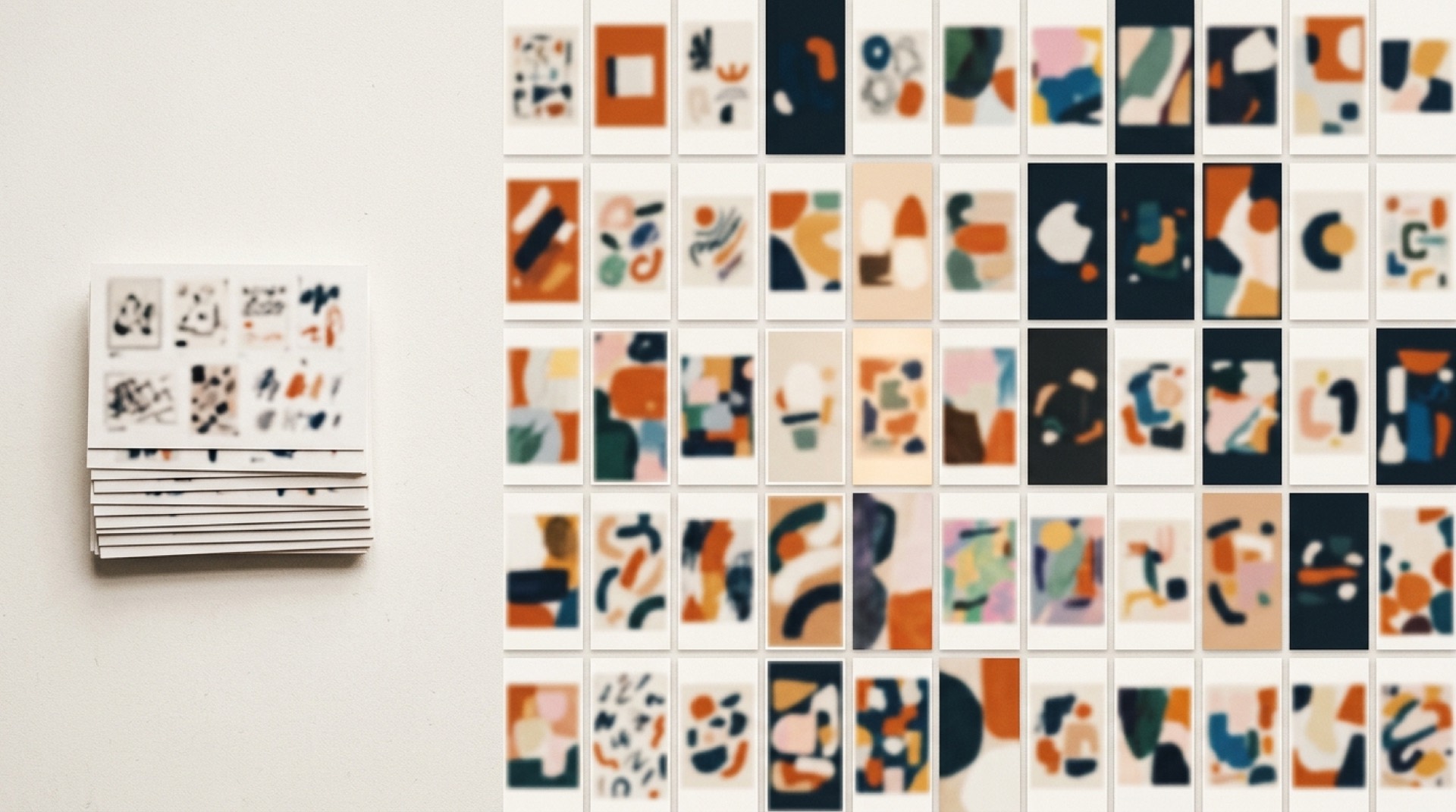
Wall of vertical AI ad frames for an art brand beside a small stack of concept cards, photographed on a studio table
On this page9 sections

Do AI ads work? AI Vidia can answer with a number instead of a position: the studio ships 50 new AI ads a week for Andy Okay, an art brand with more than 200,000 customers, and has passed 1,000 shipped ads on that one account. The ads keep producing new winners in paid social, cycle after cycle. So yes, AI ads work. The honest answer is one word longer: AI ads work conditionally, and the condition is a system the industry mostly skips.

This article lays out that condition. It is written from production data on a named, public engagement, not from a tool vendor benchmark. The short version: AI ads fail when volume means cloning variants of one tired idea. They compound when volume means new concepts, cut into variants. Andy Okay calls the brief volume without dilution, and that phrase does more strategic work than most agency decks.

The question hides three different questions

50NEW ADS SHIPPED PER WEEK
1,000+AI ADS PRODUCED TO DATE
115+CONCEPT DIRECTIONS DEVELOPED
9:16VERTICAL-FIRST, BUILT FOR THE FEED

When a growth lead asks whether AI ads work, they are really asking three things at once. Will the output look AI-generated and embarrass the brand? Will any of it beat the current best ad? And can the team sustain it past the novelty month? Each question fails for a different reason, which is why generic yes-or-no answers are useless.

The stakes are not abstract. A paid social account that stops getting fresh creative starts paying a fatigue tax within weeks: frequencies climb, CTR sags, and the algorithm quietly narrows delivery to the audiences it already knows. Motion measured creative performance across USD 1.29 billion in Meta spend for its 2026 benchmarks, and the pattern behind that dataset is the one every media buyer recognises: accounts do not die from bad ads, they die from stale ones.

Grid of vertical AI ad frames for an art brand, a small stack of concept cards beside a much larger wall of finished ad variants
The working ratio on the Andy Okay account: a short stack of concept directions on the left becomes a wall of shipped 9:16 ads on the right.

Variant-first volume is what dilutes a brand

The failed version of AI advertising is easy to picture because most feeds are full of it. A team takes one winning ad, generates forty look-alikes, and calls it creative testing. Nothing new is being tested. The account is asking the same question forty times, and the brand gets blander with every asking. That is dilution, and it is a workflow choice, not a property of AI.

The Andy Okay engagement runs the opposite workflow. Concepts come first: DOGUE magazine covers, Mona Fisa, Break Glass In Case Of No Wine, emergency humor for people who buy art with a conscience. Each direction then gets cut into statics, UGC-style videos, animated story ads and product reveals. The published counts make the ratio concrete: 115+ concept directions have carried more than 1,000 shipped ads. One idea becomes roughly nine assets, and every one of the nine is asking the account a slightly different question.

115 concept directions became 1,000+ shipped adsPublished production counts from the Andy Okay engagement
Concept directions developed115
AI ads shipped to the account1,000

AI Vidia x Andy Okay case study, counts as published

Read the chart from the left. The scarce, expensive thing is the concept direction; the cheap, fast thing is the variant. AI collapsed the cost of the second column, not the first. Teams that let AI generate the left column too are the ones who end up asking why everything looks the same.

DimensionVariant-first volumeConcept-first volume
What multipliesCopies of one winning adNew ideas, each cut into formats
What the account learnsThe same answer, restatedA new answer per direction
Brand effect over 6 monthsProgressive dilutionA recognisable, growing universe
Fatigue behaviourWhole account tires at onceLosers die alone, winners scale
Where AI helpsFaster samenessCheap exploration of expensive ideas
Want a structured plan for your AI creative pipeline?
20-minute call, no pitch deck.
Book a call

The Dilution Test

Before buying or building AI ad volume, run your current plan through five checks. The AI Vidia team uses this as the first diagnostic on any new account, and it predicts outcomes better than any tool choice does.

  1. Count concepts, not assets. If next month's plan is 60 assets from 3 ideas, you are scaling dilution. The published Andy Okay ratio is roughly one concept direction per nine shipped ads; treat anything past 1:15 as a warning light.
  2. Name the question each batch asks. A hook matrix is a set of questions to the auction: new audience, new angle, new objection handled. If a batch cannot state its question in one sentence, it is filler.
  3. Check the kill rule. Volume without a documented kill threshold turns the account into a museum of losers. Winners scale, losers get killed weekly, and the loop must say so in writing.
  4. Locate the brand lock. Something fixed has to survive every variant: the palette, the voice, the character system. If nothing is locked, volume erodes recognition instead of building it.
  5. Confirm the feedback loop closes. Last week's winners must shape this week's brief. If production and media buying do not meet weekly, the volume is decoration.

Kevin's take

That constraint explains why the strongest AI accounts look more distinct over time, not less. When exploration is cheap, taste becomes the bottleneck, and taste is a compounding asset.

The Weekly Drop Loop

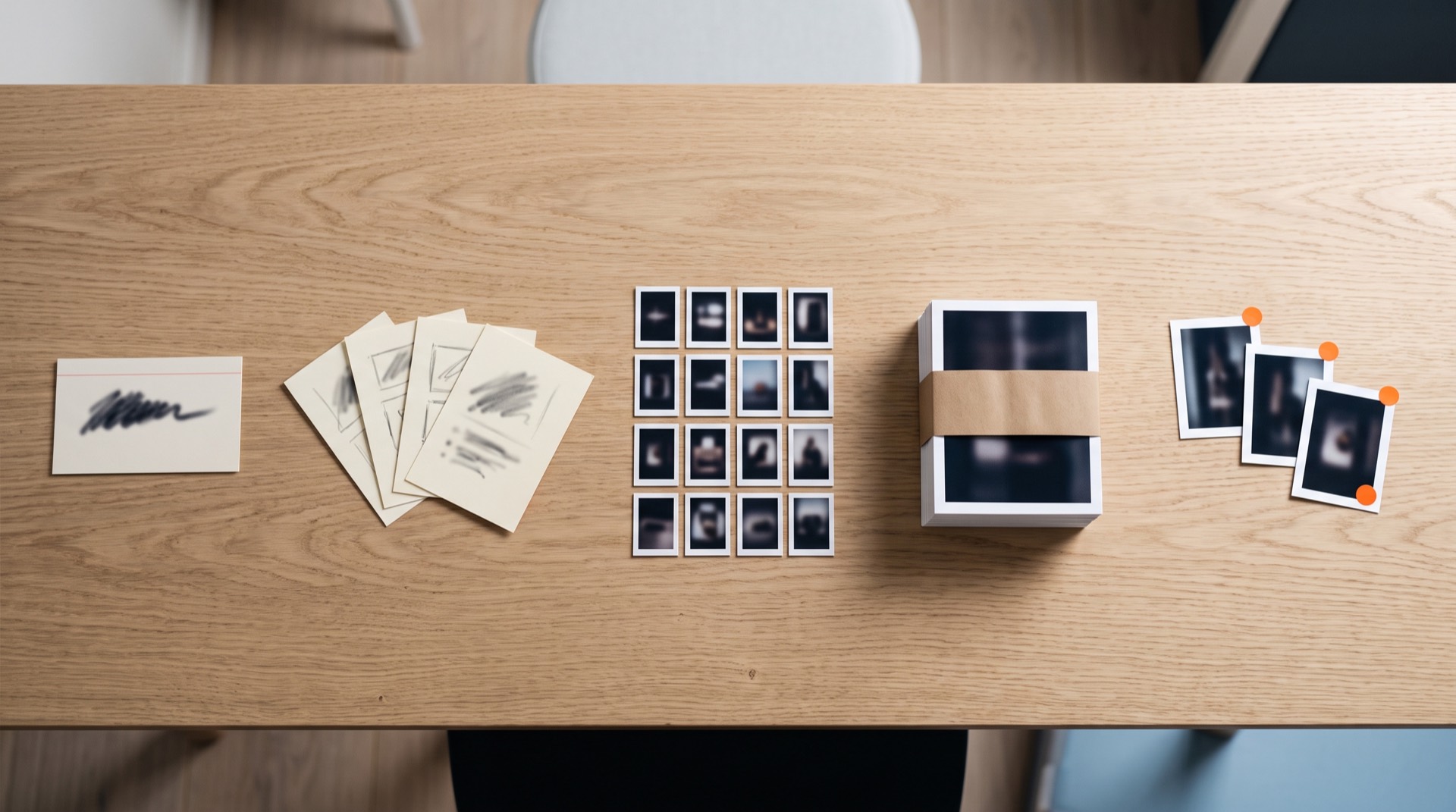
The tactical system behind the numbers is public on the case study page, and it is deliberately boring: five steps, one week, repeated. This is the loop that has run past 1,000 ads without the account going stale.

  1. Weekly brief. One theme, one drop date. The brief is fed by the previous week's winners, so the loop starts from evidence, not from a blank page.
  2. Concepts. New directions are developed first, from DOGUE covers to Break Glass. This is the human-heavy step, and it stays human.
  3. Variants. Each direction is cut into statics, video and hook variants. This is where AI does the volume work: every format the feed rewards, everything in 9:16 first.
  4. The drop. 50 fresh ads land in the ad account, ad-ready, named and organised so the media buyer can launch without a cleanup pass.
  5. Testing. Winners scale, losers get killed, and the survivors write next week's brief. The loop closes and starts again.
A 50-a-week cadence compounds to 1,000 ads in about five monthsCumulative shipped ads at the documented weekly drop rate
Week 4: 200Week 8: 400Week 12: 600Week 16: 800Week 20: 1,0001,000Week 4Week 8Week 12Week 16Week 20

Arithmetic on the published 50-per-week cadence

Proof, with names attached

The reason AI Vidia publishes client names is that unattributed numbers are worthless in 2026. Two named engagements carry the proof here. Andy Okay: 50 new ads a week, 1,000+ shipped, 115+ concept directions, documented on the Andy Okay case study. IndianBites: 142 ads shipped in 11 weeks for a DTC food brand whose account was starving for fresh creative, with winning cohorts running at 2.4x ROAS.

Nobody asks whether photography works. They ask whether the photographer is any good. AI ads have reached the same place faster than anyone admits.

Kevin Dosanjh, founder, AI Vidia
Five stations of a weekly production loop laid out on a desk, from brief card to concept sketches to variant grid to a delivery stack to a small set of marked winners
One week of the loop, laid flat: brief, concepts, variants, the 50-ad drop, and the handful of winners that write the next brief.

If your team is weighing this build-or-buy decision on price, the 2026 pricing breakdown walks through cost per tested asset across all four buying models, and the volume playbook covers what changes past 100 variants a week.

What to measure while the loop runs

Volume without measurement is just noise with a budget. Four numbers tell you within a month whether concept-first volume is working on your account. Watch the winner rate per drop: at a healthy baseline, a low single-digit share of new ads will out-deliver the incumbent, and zero winners across two consecutive drops means the concepts, not the variants, are the problem. Watch CTR by concept direction rather than by ad, so a strong idea in a weak cut is not killed by accident. Watch frequency on your scaled winners, because rising frequency with flat CTR is the earliest fatigue signal you will get. And watch the concept-to-asset ratio itself; if it drifts past one to fifteen, the account is quietly sliding back into variant-first production. None of this requires new tooling, only that the numbers are read weekly, on the same day the next brief is written.

When AI ads do not work

Honesty about the failure cases is cheaper than learning them on your own budget. AI ads underperform when the product needs demonstration physics that current video models still fumble, when nobody on the team can write a concept brief, and when the account spends too little to feed a weekly test loop. They also fail under variant-first volume, which is the most common case and entirely self-inflicted. If you cannot name a concept owner, fix that before buying any production capacity, human or AI.

The next step

The fastest way to test the thesis on your own account is not a subscription, it is a batch. AI Vidia runs concept-first production for DTC and consumer brands as AI image ads and AI video, delivered ad-ready into your account. Book a 20-minute call and bring your current concept-to-asset ratio; the conversation is a working session on volume without dilution, not a pitch.

Frequently asked questions

01Do AI ads actually work on Meta and TikTok?
Yes, with a documented production system behind them. AI Vidia ships 50 new AI ads a week for Andy Okay and has passed 1,000 ads on that account, with new winners still landing in paid social. Performance comes from concept-first volume: new ideas cut into variants, tested weekly, losers killed. Accounts that clone one winner into dozens of look-alikes see the opposite result.
02Will AI ads look AI-generated?
Only if the workflow lets them. On the Andy Okay account every asset passes a brand lock: fixed palette, voice and character system that survive every variant. The concepts are developed by people and the volume work is done by AI, which is why the account looks more distinct after 1,000 ads, not less. Assets that fail the look are killed before the client ever sees them.
03How many ad concepts does a DTC brand need per month?
The published Andy Okay ratio is a useful anchor: 115+ concept directions across 1,000+ shipped ads, roughly one concept per nine assets. A brand shipping 40 assets a month should therefore be feeding four to six genuinely new directions into the account, not stretching one idea across the whole batch. Past a ratio of one concept per fifteen assets, dilution usually shows up in CTR first.
04What is concept-first ad production?
Concept-first production develops new creative directions before any variants are generated, then cuts each direction into statics, video and hook variants. The alternative, variant-first production, multiplies copies of an existing winner. Concept-first volume keeps every batch asking the ad auction a new question, which is what sustains testing velocity without diluting the brand.
05How fast can AI ad volume ramp up?
At the documented Andy Okay cadence of 50 ads a week, an account passes 1,000 shipped ads in about five months. A smaller test is faster: IndianBites took 142 ads over 11 weeks, and winning cohorts reached 2.4x ROAS inside that window. The limiting factor is rarely generation speed; it is whether the weekly loop of brief, drop and testing actually closes.

Sources

  1. 01Motion, Creative Benchmarks 2026 (USD 1.29B Meta spend analyzed)
  2. 02Andy Okay, official brand site

Next step

Get your first 12 on-brand AI variants in 14 days.

Book a 20-minute strategy call with the AI Vidia team. No pitch deck, just a structured plan for your creative output.

Book a call

Read next