
AI/Vidia
All insights

AI UGC Avatar vs Real Creator

AI UGC avatar vs real creator: a decision framework for DTC paid social, with a cost table, two named frameworks, and when each option wins.

Founder, AI Vidia
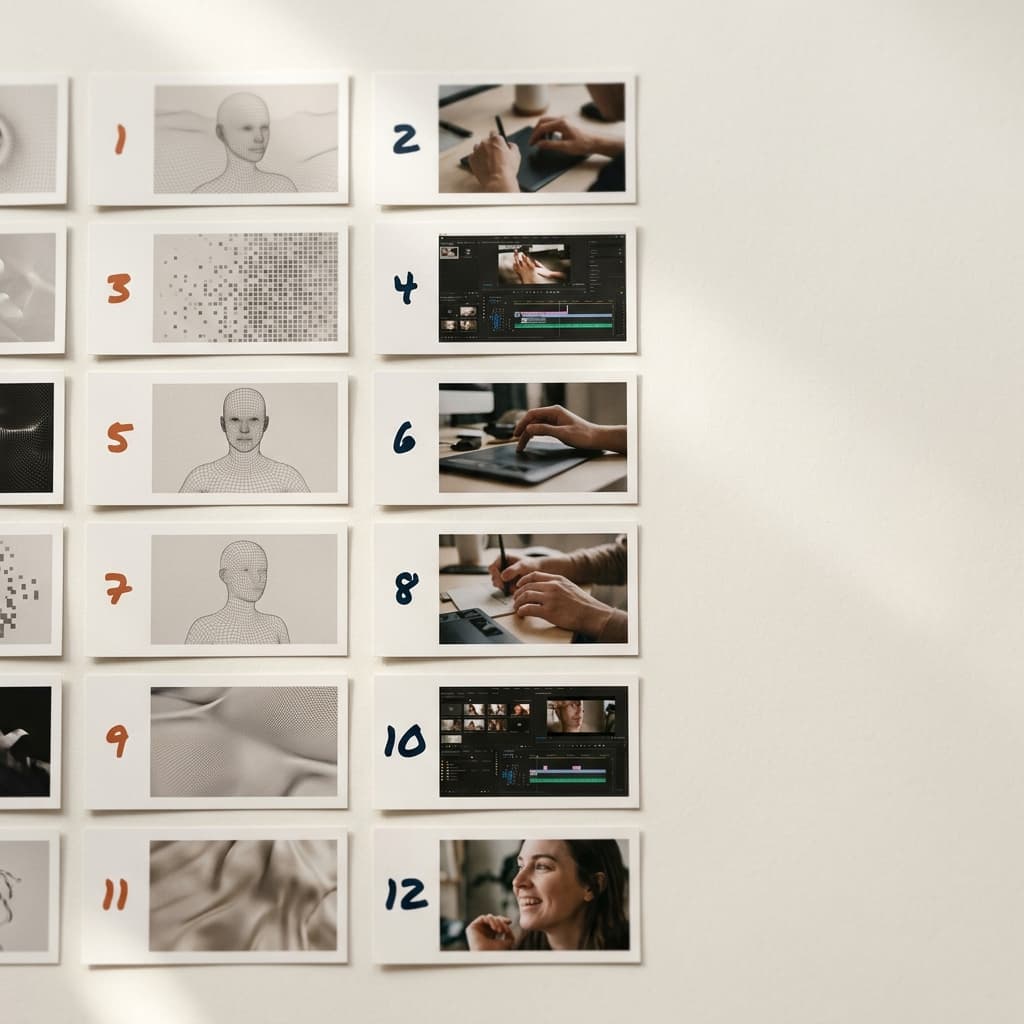
Overhead flat lay of paper cards arranged as a decision framework on a warm off-white Nordic surface.
On this page8 sections

AI Vidia builds both AI UGC avatars and real-creator content for paid social, so the AI Vidia team gets asked one question more than almost any other: AI UGC avatar vs real creator, which one should a DTC brand actually run? The short answer is that AI UGC avatars win on volume, speed, and multi-market testing, while real creators win on trust-heavy claims, founder stories, and hero launches. The AI UGC avatar vs real creator decision comes down to three variables: how fast you need fresh variants, how much authenticity the specific claim demands, and your real cost per tested asset. AI Vidia has shipped 1,834 AI videos and 70,342 AI images across 48 brands in 14 countries at a 99.2% brand-safe pass rate, and this guide draws on that production data rather than opinion.

What the choice actually costs you

1,834AI VIDEOS SHIPPED
2.4xROAS ON WINNING COHORTS
99.2%BRAND-SAFE PASS RATE
40-200VIDEO ADS PER BRAND MONTHLY

Picking the wrong default burns budget in two directions. If you make real creators your only source, creative throughput caps at the rate one person can film and re-film, and a Meta account that needs weekly fresh creative starves. Meta for Business reports that ad sets with 5 or more creative variations produce 30 to 50 percent lower CPA than ad sets running 1 or 2, so a brand that ships one creator video a month is paying a CPA tax it never sees on the invoice. If you make AI UGC avatars your only source, you risk flattening the trust signal on claims that genuinely need a human face, and you leave long-term brand affinity on the table.

The cost gap is concrete. A mid-market real creator in the Nordics charges a per-video fee plus usage rights, and every reshoot restarts both the fee and the calendar. An AI UGC avatar is generated from a locked character system, so once that system exists the marginal cost of the thirtieth variant is close to the cost of the first. AI Vidia has measured a 62 percent drop in creative production cost within 90 days on brands that move their testing layer to AI, while holding a 2.4x ROAS on the winning cohorts. The Content Marketing Institute reported in 2025 that 73 percent of B2B marketing teams cite producing enough content as their single biggest challenge, and the avatar-or-creator split is where that bottleneck either clears or hardens.

AI UGC avatar vs real creator, side by side

The table below compares the two options on the dimensions that decide a paid social program. Read it as a default-setting tool, not a verdict: most brands end up running both, with the split set by claim type and testing cadence rather than by preference.

DimensionAI UGC avatarReal creatorEdge
Cost per tested assetLow after setupHigh, per video plus usageAI UGC avatar
Turnaround per variant1 to 3 business days2 to 4 weeks with schedulingAI UGC avatar
Volume ceiling40 to 200 per month4 to 12 per monthAI UGC avatar
Authenticity on hard claimsStrong for product demoStrongest for personal claimsReal creator
Multi-market localisationSame face, new language in daysNew creator per marketAI UGC avatar
Long-term brand affinityBuilds a brand-owned characterBuilds a human relationshipDepends

Two rows decide most programs. The volume ceiling row is why performance teams default to AI UGC avatars for the testing layer: a single creator cannot produce 40 to 200 ad-ready variants a month, but a locked avatar system can hold that cadence week after week. The authenticity row is why real creators keep their place: a founder telling the origin story, or a customer making a health claim on camera, reads as more credible from a real person. Everything else in the table is a tradeoff you set deliberately, not a reason to pick a single tool for the whole account. The brands that get this wrong usually do so by treating it as one global decision instead of a per-asset one.

The AI Vidia Avatar-or-Creator Decision Model

This is the strategic model the AI Vidia team uses to set the default for each ad before anything is produced. Run an asset through these five checks and the answer is usually obvious by step three.

  1. Classify the claim. Sort the message into product demonstration, lifestyle context, or personal testimony. Demonstration and lifestyle run well on an AI UGC avatar, while personal testimony, especially in regulated categories, points to a real creator carrying the message on camera.
  2. Set the volume target. Decide how many variants the ad set needs this month to stay out of the Meta learning phase, which typically wants 30 to 50 conversions per ad set per week. Anything above roughly 12 variants a month is impractical on real creators alone and belongs on an avatar system.
  3. Check the market count. Count the languages and regions the creative must cover. One face localised across three markets in days is an avatar job, while one trusted local voice per market is a creator job that scales linearly with cost.
  4. Price the cost per tested asset. Divide the production cost by the number of usable variants you will actually test, not the number you hope to use one day. Avatars almost always win this ratio once weekly testing starts, because the setup cost is spread across every later variant.
  5. Assign the hero versus the layer. Give the hero slot, the one ad most people will see, to whichever option carries the most trust for that specific claim. Feed the variant layer beneath it with AI UGC avatars so the algorithm never runs short of fresh creative.
Want a structured plan for your AI creative pipeline?
20-minute call, no pitch deck.
Book a call

Kevin's take

In practice the teams that struggle are the ones still treating this as an identity question about whether they are an authentic brand. The real question is operational: which format clears the brand-safe gate, hits the volume target, and holds CTR for this asset. Answer that one asset at a time and the split sets itself without any debate about brand purity.

The AI Vidia UGC Variant Build Sequence

This is the tactical sequence the AI Vidia team runs once the decision model has set the split. It is the weekly build that turns a brief into a tested cohort instead of a single ad that sits in review.

  1. Lock the character system. Build the avatar against the brand's existing hero imagery so face, wardrobe, lighting, and voice are fixed as a style lock before any ad is generated. This is the asset that makes every later variant cheap and consistent across 50 or more ads.
  2. Draft the hook library. Write 10 to 15 opening hooks per cohort, mixing problem, proof, and pattern-interrupt openings. Hooks are the variable that moves hold rate most on short-form video, so they get the most variants.
  3. Batch the first cohort. Generate 12 variants in week one across 9:16, 1:1, and 4:5 ratio cuts, then ship them into the ad account for live signal. The goal is fresh creative in the account, not a single perfect ad polished for a month.
  4. Read the winners. After the cohort clears the learning phase, pull the top variants by hold rate and CTR and tag exactly what made them work. Winning hooks, scenes, and framings feed directly into the next batch.
  5. Scale the winning cohort. Move from 12 variants in week one to 30 to 50 in week two and 80 to 150 from week three, concentrating volume on the patterns the data already proved rather than guessing at new ones.

Proof from live brands

AI Vidia ran this exact split for IndianBites, a fast-growing DTC food brand with a limited production budget and a Meta account starving for fresh creative. Traditional food photography could not keep up with the weekly testing cadence, so the AI Vidia team built a brand-locked style system and shipped a weekly 12-variant batch of food hero shots, recipe-in-action sequences, and UGC-style creator frames. Over 11 weeks the program shipped 142 AI ads, cut creative production cost 62 percent, and held a 2.4x ROAS on the winning cohorts at 12 times the previous weekly test volume. You can read the numbers in the IndianBites performance creative case study, and compare the unit economics in our breakdown of AI UGC ad cost versus creator fees.

AI Vidia cut our creative production cost 62% in 90 days, and our win rate in paid social is higher than when we paid 10x more.

The broader production record sits behind that single case: 70,342 AI images, 1,834 AI videos, 48 brands, 14 countries, and EUR 2.4M+ in paid media optimized at a 99.2% brand-safe pass rate. For brands weighing avatar quality on video specifically, our comparison of Kling 2 and Runway Gen-4 for UGC ads covers which model holds up at ad scale and which one drifts off-brand under volume.

When each option wins

Choose an AI UGC avatar when you need more than 12 tested variants a month, when you are localising one message across multiple markets, or when the claim is a product demonstration or a lifestyle scene. Choose a real creator when the message is personal testimony, when a regulated category needs a named human making the claim on camera, or when a founder story or signature launch depends on a recognizable face. When a single ad set has to do both jobs at once, give the hero ad to the format with the most trust and run AI UGC avatars as the variant layer that keeps the account fed. The one case where you should stop reading and simply book a creator is a program built around one or two hero films a quarter, because at that volume an avatar system is more infrastructure than the output justifies.

Your next step

If you are setting the avatar-or-creator split for a paid social program, the fastest way to get it right is to map your claims and your monthly volume targets against the decision model above. The AI Vidia team can build the locked character system and ship the first 12-variant cohort inside two business weeks. Book a call on the AI Vidia performance creative call page to scope it, or read how the studio runs the full production pipeline on the AI UGC ads service page.

Frequently asked questions

01Is an AI UGC avatar cheaper than a real creator?
Yes, in most paid social programs an AI UGC avatar costs less per tested asset than a real creator. A real creator typically charges a per-video fee plus usage rights, and every reshoot means new fees and new scheduling. An AI UGC avatar is generated from a locked character system, so the marginal cost of variant 30 is close to the cost of variant 1. AI Vidia has shipped 1,834 AI videos across 48 brands, and the cost advantage shows up most when a brand needs weekly variant volume rather than one polished hero film.
02Will an AI UGC avatar look fake to my audience?
Not when the character system is built correctly and tested against real engagement. AI Vidia holds a 99.2% brand-safe pass rate and reviews lip sync, hand detail, and lighting before any avatar ad goes live. The risk of an uncanny result is real for teams generating one-off clips in a consumer tool without a review gate. On paid social the honest test is performance: if CTR and hold rate match or beat real-creator content, the audience has accepted it.
03When should a brand still hire a real creator?
A brand should hire a real creator for trust-heavy claims, founder stories, and signature launches where a recognizable face carries the message. Regulated categories such as health, finance, and supplements often need a real person making the claim on camera. Real creators also build long-term brand affinity that a single campaign metric does not capture. The AI Vidia team recommends real creators for hero moments and AI UGC avatars for the high-volume testing layer underneath them.
04Can AI Vidia combine both in one campaign?
Yes, and that is the setup the AI Vidia team recommends for most growth-stage brands. The standard structure uses real-creator content for the top hero ads and AI UGC avatars for the variant layer that feeds the algorithm fresh creative weekly. This keeps authenticity where it matters and volume where the ad account needs it. AI Vidia ships 40 on-brand video variants per brand per month on its Performance Retainer, which is enough to run both tracks at once.
05Who owns the AI UGC avatar and the character system?
The brand owns the creative output and the locked character system that AI Vidia builds for it. The AI Vidia team treats the avatar, its style lock, and the prompt library as brand assets that stay with the client. This matters because a character system built over months becomes a reusable production engine, not a disposable asset. Ownership terms are set in the agreement before the first batch ships, so there is no ambiguity later.

Next step

Get your first 12 on-brand AI variants in 14 days.

Book a 20-minute strategy call with the AI Vidia team. No pitch deck, just a structured plan for your creative output.

Book a call

Read next