Threads AI ad creative specs for 2026: exact 1:1 and 4:5 dimensions, file limits, video length, the 500 character copy cap, and the AI stack to ship at scale.
Threads AI ad creative specs in 2026 come down to a mobile-first square or vertical frame, 1080 x 1080 pixels at 1:1 or 1080 x 1350 pixels at 4:5, and ad copy that reads like a post rather than a placement. AI Vidia builds that native ad supply for DTC and consumer brands across 14 countries, producing campaign-ready Threads creative at the volume a newly opened auction rewards. Meta completed the global rollout of Threads as an ad placement in January 2026, opening a feed with more than 400 million monthly active users to every eligible advertiser, and Threads now runs on by default inside Advantage+ placements. This guide gives the exact spec for each Threads ad format, the AI generation stack behind each one, and the production cadence pulled from 70,342 AI images and 1,834 AI videos shipped for 48 brands inside EUR 2.4M+ in optimized paid media spend.
Why Threads specs decide your cost per result
1,834AI VIDEOS SHIPPED
70,342AI IMAGES SHIPPED
48BRANDS
99.2%BRAND-SAFE PASS
Threads is the only major Meta surface where most advertisers are spending without ever having briefed a single asset for it. Because Threads sits inside Advantage+ placements by default, ad accounts are already delivering there, usually with creative recut from Instagram feed or, worse, cropped down from a 16:9 YouTube master. A 16:9 asset dropped into a 1:1 recommended frame loses roughly a third of its vertical canvas, the product shrinks, and the tap rate follows it down. Meta recommends 1:1 as the working ratio for Threads, so every asset briefed at 16:9 is starting the auction at a structural disadvantage.
The second failure is tonal, and it costs more. Threads is a text-first, conversation-led feed where the 500 character post is the unit of attention, so a polished studio hero surrounded by a one-line caption reads as an interruption in a stream of replies. The AI Vidia team sees this weekly on accounts that switched Threads on and never changed the brief: impressions climb, the placement breakdown shows a rising share of spend, and cost per result drifts because the creative never matched the surface. A mid-market DTC brand spending EUR 3,000 to EUR 10,000 per month across Meta needs 12 to 25 Threads-native creatives per month to hold performance once the placement is carrying real budget.
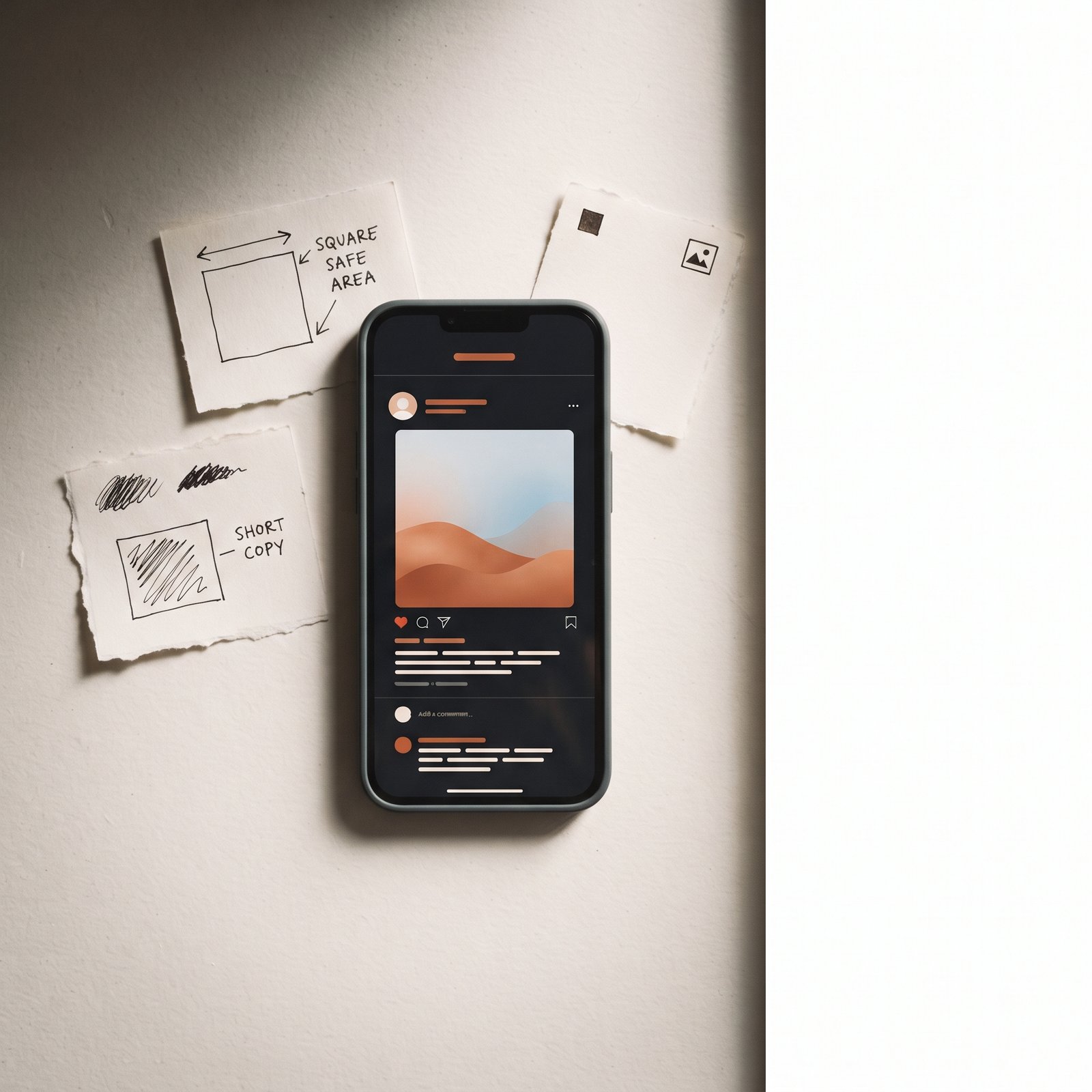
Threads is a text-first feed, so the square frame and the 500 character line above it carry the work.
Threads ad format specs for 2026
The table below maps each Threads ad format to its canvas, recommended length or card count, file limit, and the AI generation stack the AI Vidia team uses to build it. The recurring pattern is a mobile-first square or vertical frame with no 9:16 and no 16:9 support, so the differences sit in whether the unit is static, motion, multi-card, or catalog-driven. Read length as a guide rather than a ceiling: Threads accepts video up to 60 seconds, but completion and cost both favor clips under 15 seconds for direct response goals.
Threads format
Canvas and ratio
Recommended length or cards
File limit
Best AI stack
Single Image Ad
1080 x 1080 (1:1) or 1080 x 1350 (4:5)
Static single frame
30 MB, JPG or PNG
Nano Banana still, style-locked
Video Ad
1:1 or 4:5, 1080p or higher
Under 15 seconds, max 60 seconds
4 GB, H.264 MP4
Veo 3 cut, Kling product motion
Static Carousel
1:1 or 4:5, 2 to 10 cards
3 to 5 cards performs best
30 MB per card
Nano Banana card set, locked style
Video Carousel
1:1 or 4:5, mixed cards allowed
Under 15 seconds per card
4 GB per video card
Veo 3 short cuts, Kling motion
Advantage+ Catalog Ad
1:1 rendered from the catalog feed
Static, one frame per item
Per catalog item image
Nano Banana catalog template
Four reads sit inside that table. First, the ratio set is narrower than any other Meta surface: 1:1 and 4:5 only, with 1:1 as the recommended default, which means the 9:16 Reels masters most brands already own do not carry over and need a rebuild rather than a crop. Second, the copy above the creative is capped at 500 characters, and the visible portion truncates well before that, so the first line has to hold the offer on its own. Third, carousel and catalog formats arrived with the January 2026 global rollout, which makes them the newest and least competed inventory in the account. Fourth, Threads ads run against Conversions, Traffic, App installs, and Engagement objectives, and results are read in Meta Ads Manager through the placement breakdown rather than a separate reporting surface.
The AI Vidia Threads Placement Fit Diagnostic
Specs are only useful once the placement is matched to the brand, the budget, and the objective. Before any production starts, the AI Vidia team runs a five question diagnostic that decides whether Threads earns dedicated creative or stays on default delivery for another quarter. Each question has a direct answer, and a weak answer removes Threads from the brief until the gap is closed.
What share of spend is Threads already taking. Open the placement breakdown in Ads Manager and read the last 30 days before deciding anything. If Threads is under 3 percent of delivered spend, default placement is fine and dedicated creative is premature. If Threads is above 8 percent of delivered spend, it is already a material line item running on borrowed Instagram assets, and it earns its own briefed batch immediately.
Is the cost per result within 20 percent of Instagram feed. This is the single cleanest scale trigger available on a new placement. If Threads cost per result sits inside 20 percent of the Instagram feed number, the surface is working and volume is the lever. If Threads is running 50 percent or more above Instagram feed on cost per result with no conversion advantage, the creative is the suspect before the bid or the audience is.
Does the offer survive in a text-first feed. Threads users are reading, not browsing, so an offer that needs a visual reveal to make sense will underperform a claim that lands in one line. The test is simple: can the first line of the 500 character post carry the offer with the image switched off. If the answer is no, rewrite the offer for the surface before generating a single frame.
Is the brand style lock production ready. A style lock is a documented character system, lighting language, color palette, framing rules, and the 1:1 and 4:5 safe layouts Threads needs. Without a production ready style lock, AI generated creative drifts off brand inside two production weeks and pulls down the 99.2 percent brand-safe pass rate. Settle the style lock before scaling format and variant count, not after.
What weekly fresh-creative volume can the supply chain sustain. Threads winners fatigue on the same curve as the rest of Meta, so a format only earns a slot if the brand can feed it new variants every week. If sustained weekly output is under 6 creatives, hold Threads to Single Image and Static Carousel and skip video entirely. Below that floor, the variants never accumulate enough delivery to read a clear winner before they decay.
Want a structured plan for your AI creative pipeline? 20-minute call, no pitch deck.
The tell is easy to check in five minutes. Pull the placement breakdown, find the Threads row, and ask whether a single asset in the account was briefed at 1:1 with a first line written for a text feed. On most accounts the answer is no, and that gap is the cheapest performance available on Meta right now.
The AI Vidia 14-Day Threads Creative Sprint
The diagnostic sets whether Threads gets dedicated creative. The sprint sets the clock. This is the production cadence the AI Vidia team runs per brand once Threads has cleared the diagnostic and earned its own batch.
Days 1 to 2: brief and style lock. Lock the format matrix, confirm the brand style system, and rewrite the offer for a text-first feed so the first line stands alone. Every asset is briefed at 1:1, 1080 x 1080, with a 4:5 companion at 1080 x 1350 for the vertical cut, and the copy is written to the 500 character cap with the offer inside the first 90 characters.
Days 3 to 6: batch generation. Generate the first batch of 12 to 20 creatives across the chosen formats against the style lock. Video comes from Veo 3 and Kling at under 15 seconds, stills and carousel cards from Nano Banana, and every asset runs the brand-safe QA pass before it enters the shared drive. Hold 20 percent of capacity in reserve for mid-sprint top ups.
Days 7 to 9: copy and hook variants. Cut each concept into three to five first-line variants, because on a text-first surface the opening line moves tap rate harder than the frame behind it. Pair each line with a matching visual variant so the test reads cleanly, and keep every version sound-off legible since the feed plays muted by default.
Days 10 to 12: launch and read. Push the batch live, give each creative enough delivery to clear the learning signal, and read the placement breakdown by cost per result rather than by impressions. Kill the bottom third early and shift budget to the top cohort, comparing Threads cost per result against the Instagram feed baseline set in the diagnostic.
Days 13 to 14: prune and reload. Promote the winners, retire the fatigued creatives, and brief the next batch from what the data showed about first lines and formats. The reserve capacity from day 6 covers any fast refresh a winning concept needs before fatigue takes the cohort down.
Proof: what this cadence produces
The AI Vidia team has shipped 1,834 AI videos and 70,342 AI images for 48 brands across 14 countries, inside EUR 2.4M+ in optimized paid media spend, at a 99.2% brand-safe pass rate. On tested winning cohorts the work has held a 2.4x ROAS lift, and brands that moved their creative supply to the AI Vidia pipeline have seen a 62% cost reduction against traditional production. The clearest public example is IndianBites, a DTC food brand that needed weekly fresh creative its photography partner could not match. The AI Vidia team built a brand-locked style system and shipped 142 AI ads in 11 weeks, cutting creative production cost 62% and holding a 2.4x ROAS on the winning cohorts. The same discipline is what makes a new placement like Threads cheap to enter: when the style lock and the pipeline already exist, adding a ratio and a copy format is a brief change, not a new production line.
Threads is the rare case where the placement is already spending your money and nobody has briefed it. Brands that ship a 1:1 batch built for a text feed are buying attention at a discount their competitors have not noticed yet.
One locked style system, many square variants: the shape of a Threads supply that holds brand and cadence.
When each Threads format wins
Use these decision rules to set the matrix without guessing. Single Image Ads win when you need volume and a clean baseline that is cheap to batch, and they should carry most of the spend on a first Threads sprint. Video Ads win when the product benefits from motion, but only when the clip resolves under 15 seconds and works sound-off, since the feed plays muted. Static Carousels win for multi-benefit offers and product ranges where 3 to 5 cards can each carry one claim. Video Carousels win for demonstration-led products where each card shows a different use, but they cost the most per unit and should wait until a static baseline exists. Advantage+ Catalog Ads win for catalog-led ecommerce brands with many SKUs that need a product grid without a reshoot.
Stop reading and switch approach if Threads is under 3 percent of delivered spend, if you are running fewer than five active creatives in the account, or if every Threads asset is a crop of a 9:16 Reels master. None of those will clear the bar the 2026 auction sets on this placement, and no bid change fixes a creative supply and ratio problem. Fix the brief first, then decide whether the placement deserves more budget.
The receipt view: briefed square volume is what moves Threads cost per result, not a bigger bid.
Next step
Threads rewards brands that treat a default-on placement as a real channel with its own brief, its own ratio, and its own weekly supply. If your Meta spend is scaling faster than your creative throughput, the AI Vidia team can build the format matrix, the style lock, and the weekly Threads batch for you. See how AI Vidia produces video ads at performance volume, then book a Performance Retainer call to map your first 14-day Threads sprint.
Frequently asked questions
01What are the image dimensions for a Threads ad in 2026?
Threads image ads run at 1:1, 1080 x 1080 pixels, or 4:5, 1080 x 1350 pixels, and Meta recommends 1:1 as the working ratio for the placement. Static images export as JPG or PNG up to a 30 MB file limit. Threads does not support 9:16 or 16:9, so a Reels master or a YouTube cut needs a rebuild rather than a crop. AI Vidia briefs every Threads still at 1:1 with a 4:5 companion so the product never shrinks or crops inside the feed.
02How long can a Threads video ad be?
Threads allows video ads up to 60 seconds, but completion and cost both favor clips under 15 seconds for direct response goals. Supported aspect ratios are 1:1 and 4:5 at 1080p or higher, with a 4 GB maximum file size and H.264 compression recommended. Because the Threads feed plays sound-off by default, the first three seconds have to communicate with on-frame context rather than audio. AI Vidia cuts each concept into short, sound-off-safe variants that resolve the message before the viewer scrolls past.
03How many characters can Threads ad copy be?
Threads ad copy is capped at 500 characters, matching the organic post limit on the platform. In practice the visible portion truncates well before that cap, so the offer belongs inside the first 90 characters and the rest carries supporting detail. Threads is a text-first, conversation-led feed, which makes the opening line a stronger lever on tap rate than the frame behind it. AI Vidia tests three to five first-line variants per concept for exactly that reason.
04How many Threads ad creatives does a brand need each month?
A mid-market DTC brand spending EUR 3,000 to EUR 10,000 per month across Meta needs roughly 12 to 25 Threads-native creatives per month once the placement carries real budget. Threads winners fatigue on the same curve as the rest of Meta, so a steady weekly supply beats one large batch. If sustained weekly output is under 6 creatives, hold Threads to Single Image and Static Carousel and skip video entirely. AI Vidia produces this volume through an AI pipeline rather than studio shoots that would erase the placement's cost advantage.
05Do I have to opt in to Threads ads, or is the placement already running?
Threads is included in Advantage+ placements by default, so most Meta advertisers are already delivering there without having briefed a single asset for it. You can confirm the exact share by opening the placement breakdown in Meta Ads Manager and reading the last 30 days of delivered spend. If Threads is above 8 percent of delivered spend, it is a material line item running on borrowed Instagram creative and earns its own briefed batch. If it is under 3 percent, default delivery is fine and dedicated creative can wait.
06Can AI generated creative hold brand quality across a Threads batch?
Yes, when the brand runs a documented style lock and every asset is checked against it before it ships. AI Vidia maintains a 99.2% brand-safe pass rate across 70,342 AI images and 1,834 AI videos by locking the character system, palette, and framing, then rendering each concept into the 1:1 and 4:5 layouts Threads needs. Without that discipline, AI creative drifts off brand inside two production weeks and the volume advantage turns into a cleanup cost. Settle the style system first, then scale format and variant count against it.
Next step
Get your first 12 on-brand AI variants in 14 days.
Book a 20-minute strategy call with the AI Vidia team. No pitch deck, just a structured plan for your creative output.