
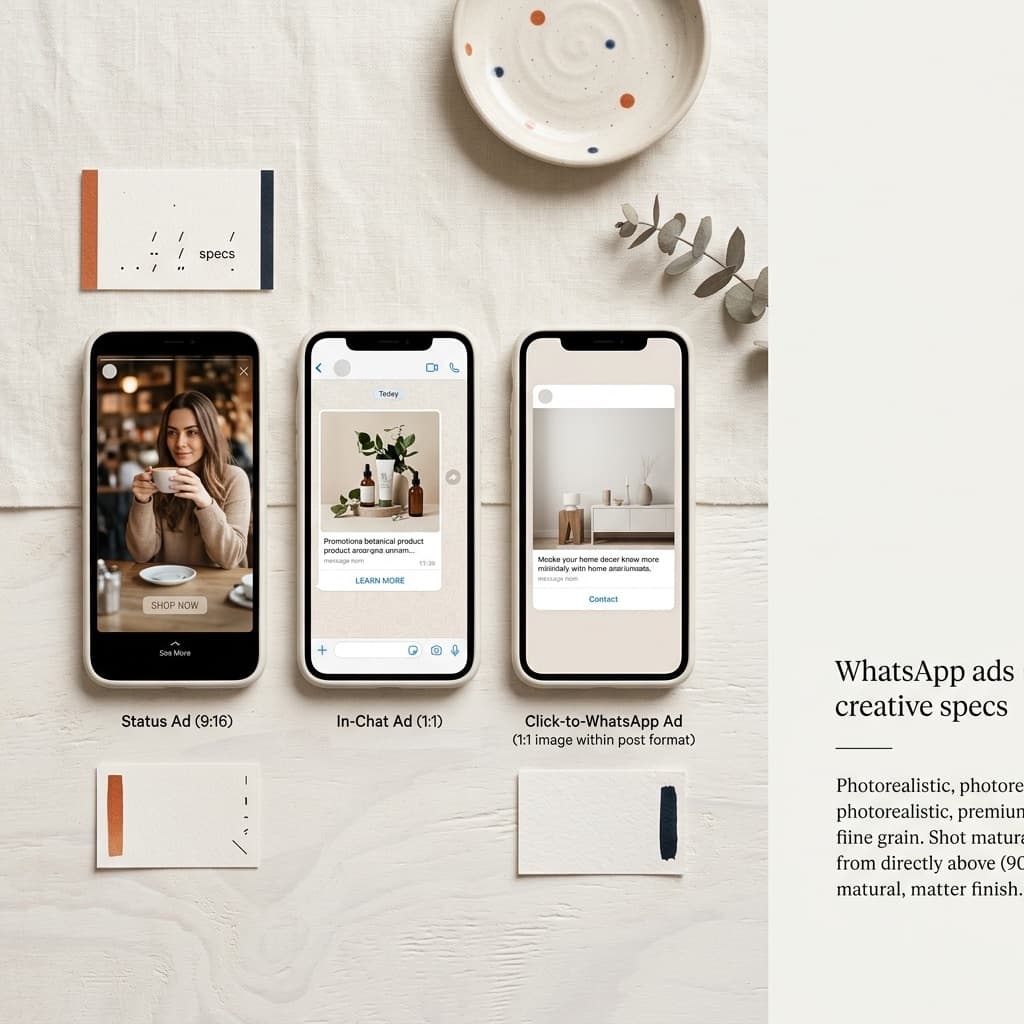
WhatsApp ads creative specs for 2026: the 1080 x 1920 canvas, the safe band Meta never published, file limits, tap destinations, and how to ship Status creative.
WhatsApp ads creative specs in 2026 start from an uncomfortable fact: Meta has never published one. Status ads are bought in Meta Ads Manager and render full screen between your customers' updates, but there is no official Ads Guide page with dimensions, file caps, or safe zones for the placement. AI Vidia produces campaign-ready vertical creative for DTC and consumer brands across 14 countries, and the working standard the AI Vidia team builds against is 1080 x 1920 pixels at 9:16, with headline, price, logo, and call to action held inside a central band roughly 250 pixels clear at the top and 400 pixels clear at the bottom. This guide separates what Meta actually confirms from what is practitioner consensus, then gives the production cadence that keeps a Status placement fed. Meta's own number for the surface: 1.5 billion people open the WhatsApp Updates tab every day.
Why the missing spec sheet costs money
1.5BDAILY UPDATES TAB USERS
1080 x 1920WORKING CANVAS
1,834AI VIDEOS SHIPPED
99.2%BRAND-SAFE PASS
Status is the largest new Meta placement since Reels, and it is the only one with no published creative specification. Meta's Ads Guide URL for the placement returns a 404 and business.whatsapp.com lists no dimensions, no file limits, and no character counts. That gap has a direct cost. The most common failure the AI Vidia team sees on new WhatsApp Status ad sets is a repurposed 1:1 or 4:5 asset with the headline and the price sitting exactly where WhatsApp draws its own interface: the progress bar, business name, and Sponsored label across the top, the reply bar and the green chat button across the bottom. When the offer collides with the chrome, the tap never happens, and a placement that should deliver conversations delivers impressions.
The second cost is slower and larger. Status runs between messages from friends and family, which is the most personal context in paid social, so a polished studio banner reads as an intruder and gets swiped past. Brands that win here run candid, phone-shot-looking creative and refresh it weekly, because frequency builds fast in a surface people open several times a day. A mid-market DTC brand putting EUR 5,000 to EUR 15,000 per month into WhatsApp and click-to-chat campaigns needs 20 to 40 fresh vertical assets per month to hold cost per conversation, which is a production rate traditional shoots cannot sustain on a weekly clock.
WhatsApp ads creative specs 2026: the working table
The table below is the spec sheet Meta has not written, with each row labelled by evidence level so you know which numbers are contractual and which are consensus. Two fields are genuinely Meta-official: where the ad appears and where a tap sends the user. Everything dimensional is cross-verified practitioner consensus, and the video duration figure is openly contested, with 30, 60, and 90 second caps all circulating and none of them traceable to a Meta page.
Creative field
Working standard in 2026
Evidence level
AI Vidia build rule
Canvas and ratio
1080 x 1920 pixels, 9:16 full screen
Secondary consensus, no Meta figure exists
Generate native at 1080 x 1920. Never crop down from a 1:1 feed asset.
Safe band
Central 1080 x 1270, about 250 px clear top and 400 px clear bottom
Reconciliation of every published claim, no Meta template
Hold headline, price, logo, and CTA inside the central band on every variant.
Image file
JPG or PNG, roughly 16 MB reported ceiling
Secondary consensus only
Export under 5 MB so detail survives platform compression.
Video container
MP4 at 1080 x 1920, no published size cap
Secondary consensus only
Deliver H.264 MP4 under 100 MB with sound designed to work muted.
Video duration
Design to 15 to 30 seconds
Contested: 30, 60, and 90 seconds all circulate, none Meta-confirmed
Cut every concept at 6, 10, and 15 seconds. The 6 second cut usually wins.
Tap destination
WhatsApp chat, website, or app (marked coming soon)
Meta-official
Write the hook for a chat that opens, not for a landing page.
Buying path
Meta Ads Manager, manual or Advantage+ placements
Placement Meta-official, objective list secondary
Isolate Status in its own ad set before trusting any read.
Three practical reads sit inside that table. First, the safe band is the whole game: because no Meta template exists, the only defensible rule is the one that satisfies every published claim at once, which means treating the central 1080 x 1270 as the only place text may live. Second, duration is not worth arguing about, because a Status viewer is flicking through updates and a 6 second cut resolves before the swipe. Third, the tap destination changes the copy, not just the tracking. A click-to-WhatsApp ad opens a conversation, so the creative should promise a reply, not a product page, and phrases like "message us for the size chart" outperform a generic shop prompt on this surface.
One number circulating widely deserves to be retired: 1080 x 1620 as the Status safe area. No source, Meta or secondary, cites an origin for it. If a guide quotes a clean safe-zone figure without saying where it came from, treat the whole page as unverified.
The AI Vidia WhatsApp Status Readiness Test
Status is not right for every brand, and the placement punishes weak preparation faster than Reels does. Before any production starts, the AI Vidia team runs a five question test that decides whether Status enters the next 90 day matrix and at what weight. A weak answer to any single question caps the budget rather than killing the channel.
Is the placement live in your markets. Non-EU markets including the United States, India, Brazil, and Indonesia completed rollout through late 2025. The EU was blocked through 2025 by the Irish Data Protection Commission, and Meta's DMA compliance report of 6 March 2026 stated that Status and Channels ads were rolling out across the EU in the coming weeks. For a Danish or Nordic brand this means verifying availability per country inside Ads Manager before committing spend, because the phase-in is not uniform.
Can you answer the conversations you create. The flagship Status destination opens a WhatsApp chat with your business, so the ad generates inbound messages rather than sessions. If nobody owns first response inside business hours, the placement converts worse than a standard traffic campaign and damages sentiment at the same time. Settle staffing or automated reply flows before the first EUR is spent.
Does the product read in a personal feed. Status sits between updates from real contacts, so visually led, impulse-friendly products perform and considered high-ticket purchases struggle. Food, beauty, fashion, wellness, and local service offers fit the context. A complex SaaS or a EUR 4,000 product needs a different first touch.
Is the style lock production ready. A style lock is a documented lighting language, colour palette, framing rule set, character system, and a Status-specific text zone map that respects the central 1080 x 1270 band. Without it, AI generated variants drift off brand inside two production weeks and the 99.2% brand-safe pass rate the AI Vidia team holds becomes unreachable. Lock the system before scaling variant count.
What weekly volume can the supply chain sustain. Status fatigues quickly because people open the Updates tab several times a day. If sustained output is under 10 fresh assets per week, run Status as a single ad set with two concepts rather than a full matrix, because thin variant pressure across many concepts reads as stale to the auction and to the viewer.
Want a structured plan for your AI creative pipeline? 20-minute call, no pitch deck.
The practical version of that take: the winning Status asset usually looks worse than the brand's Instagram grid and performs better. Polish signals advertising in a context where people expect a person. That is also why AI generation fits this placement well, because a locked style system can produce candid, imperfect-looking frames at volume without a weekly shoot.
The AI Vidia 14-Day Status Batch
The readiness test sets the weight. This sets the clock. It is the two week production loop the AI Vidia team runs per brand on an active WhatsApp Status placement once the market and staffing checks clear.
Days 1 to 2: brief, band map, and offer. Lock the style system, draw the central 1080 x 1270 band onto the brief template, and write the offer as a chat opener rather than a product claim. Every asset is briefed at 1080 x 1920 with the top 250 pixels and bottom 400 pixels held empty for WhatsApp's own interface.
Days 3 to 6: batch generation. Produce 16 to 28 vertical assets against the style lock, split across static offers and short motion cuts. Every asset clears the brand-safe QA gate before it reaches the shared drive, and 20 percent of capacity stays in reserve for a mid-sprint refresh of whatever moves.
Days 7 to 9: hook and length variants. Cut each surviving concept at 6, 10, and 15 seconds, and build two headline treatments per cut inside the safe band. Length and hook are the two variables that move cost per conversation on this placement, so they carry the heaviest variant pressure.
Days 10 to 12: isolate, launch, read. Run Status in its own ad set so the read is clean, then measure cost per conversation started and reply rate rather than impressions or reach. Kill the bottom third early and move budget to the top cohort while the learning signal is still fresh.
Days 13 to 14: prune and reload. Retire fatigued assets, promote winners into the next batch as a base concept, and brief the following two weeks from what the data showed. Reserve capacity from day 6 covers any fast refresh a winning cohort needs to keep frequency in check.
Proof: what this production model delivers
The AI Vidia team has shipped 1,834 AI videos and 70,342 AI images for 48 brands across 14 countries, inside EUR 2.4M+ of optimized paid media spend, at a 99.2% brand-safe pass rate. On tested winning cohorts that work has held a 2.4x ROAS lift, and brands that moved creative supply onto the AI Vidia pipeline have recorded a 62% cost reduction against traditional production. The clearest public example is IndianBites, a DTC food brand with a Meta account starving for fresh creative and a photography partner that could not match a weekly testing cadence. The AI Vidia team built a brand-locked style system and shipped 142 AI ads in 11 weeks, holding 2.4x ROAS on the winning cohorts at 12x the previous weekly test volume.
Nobody wins a new placement by having the correct file size. You win it by being the brand with something fresh in the slot every week while everyone else is still waiting for the spec sheet.
The mechanics of that weekly batch are documented in the IndianBites creative production case study, and the same 9:16 supply chain feeds the adjacent Meta surface, which is broken down in the AI Vidia guide to Meta Reels ad creative specs. One 9:16 export can serve Reels, Stories, and Status, but the safe band differs on each, so the text layer has to be composed per surface rather than reused.
When WhatsApp Status wins, and when to skip it
Status wins when three conditions hold at once: the placement is live in your market, the offer is simple enough to land in a 6 second candid frame, and someone answers the chat within business hours. It wins hardest for food and beverage, beauty, fashion, wellness, and local service brands with a message-led sales motion, and in markets where WhatsApp is the default commerce channel a chat destination often outperforms a website destination outright.
Skip it, for now, if any of the following is true. You cannot staff replies, in which case a click-to-chat ad creates a queue of ignored customers. Your only creative is repurposed 1:1 feed assets, because the crop will bury the offer under WhatsApp's interface. Your sustained output is under 10 fresh vertical assets per week, since thin supply fatigues before it accumulates a readable result. Or the placement is not yet confirmed live in your country, in which case verify in Ads Manager rather than trusting a dated guide, since the EU phase-in is still moving through 2026.
Next step
WhatsApp Status rewards the brands that build native vertical creative to the reconciled safe band and refresh it weekly, not the ones waiting for Meta to publish a template. If your paid social spend is scaling faster than your creative supply, the AI Vidia team can build the style lock, the band map, and the weekly batch. See how AI Vidia produces video ads at performance volume, then book a Performance Retainer call to scope your first 14 day Status batch.
Frequently asked questions
01What size is a WhatsApp Status ad?
The working standard for a WhatsApp Status ad is 1080 x 1920 pixels at a 9:16 full-screen ratio, the same canvas as Instagram Stories and Reels. Meta has published no official dimensions for the placement, so that figure is cross-verified practitioner consensus rather than documented specification. Build the file natively at 1080 x 1920 instead of cropping down from a 1:1 or 4:5 feed asset, because the crop pushes the offer into the interface. AI Vidia generates every Status asset at that size against a locked brand style system.
02Is there an official safe zone for WhatsApp Status ads?
No official safe zone exists, because Meta has never published a template for the placement. Secondary sources disagree sharply, with claimed unsafe bands ranging from 120 pixels at the top and 200 at the bottom up to roughly 250 and 400 pixels respectively. The defensible rule is to satisfy every published claim at once by keeping headline, price, logo, and call to action inside a central band of about 1080 x 1270 pixels. Any guide quoting a single clean safe-zone number without citing its origin should be treated as unverified.
03How long can a WhatsApp Status video ad be?
There is no Meta-confirmed duration cap for WhatsApp Status video ads. Published guides circulate 30 seconds, 60 seconds, and 90 seconds as the limit, and none of those figures traces back to a Meta page. The practical answer is to design to 15 to 30 seconds, which sits inside every reported ceiling, and to cut each concept at 6, 10, and 15 seconds for testing. In practice the 6 second cut usually wins, because Status viewers flick through updates at speed.
04Are WhatsApp Status ads available in Denmark and the rest of the EU?
The EU rollout started later than the rest of the world and is still phasing in. Non-EU markets including the United States, India, Brazil, and Indonesia completed rollout through late 2025, while the EU was blocked through 2025 by the Irish Data Protection Commission. Meta's DMA compliance report of 6 March 2026 stated that Status and Channels ads were rolling out across the EU in the coming weeks. Verify availability for your specific country inside Meta Ads Manager before committing budget, because the phase-in is not uniform across member states.
05How many fresh Status assets does a brand need per month?
A mid-market DTC brand spending EUR 5,000 to EUR 15,000 per month on WhatsApp and click-to-chat campaigns needs roughly 20 to 40 fresh vertical assets per month to hold cost per conversation. Status fatigues faster than feed placements because people open the Updates tab several times a day, which builds frequency quickly. If sustained output is under 10 fresh assets per week, run a single ad set with two concepts rather than a wide matrix. AI Vidia produces 40 on-brand assets per brand per month on its Performance Retainer to cover that cadence.
06Do WhatsApp Status ads use my chats for targeting?
No. Meta states that personal messages, calls, and the groups a person belongs to are not used to determine the ads they see, and end-to-end encryption on personal messaging is unchanged. Targeting for the placement runs on signals such as country or city, language, Channels followed, ad interactions, and cross-Meta signals when a user has linked WhatsApp to Accounts Center. Ads appear only in the Updates tab where Status and Channels live, never inside personal chats or calls.
Next step
Get your first 12 on-brand AI variants in 14 days.
Book a 20-minute strategy call with the AI Vidia team. No pitch deck, just a structured plan for your creative output.