
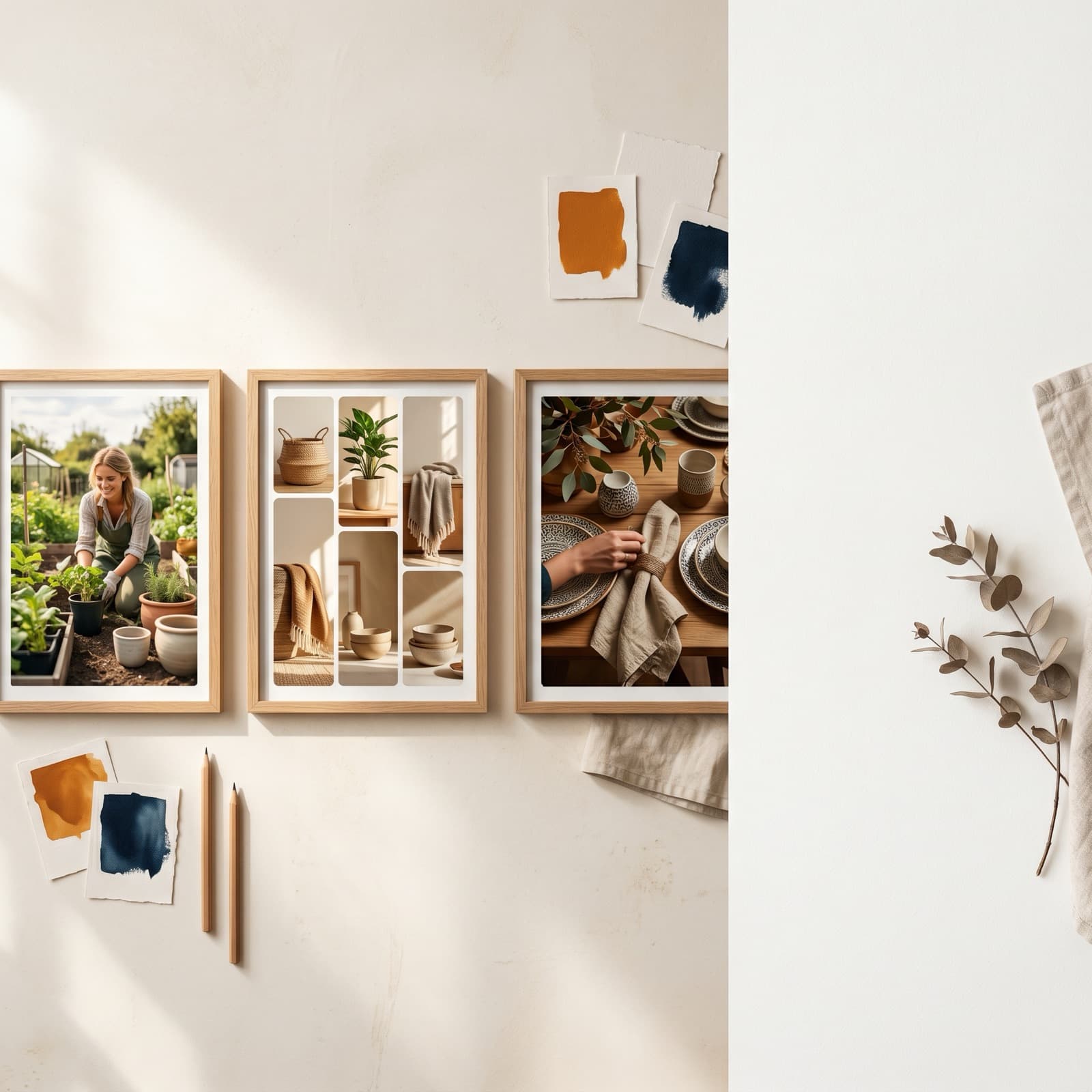
Pinterest ai ad creative 2026 wins on fresh Pin volume at 2:3. AI Vidia ships it across 48 brands, 14 countries, 70,342 AI images. Formats, benchmarks, cadence.
Pinterest ai ad creative 2026 rewards one thing above all else: a steady supply of fresh, native looking Pins shipped at the 2:3 ratio Pinterest favors. AI Vidia builds that supply for DTC and consumer brands across 14 countries, producing campaign-ready Pin sets at the volume Pinterest's fresh-content ranking now demands. This article gives the format benchmarks, the AI generation stack behind each Pin type, and a production cadence pulled from 70,342 AI images and 1,834 AI videos shipped for 48 brands inside EUR 2.4M+ in optimized paid media spend. Pinterest is a high commercial-intent discovery surface, so the brands winning on it in 2026 treat creative volume as the primary lever, not an afterthought.
What changed in Pinterest ad creative between 2024 and 2026
70,342AI IMAGES SHIPPED
1,834AI VIDEOS SHIPPED
48BRANDS
99.2%BRAND-SAFE PASS
Two platform shifts decide whether your pinterest ai ad creative compounds or stalls in 2026. First, Pinterest's ranking now rewards fresh Pins over republished evergreen assets, so a brand that recycles the same 8 Pins each month loses reach to brands that ship 30 to 60 new Pins per month. Second, Pinterest Performance+ campaigns automate bidding and placement, which moves the entire performance burden onto the creative; when targeting is automated, the Pin is the variable that decides cost per acquisition. The practical consequence is volume. A mid-market DTC brand spending EUR 8,000 to EUR 20,000 per month on Pinterest in 2024 could hold cost per click on roughly 10 fresh Pins per month, while the same brand in 2026 needs 30 to 60 fresh Pins per month to keep blended ROAS inside the same band.
That volume is not reachable with traditional studio photography on a weekly cadence. A single product photoshoot that yields 10 to 15 usable Pins costs EUR 2,000 to EUR 6,000 and takes 2 to 3 weeks from brief to delivery. AI generation collapses that to 30 plus on-brand variants per week at a fraction of the per-asset cost, which is the single strongest reason consumer brands moved their Pinterest creative supply to AI pipelines in the last 12 months.
Pinterest ad format benchmarks for 2026
The table below maps each Pinterest ad format to the AI generation stack that builds it, the recommended aspect ratio, the fatigue window in weeks, and a cost per acquisition index relative to a static product Pin baseline set to 100. Lower is better on the CPA index. These numbers are AI Vidia portfolio medians across Pinterest accounts in Q1 and Q2 2026, not Pinterest published figures. Read the index as a ranking signal: formats below 100 beat the static product Pin on average, and formats above 100 should run as supporting variants rather than as the primary control.
Pinterest format
What it does best
Best AI stack
Aspect ratio
Fatigue window
CPA index vs static Pin
Standard image Pin
Workhorse reach and shopping intent at lowest production cost
Nano Banana product still, brand-locked style
2:3
4 to 6 weeks
100
Idea-style multi-image Pin
Step sequences, before and after, recipe or how-to framing
Nano Banana set, consistent character system
2:3
5 to 7 weeks
92
Video Pin
Motion in the feed, demo and lifestyle context
Veo 3 short cut, Kling product motion
2:3 or 9:16
3 to 5 weeks
84
Collections ad
Hero plus product grid for catalog-led shopping
Nano Banana hero, product feed tiles
1:1 hero with grid
4 to 6 weeks
88
Showcase ad
Swipeable brand showcase for consideration
Nano Banana card set, locked palette
2:3 cards
5 to 8 weeks
96
Quiz ad
Interactive product match for first-time buyers
Nano Banana option cards, Veo 3 intro
2:3
6 to 9 weeks
90
Three reads sit inside that table. Video Pins carry the lowest CPA index at 84 because motion earns disproportionate distribution in a feed that is still mostly static, but they fatigue fastest, so they need the heaviest variant supply. Idea-style multi-image Pins beat the static product Pin by 8 index points because the sequential format holds attention longer, and they are cheap to batch once a brand has a locked character system. Static image Pins remain the volume workhorse: they set the baseline, they fatigue slowly, and they are where a brand should spend the bulk of its weekly Pin budget while video Pins do the heavy lifting on cost per acquisition.
The AI Vidia Pinterest Creative Fit Diagnostic
Formats are only useful when matched to the brand. Before any production starts, the AI Vidia team runs a five question diagnostic that decides which Pinterest formats belong in the next 90 day test matrix and which to skip. Each question has a direct answer, and a weak answer removes the matching format from the brief.
What is the monthly Pinterest spend tier. Under EUR 5,000 per month, run standard image Pins and one video Pin track only, because the supply chain cannot feed more formats without thinning each one below useful variant pressure. Between EUR 5,000 and EUR 15,000 per month, add Idea-style Pins and Collections ads. Above EUR 15,000 per month, run the full format set with weekly pruning.
How visual is the buying decision. Pinterest favors categories where the purchase is visually led, such as home, fashion, beauty, food, wedding, and DIY. If your product is bought on visual inspiration rather than spec comparison, weight the matrix toward lifestyle image Pins and video Pins. If the decision is spec led, weight toward Idea-style Pins that carry detail across multiple frames.
Is the brand style lock production ready. A style lock is a documented character system, lighting language, color palette, framing rules, and Pinterest-safe text zones. Without a production ready style lock, AI generated Pins drift off brand inside two production weeks and pull down the brand-safe pass rate. Settle the style lock before scaling format count.
How fast does the catalog turn over. Brands with frequent new SKUs or seasonal drops should weight toward Collections and Showcase ads that surface multiple products, because those formats absorb catalog change without a full reshoot. Brands with a stable hero range can run heavier on single-product image and video Pins.
What weekly fresh-Pin volume can the supply chain sustain. Pinterest ranking rewards freshness, so a format only earns a slot if the brand can feed it new variants every week. If sustained weekly output is under 15 Pins, hold the matrix to two formats; the rest will go stale before they accumulate enough distribution to matter.
Want a structured plan for your AI creative pipeline? 20-minute call, no pitch deck.
A concrete tell: Pinterest Pins keep earning impressions for months after publish, far longer than a Meta ad that fatigues inside days. That long half-life is an argument for more fresh Pins, not fewer, because each new Pin keeps compounding while the old ones still work. Brands that treat Pinterest as a recycling bin for Meta creative leave that compounding effect on the table.
The AI Vidia 14-Day Pinterest Pin Sprint
The diagnostic sets the format matrix. The sprint sets the clock. This is the production cadence the AI Vidia team runs per brand on an active Pinterest account once the formats are chosen.
Days 1 to 2: brief and style lock. Lock the format matrix from the diagnostic, confirm the brand style system, and map the next two weeks of Pins to seasonal and catalog priorities. Every Pin in the sprint maps to a target keyword cluster on Pinterest search, because Pinterest is a discovery surface and Pins are indexed against intent.
Days 3 to 6: batch generation. Generate the first batch of 20 to 40 Pins across the chosen formats against the style lock. Image Pins come from Nano Banana, video Pins from Veo 3 and Kling, and every asset runs the brand-safe QA pass before it enters the shared drive. Hold 20 percent of capacity in reserve for mid-sprint top ups.
Days 7 to 8: launch in a staggered wave. Publish Pins across the two weeks rather than dumping the full batch at once, because Pinterest ranking rewards a consistent fresh-Pin signal over a single spike. Tag each Pin to its keyword cluster and its destination URL at publish, not after.
Days 9 to 12: prune and reallocate. Read early signal on saves, outbound clicks, and cost per click. Cut any Pin below 60 percent of the format median, and move budget into the top quartile within 48 hours. Document every cut so the next sprint briefs against winners, not the mean of the batch.
Days 13 to 14: brief the next sprint. Pull the winning cohort, identify the visual and keyword patterns that drove saves and clicks, and write the next two week brief against those patterns. The sprint never restarts from a blank brief; it always inherits the prior winners.
What the numbers look like across 48 brands
The portfolio outcomes for pinterest ai ad creative sit inside a tight band when a brand runs the format matrix on a sustained weekly Pin supply. Brands that ship 30 plus fresh Pins per week across two or more formats land a median 2.4x ROAS on winning cohorts and a 38 percent average CTR lift on video creative, with a 99.2 percent brand-safe pass rate across 70,342 AI images and 1,834 AI videos shipped through Q1 2026. The IndianBites DTC food account is the published example of the same supply logic applied across paid social.
IndianBites, the Indian cuisine DTC food brand, was running a fast scaling paid account with a limited production budget and a creative supply chain that could not keep pace. In 11 weeks of AI Vidia production, the account shipped 142 AI ads, cut creative production cost by 62 percent, and held a 2.4x ROAS on the winning cohort across a 12x weekly test volume. The same brand-locked style system and weekly batch cadence carry directly to a Pinterest account, where fresh-Pin frequency matters even more than on Meta.
AI Vidia cut our creative production cost 62% in 90 days, and our win rate in paid social is higher than when we paid 10x more.
The benchmark to hold against your own Pinterest account is straightforward. Two or more native formats in the weekly Pin supply, a 4 to 6 week fatigue read per format, and a 48 hour reallocation lag from losers to winners. Brands that miss any of the three give back reach to Pinterest's freshness ranking and pay more per acquisition than the format mix should cost. The full hook and variant logic carries across channels, as set out in the AI content for Meta ads playbook.
When each Pinterest format wins
Use the formats in matched pairs, not as a single control. The strongest pairing for ecommerce DTC is a standard image Pin baseline with a video Pin pressure track, because the image Pins hold reach cheaply while the video Pins pull down cost per acquisition. For consideration-heavy categories such as furniture, travel, and high-ticket beauty, pair Idea-style multi-image Pins with Showcase ads so the buyer gets detail across frames before the click. Collections and Quiz ads belong in catalog-led and first-purchase contexts respectively, where the job is to route a new buyer to the right SKU rather than to win raw reach.
The single largest mistake mid-market brands make on Pinterest in 2026 is running a thin set of recycled Pins and blaming the channel when cost per acquisition stays flat. Pinterest pays out to consistent freshness and native format fit; a matrix of two strong formats fed weekly beats a pile of reposted Meta creative every time in the AI Vidia portfolio data. Volume, freshness, and native ratio are the three levers, and AI generation is what makes all three affordable at once. For the underlying volume mechanics, see the 100 variants per week cadence.
The next step on your Pinterest ad account
If the format matrix maps to a brand you run, the next step is a 30 minute scoping call. Book the call and the AI Vidia team will share a worked 90 day Pinterest plan with format mix, weekly Pin volume, keyword clusters, and a projected cost per acquisition range based on your current spend and vertical. The Pinterest side of an active retainer usually sits inside the AI image ads service, with the video Pin track drawn from the video pipeline. The performance benchmarks above come straight from the IndianBites case study and the wider AI Vidia portfolio.
Frequently asked questions
01What aspect ratio should Pinterest ad creative use in 2026?
The standard and best performing aspect ratio for Pinterest ad creative in 2026 is 2:3, which renders as 1000 by 1500 pixels in the feed. Vertical Pins at 2:3 take up more screen space than square or landscape formats and earn more saves and outbound clicks as a result. Video Pins can also run at 9:16 for a taller frame, but 2:3 remains the safe default across both image and video formats. Brands that repost square Meta creative to Pinterest leave distribution on the table because the format does not fill the vertical feed the way a native 2:3 Pin does.
02How many fresh Pins per month does a brand need on Pinterest in 2026?
A mid-market DTC brand spending EUR 8,000 to EUR 20,000 per month on Pinterest typically needs 30 to 60 fresh Pins per month to hold blended ROAS inside a stable band. Pinterest ranking now rewards a consistent fresh-content signal over republished evergreen assets, so recycling the same handful of Pins each month loses reach over time. Brands above EUR 20,000 per month usually push toward 60 plus fresh Pins per month spread across two or more formats. That volume is the single strongest driver of the move to AI generated creative for Pinterest in the last 12 months because studio photography cannot sustain it affordably.
03Is AI generated creative allowed in Pinterest ads?
Yes, AI generated images and video are permitted in Pinterest ads as long as the creative meets Pinterest advertising policies on accuracy, safety, and prohibited content. The practical constraint is brand safety and quality rather than permission, since low quality or off-brand AI assets get poor distribution and waste spend. AI Vidia runs a brand-safe QA pass on every asset before it ships, holding a 99.2 percent brand-safe pass rate across 70,342 AI images and 1,834 AI videos. The right approach is a locked brand style system that keeps AI Pins consistent and on-brand across hundreds of assets rather than one-off generations.
04Which Pinterest ad format has the lowest cost per acquisition?
Across the AI Vidia portfolio in 2026, video Pins carry the lowest cost per acquisition index at 84 against a static product Pin baseline of 100. Motion earns disproportionate distribution in a feed that is still mostly static images, which is why video Pins outperform on cost per acquisition despite higher production effort. The tradeoff is a shorter fatigue window of 3 to 5 weeks, so video Pins need the heaviest fresh-variant supply of any format. The strongest setup pairs a cheap static image Pin baseline for reach with a video Pin pressure track that pulls down blended cost per acquisition.
05What is the AI Vidia Pinterest Creative Fit Diagnostic?
It is a five question filter the AI Vidia team runs before any Pinterest production starts, and it decides which Pinterest ad formats belong in the test matrix for the next 90 days. The five questions cover the monthly spend tier, how visual the buying decision is, the readiness of the brand style lock, how fast the catalog turns over, and the sustainable weekly fresh-Pin volume. A weak answer on any question removes the matching format from the brief so the brand never spreads its supply too thin. The diagnostic produces a concrete format matrix and a weekly Pin volume target that the 14 day production sprint then runs against.
Next step
Get your first 12 on-brand AI variants in 14 days.
Book a 20-minute strategy call with the AI Vidia team. No pitch deck, just a structured plan for your creative output.