
AI/Vidia
All insights

AI Creative Approval Workflow Framework

An ai creative approval workflow tiers every asset by risk so AI Vidia clears most creative in 48 hours at a 99.2% brand-safe pass rate.

Founder, AI Vidia
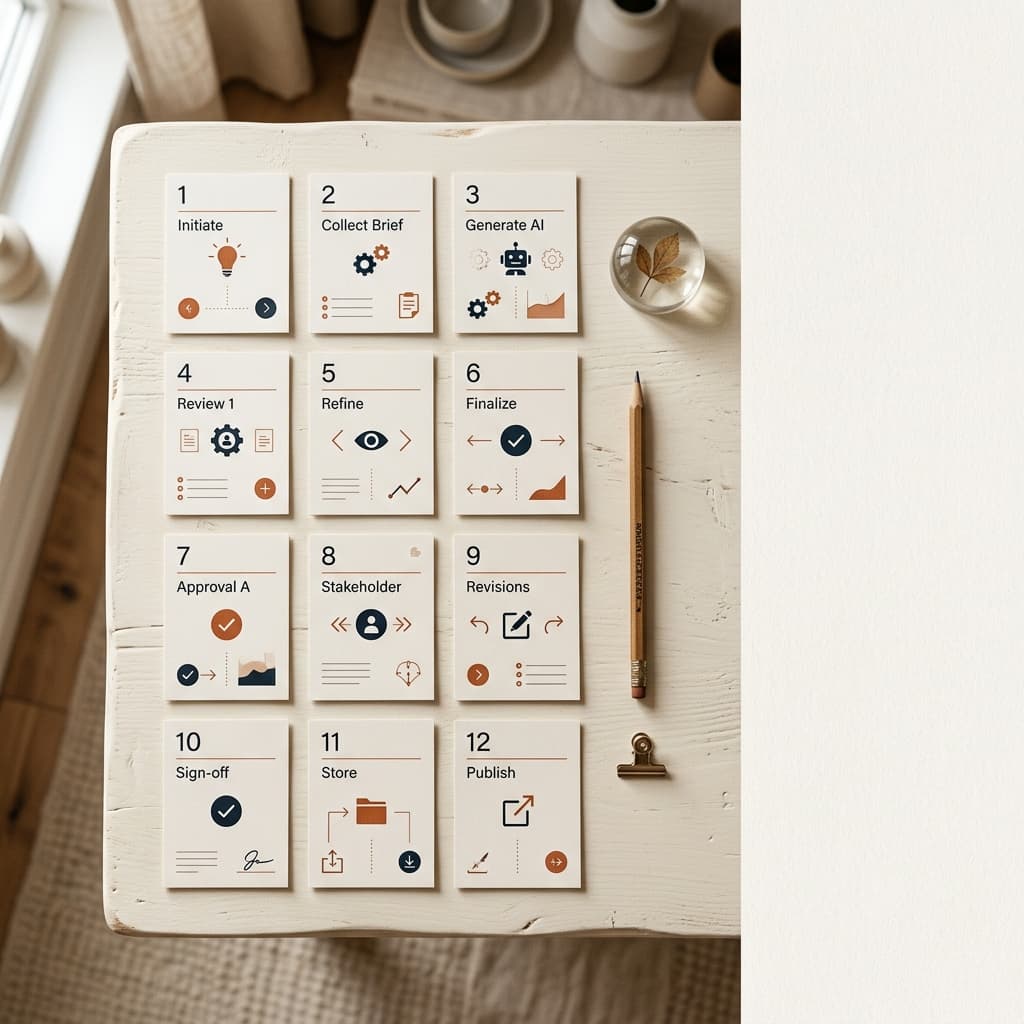
Overhead flat lay of small numbered paper cards arranged as approval tiers on a warm off-white Nordic surface.
On this page8 sections

AI Vidia runs an ai creative approval workflow that moves a brand from brief to ad-ready asset in about 48 hours, without the email threads and sign-off chains that stall most paid social teams. An ai creative approval workflow is the defined path every image, video, and variant travels from first draft to live ad: who reviews it, what they check, and how fast it clears. AI Vidia has shipped 1,834 AI videos and 70,342 AI images across 48 brands in 14 countries on this exact workflow, at a 99.2% brand-safe pass rate. The workflow is not a folder of comments. It is a tiered system that routes each asset to the lightest review that still protects the brand, so creative testing dies in the ad account, not in the approval queue.

What a broken approval workflow actually costs

48hCONCEPT TO CREATIVE
99.2%BRAND-SAFE PASS RATE
1,834AI VIDEOS SHIPPED
70,342AI IMAGES SHIPPED

The approval queue is where creative velocity goes to die. Meta for Business reports that ad sets with 5 or more creative variations produce 30 to 50 percent lower CPA than ad sets with 1 or 2. To feed that, a brand needs to ship new variants weekly. If the review process takes six business days, the team ships one batch a month and the algorithm never sees enough fresh signal. The Content Marketing Institute reported in 2025 that 73 percent of B2B marketing teams cite producing enough content as their biggest challenge, and approval drag is a large hidden part of that number.

The cost is concrete. A brand spending EUR 40,000 a month on paid social with a stalled review loop typically tests 4 to 6 concepts a month instead of 30 or more. That gap suppresses ROAS because winners surface later and fatigued creative runs longer. HubSpot reports that AI-native creative pipelines run with about 40 percent fewer revision cycles, and most of that saving comes from fixing the approval workflow, not the rendering.

External research backs the structural case. McKinsey reports that AI in creative production drives a 30 to 50 percent cost reduction and a 3 to 5x output increase, but only when the pipeline around it can clear the extra volume. Deloitte reports 67 percent faster time to market for AI-enabled creative teams, and time to market is mostly approval time, not render time. A workflow that cannot route assets by risk caps both numbers, because the bottleneck moves from the camera to the inbox. Fixing the inbox is what turns a tooling upgrade into an actual output gain.

Four approval workflow models, compared

Most brands run one of four approval models. The right one depends on monthly spend, the number of reviewers, and how brand-sensitive the category is. The table below compares them on the metrics that decide throughput.

Approval modelTypical clear timeRevision roundsWeekly throughputBrand-safety risk
Ad hoc email and chat4 to 8 business days3 to 54 to 8 assetsHigh, no record
Shared drive with comments3 to 6 business days2 to 410 to 20 assetsMedium
Sequential sign-off chain5 to 10 business days2 to 38 to 15 assetsLow but slow
AI Vidia tiered async review1 to 2 business days0 to 140 to 150 assetsLow, 99.2% pass rate

Ad hoc email and chat feels fast for a two person team and collapses past 10 assets a week, because nobody can reconstruct what was approved or why. Shared drives improve the record but still gate every asset behind the same slow human read. Sequential sign-off chains are common in regulated and enterprise brands; they protect the brand but add a full day per reviewer, so a four person chain alone costs four business days. The AI Vidia tiered async model wins on throughput because it does not treat all assets as equal risk: a ratio cut of an already approved hero clears in minutes, while a net-new concept gets a full read.

The AI Vidia Creative Approval Tiering Model

This is the strategic model that decides how much review each asset earns. The principle is simple: review intensity should match risk, not asset count. AI Vidia sorts every asset into one of four tiers before a human ever opens it.

  1. Tier 0, auto-clear. Format and ratio cuts of an already approved master asset move straight to the ad account. The 9:16, 1:1, and 4:5 versions of an approved 16:9 ad carry no new creative risk, so they clear on an automated brand-safety check alone.
  2. Tier 1, single async read. New variants inside an approved concept, such as a fresh hook on a proven hero, get one reviewer and a 24 hour window. Most weekly volume sits here, and one clear yes or no keeps it moving.
  3. Tier 2, paired review. Net-new concepts get a creative lead and a brand owner reviewing in parallel, not in sequence. Parallel review removes the queue effect that makes sign-off chains slow.
  4. Tier 3, full compliance read. Claims, pricing, regulated categories, and anything with a human likeness route to a compliance reviewer. This tier is slower on purpose, and keeping it small is the point of the whole model.

The tiering decision is made at brief time, not at review time. When the brief names the tier, the reviewer knows their job before the asset lands, and the asset never waits in an undefined queue.

Want a structured plan for your AI creative pipeline?
20-minute call, no pitch deck.
Book a call

Kevin's take

The reframe matters because brands keep trying to fix the wrong layer. They buy a faster generator, then funnel its output into the same one-lane approval road. Speed at the front of the pipe just lengthens the queue at the back. The fix is structural, and it is cheaper than any tool.

The AI Vidia 48-Hour Approval Sprint

This is the tactical sequence that runs the model every week. It compresses the path from brief to live ad into two business days for the bulk of assets, while still giving high-risk work the read it needs.

  1. Brief with tier tags. Every brief names the tier and the single reviewer for each asset before production starts. The reviewer is booked, not surprised, so nothing waits on an unassigned read.
  2. Batch render and pre-check. Assets render in a batch and pass an automated brand-safety and spec check before any human sees them. This removes the most common revision reason, which is a spec or safety miss, not a taste call.
  3. Async review window. Reviewers clear their tier inside a fixed 24 hour window using approve, fix, or kill, with no live meetings. A fix carries one specific instruction, which keeps revision rounds at zero or one.
  4. Single revision pass. Flagged assets get one corrective pass, not an open thread. If an asset needs more than one pass, it is reclassified to a higher tier and re-briefed rather than looped.
  5. Ship and log. Cleared assets go live and the decision is logged against the brand-safe record. The log is what lets the next batch clear faster, because precedent answers most questions before they are asked.

Proof from live accounts

AI Vidia built this workflow on real spend, not a whiteboard. Across 48 brands and EUR 2.4M or more in optimized ad spend, the tiered model holds a 99.2% brand-safe pass rate while clearing 40 to 200 video ads per brand per month. For IndianBites, a fast-growing DTC food brand, the AI Vidia team paired a brand-locked style system with this approval sprint and shipped 142 AI ads in 11 weeks. The result was a 62 percent cut in creative production cost and 2.4x ROAS on winning cohorts, with a 12x jump in weekly test volume. The approval workflow is what let that test volume actually reach the ad account.

The win rate in paid social is higher than when the brand paid 10x more, and the reason is simple: more on-brand variants reaching the account, faster.

You can read the full breakdown of the brand-locked system and weekly cadence in the IndianBites case study and its 11 week results. The same structure powers the AI Vidia brief-to-asset pipeline that ships 200 ads a month, where approval is the step that decides whether volume is real or theoretical.

A second pattern shows up on a Nordic ecommerce brand that ran the same model with a three person team. Asset output moved from 20 a month to 210 a month, a 10.5x jump, while cost per asset fell from 2,200 DKK to 320 DKK. Campaign launch compressed from three weeks to five business days, variants per campaign rose from 4 to 35, and ROAS lifted 28 percent in 90 days across three languages. The approval workflow, not the generator, was the change that made that volume reviewable in the first place.

When each model wins

Match the model to the account, not to a preference. The rules below are concrete.

Use ad hoc email and chat only if you ship fewer than 8 assets a week and have one reviewer. Use a shared drive with comments if you ship 10 to 20 assets a week and need a record but not speed. Use a sequential sign-off chain only when a regulator or legal team requires named, ordered approval, and accept the time cost. Use the AI Vidia tiered async model when weekly volume passes 20 assets, when more than two people review, or when paid social spend is high enough that a stalled test cadence costs more than the workflow. A clear rule of thumb: if approval is taking longer than rendering, the workflow is the problem, and a good tier-tagged creative brief template for AI ads fixes more of it than a faster model ever will.

Next step

If your test cadence is stalling in review rather than production, the fastest fix is to tier your assets and book reviewers at brief time. AI Vidia runs this workflow as part of every AI video ad production engagement, so the approval structure ships with the creative. To map your current approval drag and see where the tiers would cut it, book a Performance Retainer call with the AI Vidia team.

Frequently asked questions

01What is an AI creative approval workflow?
An AI creative approval workflow is the defined path every AI-generated image, video, and variant follows from first draft to a live ad. It sets who reviews each asset, what they check, and how fast it must clear. The point of the workflow is to match review effort to creative risk instead of reviewing every asset the same way. AI Vidia runs a four tier version of this workflow that clears most assets in one to two business days.
02How long should creative approval take?
Low-risk assets such as ratio cuts of an already approved master should clear in minutes through an automated brand-safety check. New variants inside an approved concept should clear within 24 hours on a single async read. Net-new concepts and regulated claims need a longer paired or compliance review, usually one to two business days. As a rule, if approval is taking longer than rendering the asset, the workflow itself is the bottleneck.
03Why do creative approvals slow down paid social testing?
Paid social rewards volume, because Meta ad sets with five or more creative variations show 30 to 50 percent lower CPA than ad sets with one or two. A slow approval loop means a team ships one batch a month instead of weekly, so the algorithm never sees enough fresh signal. Winners surface later and fatigued creative runs longer, which suppresses ROAS. The fix is structural: tier the assets so most clear fast and only high-risk work waits.
04What is the AI Vidia Creative Approval Tiering Model?
It is a strategic model that sorts every asset into one of four review tiers before a human opens it. Tier 0 auto-clears format and ratio cuts of approved masters. Tier 1 gives new variants a single async read inside 24 hours, and Tier 2 gives net-new concepts a paired parallel review. Tier 3 routes claims, pricing, and regulated work to a full compliance read, and keeping that tier small is the entire point of the model.
05When should a brand move to a tiered async approval workflow?
A brand should switch once weekly creative volume passes about 20 assets, once more than two people review work, or once paid social spend is high enough that a stalled test cadence costs real money. Below that, an ad hoc or shared-drive process is usually enough. Regulated categories that require named ordered sign-off are the main exception and may need a sequential chain. AI Vidia ships the tiered workflow as part of every video ad engagement so the structure arrives with the creative.

Next step

Get your first 12 on-brand AI variants in 14 days.

Book a 20-minute strategy call with the AI Vidia team. No pitch deck, just a structured plan for your creative output.

Book a call

Read next