
AI/Vidia
All insights

TikTok Spark Ads vs Meta Advantage Plus 2026

TikTok Spark Ads vs Meta Advantage Plus in 2026: the channel allocation table, AI creative picks, fatigue windows, and the AI Vidia diagnostic and cadence.

Founder, AI Vidia
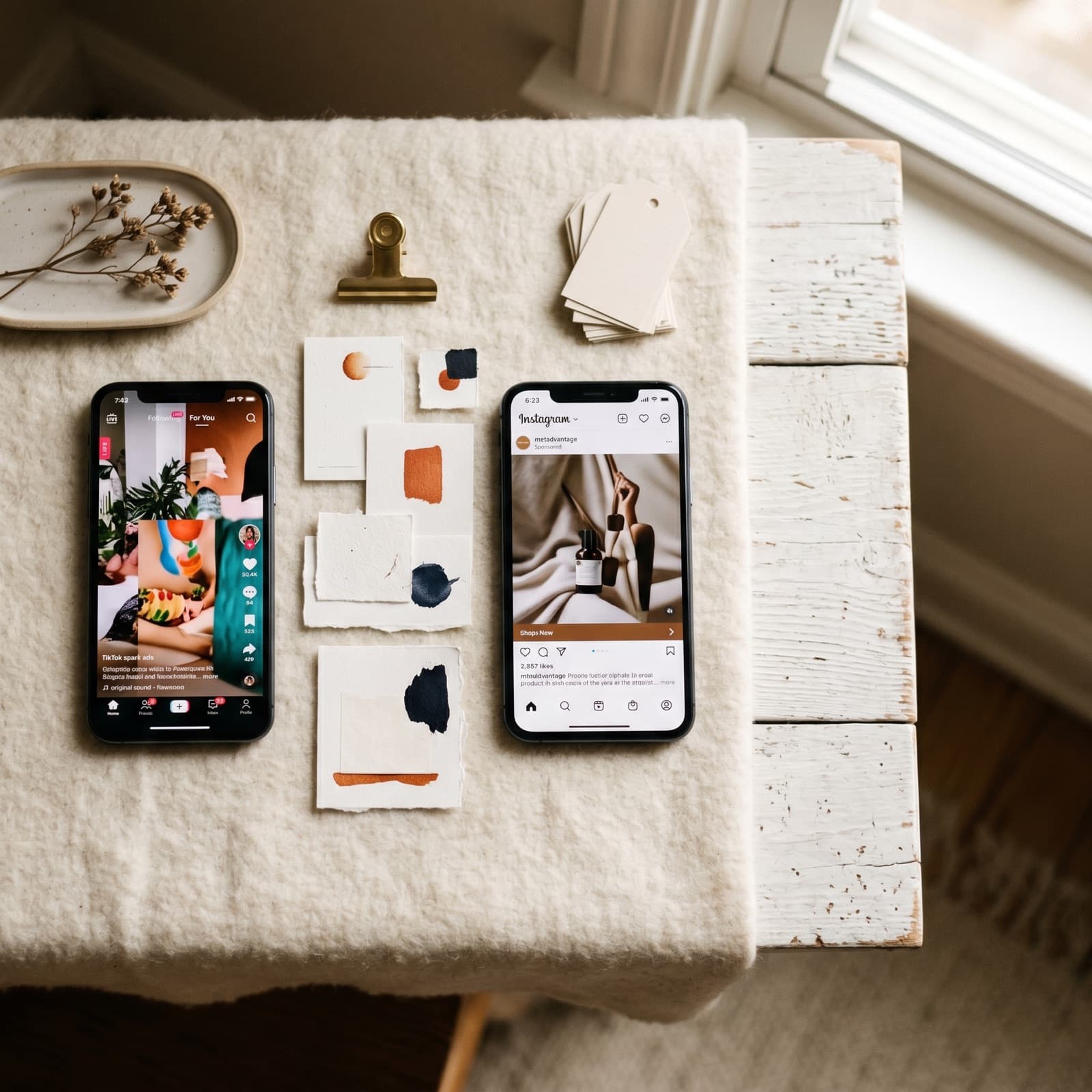
Editorial overhead flat lay of two phone frames on a warm off-white Nordic surface, one showing a TikTok Spark Ads post and one showing a Meta Advantage Plus placement, with paper variant cards between them.
On this page8 sections

TikTok Spark Ads vs Meta Advantage Plus is a channel allocation decision, not a single winner. Spark Ads turn real organic TikTok posts into paid placements, while Meta Advantage Plus is Meta's automated suite for targeting, placement, and budget across Facebook and Instagram surfaces. AI Vidia runs both stacks across 48 brands in 14 country markets, with EUR 2.4M+ in paid social spend optimised between 2024 and Q1 2026. The short answer for most DTC brands: TikTok Spark Ads win on creator-led social proof and top of funnel discovery, Meta Advantage Plus wins on lower funnel conversion volume and catalog scale, and the brands that hold a 2.4x median ROAS run both from one shared AI creative supply chain. TikTok Spark Ads keep the likes, comments, and follows attached to the original post, so they compound social proof that a standard Meta Advantage Plus upload does not carry.

What the TikTok Spark Ads vs Meta Advantage Plus choice actually decides

1,834AI VIDEOS SHIPPED
70,342AI IMAGES SHIPPED
2.4xMEDIAN ROAS
EUR 2.4M+SOCIAL SPEND MANAGED

The choice decides where your AI creative budget compounds and where it leaks. Spark Ads and Advantage Plus are not the same kind of product. Spark Ads is a TikTok ad format that takes a live organic post, yours or a creator's with an authorisation code, and pushes paid spend behind it while the post keeps its native engagement. Meta Advantage Plus is an automation layer that decides who sees an uploaded ad, on which placement, at what budget, across Feed, Reels, Stories, and Shopping catalogs. One is a creative format. The other is a delivery engine. Treating them as direct rivals is the first mistake that costs DTC brands paid revenue in 2026.

The stakes are concrete. A brand that pours all of its budget into Meta Advantage Plus often starves its top of funnel and watches blended customer acquisition cost climb 20 to 40 percent as audiences saturate. A brand that runs only TikTok Spark Ads tends to win cheap reach but undershoots lower funnel conversion, because Spark Ads inherit organic post structure rather than conversion-optimised ad structure. The 2026 platform shifts sharpen this. TikTok creative fatigue now turns over in 4 to 7 days in most consumer verticals, Meta Reels fatigue sits at 5 to 7 days, and both platforms enforce AI content disclosure that can cut delivery 40 to 90 percent on an unlabelled synthetic asset. Volume and discipline decide the outcome, not the channel label.

TikTok Spark Ads vs Meta Advantage Plus: the 2026 decision table

The two channels diverge on eight decision factors that matter to a media buyer and a creative lead. The table below compares them on AI Vidia performance data across 48 brands in 14 country markets, with the recommendation the AI Vidia team applies as a default before a brand-specific test overrides it. Read it as an allocation guide, not a verdict.

Decision factorTikTok Spark AdsMeta Advantage PlusAI Vidia default
Creative originMust start as an organic post, yours or a creator'sStandard creative uploaded to Ads ManagerBuild once, post organically for Spark, upload for Advantage Plus
Best AI creative typeCreator-style UGC, sound-on vertical video, avatarsStatic product, catalog sets, short product-in-motionOne concept, channel-specific cuts and hooks
Audience modelInterest and behaviour signals, strong discovery reachAutomated audience expansion plus catalog signalsTikTok for discovery, Meta for conversion
Creative fatigue window4 to 7 days5 to 14 days by surfaceRefresh TikTok first, Meta second
Variants per week per brand15 to 308 to 20 per surface30 or more combined
ROAS lift band1.3x to 2.4x1.5x to 3.1x2.4x median on winning cohorts
AI disclosure triggerRealistic AI content label plus organic post detectionAI information label on real people, places, or eventsTag at build time on both
Best funnel stageTop and mid funnelMid and lower funnelRun both, not one

Three rows carry the decision. Creative origin is the structural difference: because Spark Ads must begin as a real post, the AI creative has to read as native social content, not as a polished ad, which is why creator-style AI UGC and avatar formats outperform glossy product films on TikTok. Variant cadence is the cost driver: a single channel already demands 15 to 30 fresh assets a week, and a three-designer team stretched at 40 assets a month cannot feed both channels by hand. The ROAS bands overlap enough that channel choice alone rarely explains a result; the brands that win run a high enough variant volume on both that fatigue never starves an ad set. AI Vidia builds creator-native AI UGC through its AI UGC ads service so the same concept ships to both stacks in the same week.

The AI Vidia Channel Allocation Diagnostic

Before a brand splits a single euro between TikTok Spark Ads and Meta Advantage Plus, the AI Vidia team runs a 6-step allocation diagnostic. It decides the budget split, the creative type per channel, and the variant cadence each channel needs to avoid fatigue. It runs in under 60 minutes for a mid-market brand and produces a one-page allocation brief that the media buyer and creative lead approve together.

  1. Separate the format from the engine. Write down what each channel is doing for the brand: Spark Ads as a creative format that boosts native social posts, Advantage Plus as a delivery engine that automates targeting and budget. This stops the team from treating two different tools as interchangeable line items.
  2. Rank channels by funnel job, not by gut. Pull 90 days of platform data and assign each channel a primary funnel job. In most DTC accounts TikTok Spark Ads carry discovery and new-audience reach, while Meta Advantage Plus carries conversion and catalog. Set the budget split to the job each channel does best, not to last week's headline ROAS.
  3. Match AI creative type to channel physics. Assign creator-style AI UGC, sound-on vertical video, and avatars to Spark Ads, and static product, catalog sets, and short product-in-motion to Advantage Plus. The same concept gets different cuts, hooks, and ratios for each channel rather than one asset reused everywhere.
  4. Set variant cadence to the faster fatigue clock. Take the fatigue window from the decision table and size weekly variant volume to it. TikTok at a 4 to 7 day window needs 15 to 30 fresh variants per week, and Meta needs 8 to 20 per surface, so the combined target lands at 30 or more variants per brand per week.
  5. Tag disclosure at build time on both channels. Apply the AI content label to any synthetic depiction of a real person, real place, or real event before the asset goes live on either platform. Self-labelling protects delivery, while classifier-triggered labels cut reach 40 to 90 percent within 48 hours.
  6. Lock one cross-channel reporting view. Choose a single blended reporting model that reads TikTok and Meta together, then freeze it for 90 days. Switching attribution windows mid-test invalidates the channel comparison the rest of the diagnostic depends on.
Want a structured plan for your AI creative pipeline?
20-minute call, no pitch deck.
Book a call

Kevin's take: stop framing it as TikTok versus Meta

The mechanism is simple. Both TikTok and Meta auctions reward fresh, relevant creative, and both punish fatigue with rising costs inside a week. A brand that can only refresh one channel will always see the other decay, then conclude that the decayed channel does not work. AI Vidia removes the constraint by producing channel-native AI creative on both stacks from one brief, which turns the allocation question into a throughput question.

The AI Vidia Dual-Channel Weekly Variant Cadence

The diagnostic decides the split. The cadence below is how the AI Vidia team ships against it, week after week, with one explicit handoff between creative and media buying on each working day. It is a 5-day loop tuned to the faster TikTok fatigue clock so neither channel ever runs dry.

  1. Monday: dual-channel brief and model assignment. The media buyer flags the discovery target for TikTok and the conversion target for Meta. The creative lead assigns AI UGC and avatar formats to Spark Ads, static and catalog formats to Advantage Plus, then breaks the brief into batch tickets per channel.
  2. Tuesday: batch generation across models. Production runs creator-style video for TikTok and product and catalog assets for Meta, generating 3 to 4 times the final variant count to allow a hard brand-safe pass. Hooks and ratios are cut per channel in the same session.
  3. Wednesday: brand-safe pass and disclosure tagging. Every variant runs a 6-point check against the brand style lock, and any depiction of a real person, place, or event gets the AI content label on both platforms. Variants that fail the check are killed, not reworked, to protect the 99.2 percent brand-safe pass rate.
  4. Thursday: post organically for Spark, upload for Advantage Plus. TikTok variants are posted to the brand or creator handle so they qualify as Spark Ads, while Meta variants enter Ads Manager grouped by Advantage Plus surface. Authorisation codes for creator posts are collected the same day.
  5. Friday: read winners and seed next week. The media buyer pulls performance at 24, 48, and 72 hour marks against each channel's fatigue window. Winning cohorts seed Monday's brief, and the bottom quartile is retired before the weekend so the next batch starts clean. The full scale-out cadence appears in the 2026 TikTok AI hook library.

Proof: what the dual-channel stack ships

AI Vidia's dual-channel stack has shipped 1,834 AI videos and 70,342 AI images across 48 brands in 14 country markets, with EUR 2.4M+ in paid social spend optimised against it. The median tested winning cohort sits at 2.4x ROAS, and the brand-safe pass rate holds at 99.2 percent across the full inventory. IndianBites is the public case: a DTC food brand with a limited production budget and a Meta account starving for fresh creative, where traditional food photography could not keep up with the weekly testing cadence. The AI Vidia team built a brand-locked style system, then shipped 142 AI ads in 11 weeks at a production cost 62 percent lower than the legacy setup, with 2.4x ROAS on the winning cohort and 12 times the weekly test volume.

The channel debate is a symptom of a starved creative supply chain. Fix the supply chain and the debate disappears, because you can finally afford to win on both.

Kevin Dosanjh, founder, AI Vidia

When TikTok Spark Ads win and when Meta Advantage Plus wins

The diagnostic and the cadence answer most cases. The edges come down to three decision rules that tilt the split one way or the other.

Weight the split toward TikTok Spark Ads when the brand sells a visually demonstrable product to a consumer audience, when discovery and new-audience reach are the current bottleneck, and when the brand has, or can license, creator content that AI UGC can extend. Spark Ads compound the creator's existing social proof, which a fresh Meta upload cannot replicate, and they tend to deliver cheaper reach at the top of the funnel.

Weight the split toward Meta Advantage Plus when the brand runs a large product catalog, when lower funnel conversion volume and retargeting are the priority, and when the account already has strong pixel and catalog signal for the automation to act on. Advantage Plus turns a deep variant library into broad auction coverage, which is where the 1.5x to 3.1x ROAS band lives.

Run both at a roughly even split, refreshing TikTok first, when the brand is scaling spend past the point where one channel saturates, or when blended customer acquisition cost is climbing on a single-channel program. This is the configuration most growth-stage DTC brands need, and it is the one that holds the 2.4x median ROAS in AI Vidia's data.

Next step

Most DTC and consumer brands lose 15 to 35 percent of their potential paid social ROAS in 2026 because their creative supply chain cannot feed both TikTok and Meta at the cadence each channel demands. AI Vidia closes that gap with the brief-to-asset pipeline that produced the 1,834 AI videos and 70,342 AI images already in flight across 48 brands. Book a Performance Retainer scoping call at aividia.dk/book to run the allocation diagnostic against your TikTok and Meta accounts, or read the companion Meta Advantage Plus AI creative stack guide for the surface-by-surface model picks. For the public results, see the IndianBites 11-week paid social teardown.

Frequently asked questions

01What is the difference between TikTok Spark Ads and Meta Advantage Plus?
TikTok Spark Ads are a paid format that boosts an existing organic TikTok post, either your own or a creator's post you hold an authorisation code for, so the ad keeps its original likes, comments, and follows. Meta Advantage Plus is an automated campaign suite that optimises targeting, placement, and budget across Facebook and Instagram using creative you upload to Ads Manager. The core difference is origin, because Spark Ads must start as a real social post while Advantage Plus runs standard ad creative through Meta automation. AI Vidia treats them as two ends of one funnel rather than competitors, feeding both channels from a single brand-locked AI creative pipeline.
02Which channel gives better ROAS for DTC brands in 2026, TikTok Spark Ads or Meta Advantage Plus?
Neither channel wins on ROAS in isolation, because the answer depends on funnel stage and creative supply rather than the channel name. Meta Advantage Plus typically posts the higher last-click ROAS on lower funnel conversion and catalog campaigns in the markets the AI Vidia team tracks. TikTok Spark Ads usually win on top of funnel discovery, creator-led social proof, and new audience reach that often converts later on Meta. Across 48 brands AI Vidia holds a 2.4x median ROAS on tested winning cohorts by running both channels from one creative supply chain rather than picking one.
03Do TikTok Spark Ads need different AI creative than Meta Advantage Plus?
Yes, the two channels reward different AI creative even when the product is identical across both. TikTok Spark Ads perform best with creator-style, sound-on, vertical video that looks native to the feed and reads as a real post, which is why AI generated UGC and avatar formats fit Spark Ads well. Meta Advantage Plus absorbs a wider mix, from static product images on Feed and catalog to short product-in-motion video on Reels and Stories. AI Vidia produces both from one brief, then cuts channel-specific ratios and hooks so the same concept ships to both stacks inside the same week.
04How many AI ad variants do I need per week for TikTok Spark Ads and Meta Advantage Plus?
Variant volume tracks the creative fatigue window of each channel, and both windows compressed during 2026. TikTok feeds fatigue fastest, so Spark Ads usually need 15 to 30 fresh variants per week per brand to stay ahead of a 4 to 7 day window. Meta Advantage Plus holds slightly longer, with 8 to 20 variants per week sufficient depending on the surface and the audience size. AI Vidia ships 30 or more variants per brand per week across both channels combined, which is the throughput most in-house teams of three designers cannot reach by hand.
05Are TikTok Spark Ads and Meta Advantage Plus subject to AI content disclosure rules?
Both platforms require disclosure on AI generated depictions of real people, real places, or real events, but their enforcement differs in practice. Meta applies an AI information label and can cut delivery 40 to 90 percent within 48 hours when its classifier flags an unlabelled synthetic asset. TikTok requires creators and advertisers to label realistic AI generated content and applies its own automated detection on Spark Ads sourced from organic posts. AI Vidia tags every qualifying asset at build time on both channels, which protects delivery and keeps the 99.2 percent brand-safe pass rate intact across 70,342 AI images shipped.

Next step

Get your first 12 on-brand AI variants in 14 days.

Book a 20-minute strategy call with the AI Vidia team. No pitch deck, just a structured plan for your creative output.

Book a call

Read next