

All insights

Creative is the new targeting: what Meta and TikTok actually want from e-commerce advertisers

Automated Meta and TikTok campaigns pick the audience, so your creative decides who sees each ad. Here are the budgets, ad counts, refresh rules and KPIs.

Kenneth Dosanjh
Founder and Creative Director, AI Vidia · Lecturer, Business Academy Copenhagen
A woman points at one of three phones showing vertical sneaker ads while a colleague holding a coffee cup looks on, beside a laptop showing dozens more variants. AI-generated image.
Two colleagues review vertical video variants of the same product. Image generated with AI.
On this page11 sections

Marketing in 2026 means operating a system whose distribution layer someone else owns. Twenty years ago the marketer chose the medium, the placement, the audience and the message. Today, in their default automated campaign types (Advantage+ on Meta, Smart+ on TikTok), the platforms choose the placement and the audience in real time. That is why "creative is the new targeting" has become the shorthand of 2026: the ads you supply are now the main signal deciding who sees them.

What the marketer still controls has narrowed to three inputs: the creatives going in, the conversion data coming back, and the budget that connects them. The job is no longer to craft the one right message for the one right segment. It is to run a production and testing system:

  • supply a steady flow of varied, realistic creative;
  • feed the platform clean purchase data, so it optimises toward money rather than clicks;
  • keep the structure simple enough that each ad set learns;
  • read results on the metrics that reflect profit;
  • retire creative the moment it fatigues.

Creative is also the biggest lever. NCSolutions analysed nearly 450 consumer packaged goods (CPG) campaigns across digital and TV. It attributed 49 percent of incremental sales lift to creative, more than reach, targeting and recency combined (14, 11 and 5 percent), a share unchanged since its 2017 study.

Generative AI has just made that lever cheap. The question is how to use it at a volume the platforms reward and a quality consumers accept, within the EU disclosure rules that apply from 2 August 2026.

I lecture at Business Academy Copenhagen and research how marketing teams, especially in Danish SMEs, adopt AI. This article tests Meta's and TikTok's claims against independent evidence and ends with an operating model for your own account.

Why is creative the new targeting on Meta and TikTok?

Meta's Andromeda-based delivery and TikTok's Smart+ campaigns now pick which ad each person sees, and they use the ads themselves to find the audience. Meta's own guidance names creative diversification, not niche targeting, as the best lever for finding audiences.

Meta defines creative diversification as "an advertising strategy where marketers create unique campaign assets tailored to different potential customer personas or use cases" (Meta for Business, December 2025). In practice that means distinct concepts for distinct buyers, not small tweaks of one idea. See how to plan distinct creative concepts for Meta broad targeting.
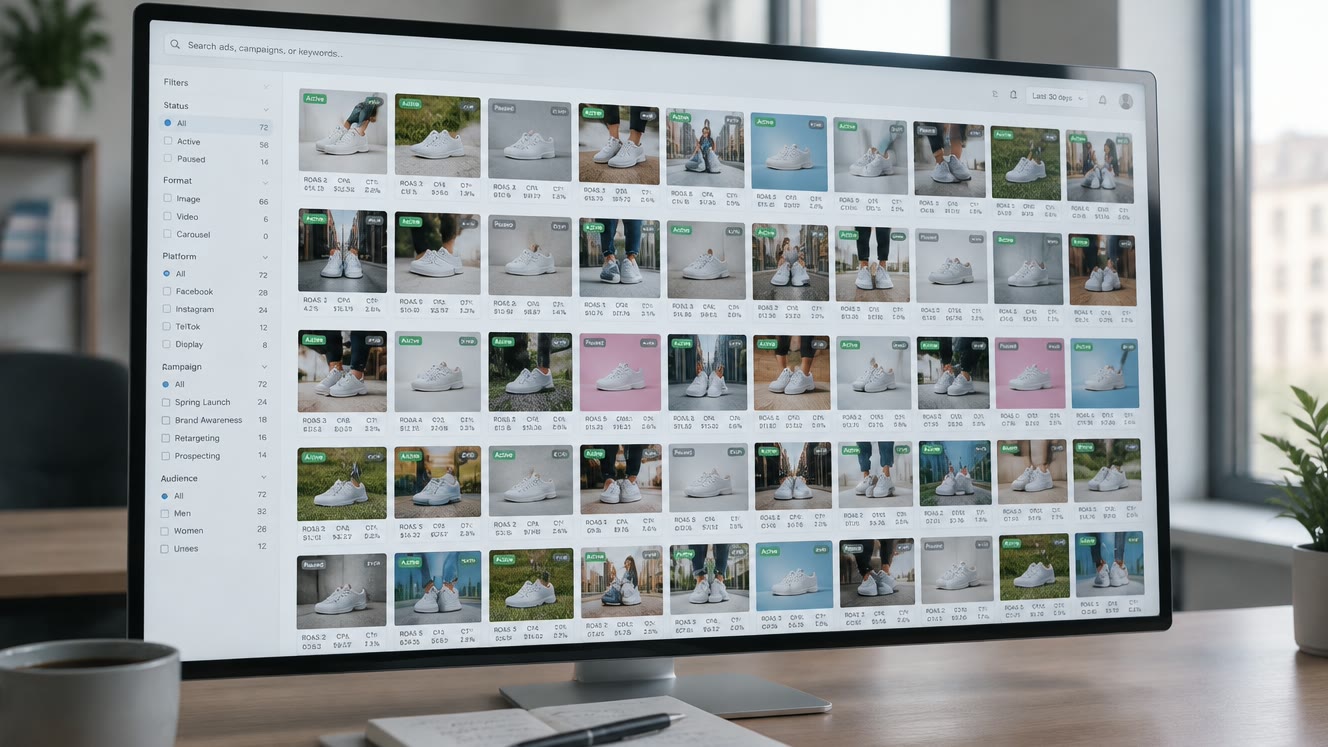
A monitor shows an ad library grid of about 50 white sneaker ads, each labelled with ROAS, CPA and CTR.
An ad library in 2026: dozens of variants of the same product, each with its own ROAS, CPA and CTR, and the algorithm deciding which one each person sees. Fictional interface and figures. Image generated with AI.

What Meta has published

In December 2024 Meta's engineering team described Andromeda, its new retrieval engine for ads (Meta Engineering). The system "is designed to maximize ads performance by utilizing the exponential growth in volume of eligible ads available to the retrieval stage".

Meta says Andromeda, rolled out in the second half of 2024, made its ad retrieval models 10,000 times more complex. In April 2025 its business blog drew the conclusion: the focus "has shifted from niche targeting to creative diversification as the best lever to find the most relevant audiences".

On the July 2026 earnings call, CFO Susan Li credited advances in Meta's user understanding models, plus the GEM ranking model and sequence learning. Together they "generated an 8.3% increase in ad clicks and a 15.7% uplift in conversions on Facebook". These are Meta's own, self-reported numbers.

What TikTok has published

TikTok's Creative Jumpstart handbook (August 2023) states that "creative refresh frequency is the #1 factor that determines the lifespan of an ad group" (TikTok Creative Center). Its Smart+ suite, announced at Advertising Week on 7 October 2024, automates targeting, bidding and creative selection across web, catalog and app campaigns (TikTok Newsroom).

The phrase "creative is the new targeting" itself is industry shorthand. It appears in neither platform's help documentation. The underlying claim, however, is now written into both platforms' own published guidance.

Meta and TikTok: the key numbers at a glance

Meta ad sets need about 50 results a week to exit learning; TikTok cites about 25 results or 7 days. TikTok also asks for a daily budget of at least 10 times target CPA and 3 to 5 ads per ad group.

Meta and TikTok published rules, checked 22 September 2026
RuleMetaTikTok
Learning
stabilises
About 50 results in the week after the last significant editAbout 25 results or 7 days; an older guide says 50 in 7 days
Ads per
ad set
Fewer ads, but diverse assets in each ad set; 6 or fewer until at least February 20253 to 5 per ad group; at least 6 assets for Smart+ Web
Daily
budget
No published rule; 50 purchases a week is about 7 times CPA a day (my arithmetic)At least 10 times target CPA; Smart+ Web: ideally 30 times
Restarts
learning
A new ad; edits to targeting, creative, optimization event or bid strategy; a pause of 7 days or morePausing campaigns or ad groups, and edits that retrigger learning; change one setting at a time, 2 days apart
Refresh
creative
"Creative fatigue": cost per result at least double that of past adsResults decline steadily, or daily new users are low
Sourceslearning phase, significant edits, ad volume (2025 archive), creative fatiguelearning phase, ad delivery, bidding, Smart+ Web, Ace the Auction, creative best practices

Why is my Meta ad set stuck in learning, and what resets it?

An ad set stays in learning until it reaches about 50 optimization events in the week after its last significant edit. Adding an ad, editing targeting, creative, optimization event or bid strategy, or pausing for 7 days or more restarts that count.

The usual causes are too few conversions for the budget, too many ad sets splitting them, or edits that keep resetting the clock. Meta says ad sets exit learning "as soon as they can deliver stably" (About the learning phase). That "usually occurs after about 50 results in the week after the ad set's last significant edit".

On TikTok, the troubleshooting guide (updated August 2026) still says to "give your ads a full 7 days to reach 50 conversions" (TikTok Ads Manager). The learning phase page (updated June 2026) says "volatility starts to decline after about 25 campaign results or 7 days" (About learning phase). Both are live, which suggests TikTok is lowering the bar as its models improve. Treat 50 as the conservative planning figure and 25 as the optimistic one.

How much daily budget an ad set needs

The threshold dictates budget. TikTok's bidding guidance says to "set the budget to be at least 10 times the CPA bid" (best practices for bidding strategies). For Smart+ Web campaigns on Target CPA or Minimum ROAS, its Smart+ guide asks for a daily budget of ideally 30 times historical CPA and "no less than 10 times".

With a EUR 30 target CPA:

  • TikTok's rule puts the minimum daily ad group budget at EUR 300.
  • Meta publishes no multiplier, but 50 purchases a week is EUR 1,500, or about EUR 214 a day: roughly 7 times CPA.
  • A EUR 75 daily budget buys about 17.5 purchases a week, below both the 25 and the 50 threshold. It is very unlikely to exit learning.

What resets learning, and what does not

Meta's own list of significant edits is short:

  • a change to targeting, creative, optimization event or bid strategy;
  • adding a new ad;
  • pausing the ad set for seven days or longer.

Budget changes are less clear-cut. In Meta's example, raising a budget from $100 to $101 "isn't likely" to restart learning, while a jump to $1,000 may. TikTok's learning phase page says to avoid pausing campaigns or ad groups, and edits that retrigger learning, until the phase ends. Its Ace the Auction guide adds: adjust one setting at a time, then "wait at least two days before making additional adjustments".

Why fewer, fatter ad sets learn faster

Meta's Performance 5 framework puts "simplify your account structure" first, and its learning phase page notes that "by combining similar ad sets, you also combine learnings". TikTok's troubleshooting guide says to "consolidate active ad groups with similar targeting settings into one ad group". Its creative best practices suggest "3-5 diversified ad groups per campaign". Fifteen ad sets with three purchases a week each starve all of them of data.

How to get an ad set out of learning

All but the last of these remedies come from Meta's guidance on ad sets marked Learning Limited:

  1. Merge ad sets until each one can plausibly reach 50 purchases a week.
  2. Broaden the audience rather than narrowing it.
  3. Raise the budget, or the bid or cost cap.
  4. Use a more frequent event as a bridge. If purchases are too few, optimising for add to cart is legitimate until purchase volume allows a switch back.
  5. Leave the ad set alone for seven days after the change. TikTok's Smart+ guide says the same: "run for seven days without any significant edits".

How many creatives should you put in one ad set?

Fewer than most advice suggests: 3 to 5 creatives per TikTok ad group (at least six assets for Smart+ Web), and fewer ads with diverse assets per Meta ad set. Meta's Advantage+ sales campaigns (formerly Advantage+ shopping) are the exception, testing up to 150 creative combinations.

Meta's help page on managing ad volume now says "decrease ads per ad set, but maintain diverse creative assets per ad set". One ad can hold up to 10 creative assets. Until at least February 2025 the page said "Use 6 or fewer creatives per ad set" (archived version). Past six ads, "there is little marginal benefit".

TikTok is more specific. Its creative best practices suggest "between 3-5 different creatives per ad group", and its Smart+ Web guide says to "add at least six creative assets during campaign creation".

Advantage+ shopping campaigns, since renamed Advantage+ sales campaigns, work differently. Meta's product page asks you to import all eligible existing ads so it can test "up to 150 creative combinations". That is a ceiling, not a target.

The case against piling everything into one ad set

Monica Shukla, a vice president at the agency Mile Marker, made that case in a January 2026 AdExchanger opinion column. Uploading 20 or more creatives per ad set, she argued, often works against the advertiser. When creative supply dramatically outweighs the available budget, she wrote, "learning slows, delivery fragments, and the system struggles to distinguish signal from noise".

The reconciliation: breadth at the concept level, depth at the variant level. That means several distinct angles across the account, a handful of ads per ad set, and a weekly cadence of retiring losers and adding new concepts. A creative testing matrix that separates concepts from variants makes that split explicit.

How many ad creatives do you need each week for Meta ads?

Plan volume per week, not per ad set, and scale it with spend. In Motion's 2026 benchmark, top-quartile Meta accounts launched 4.8 new creatives a week below $10,000 of monthly spend and 15.9 at $50,000 to $200,000.

Motion's Creative Benchmarks 2026 cover $1.29 billion of Meta spend across 578,750 creatives and 6,015 advertiser accounts, from September 2025 to January 2026 (methodology). The window includes the holiday season. "Top quartile" means the accounts with the most winning creatives within each spend tier (Motion, top 25 percent).
New creatives launched per week, by monthly Meta spendTier average and top quartile of accounts
  • Tier average
  • Top quartile
2.8
4.8
Under $10K
4.1
8
$10K-50K
6.6
16
$50K-200K
11
31
$200K-1M
19
55
$1M+

Motion, Creative Benchmarks 2026: 6,015 Meta advertiser accounts, September 2025 to January 2026. Top quartile = accounts with the most winners in their spend tier.

In figures, the average account launched 2.8, 4.1, 6.6, 11.2 and 18.8 new creatives a week, from the smallest spend tier to the largest. The top quartile launched 4.8, 8.0, 15.9, 31.1 and 54.6.

Only around 5 percent of creatives become winners, which Motion defines as spending at least 10 times the account median and at least $500. Those winners absorb about 55 percent of spend. Motion's own summary is the one I would put on the wall: volume creates more chances to surface a winner, but the odds for each individual creative do not change.

That holds within a spend tier. Across tiers, the average hit rate roughly doubles, from 4.0 percent in the smallest tier to 8.8 percent in the largest (Motion's table). Either way, an ad account now works like a lottery where you control the number of tickets.

Need new ads?
Describe your product and what you want to test.
Send your brief

What should you do when Meta ads show creative fatigue?

Add new, materially different creative to the existing ad set rather than capping frequency or restarting the campaign. In Meta's own tests, following its fatigue guidance can lift conversion rate by 8 percent on average in high-fatigue cases.

Volume matters because every creative dies. The clearest data I know of is a 2023 Medium post by Meta's analytics team. Across all Meta ad impressions, the viewer had on average already seen that same creative 4.2 times, over a 30-day lookback. At 4 repeated exposures, "the associated likelihood of a conversion drops by about 45%".

"Associated" matters: the figure comes from a regression model, not an experiment. The post also argues that frequency on its own is a poor measure of fatigue. Its test across roughly 26,000 cases, which added new creative to fatigued ad sets, is the source of the 8 percent figure above.

Ads Manager now shows two statuses (creative fatigue recommendations). "Creative fatigue" means cost per result is at least twice that of ads you ran in the past; "creative limited" means higher but less than double. Both cover only ad sets with a single creative.

What the research on repetition adds

In Susanne Schmidt and Martin Eisend's 2015 meta-analysis in the Journal of Advertising, brand attitude follows an inverted U that peaks at around ten exposures in experiments. Recall rises linearly and does not level off before the eighth.

My reading for a performance advertiser: the conversion effect fatigues long before the memory effect does. That is why a creative can still be "working" for awareness while your CPA climbs.

A practical sequence when the status appears

  1. Confirm the diagnosis. Check frequency and the first-time impression ratio, the share of daily impressions from people new to your ad set (see how to investigate creative fatigue on Meta). A falling ratio points to saturation.
  2. Add two or three materially different concepts to the same ad set. Meta recommends this first. Each new ad is a significant edit, so add them in one batch.
  3. Let the new ads take over before you pause the old one. Meta notes that keeping the original ad active "may maximize results". Retire it once the new concepts carry delivery and its cost per result stays at double.
  4. Do not duplicate the ad set into a fresh audience. That restarts learning and usually shows the same fatigued creative to the same people.

For a step-by-step choice between these fixes, see how to choose the right change when a Meta ad fatigues.

How often should you refresh TikTok ad creatives?

TikTok sets a performance trigger, not a calendar: refresh when results decline steadily or daily new users drop, and add the new creatives to the existing ad group. For a shop at mid-level spend, I recommend at least one new creative per ad group every week.

TikTok's help centre says to refresh "when delivery results exhibit a consistently declining trend, or when daily new users are low" (creative best practices).

The popular seven-day refresh rule is not in the help centre. It most likely traces to TikTok's 2023 Creative Accelerator guide, which says fatigue tends to appear "around every 7 days" (TikTok Creative Center). Treat it as a rough average, not a schedule.

In my weekly cadence, the weakest creative leaves as each new one enters. That is my recommendation, not a TikTok rule.

TikTok's Smart Creative tool, separate from Smart+, automates part of this. It tests your most differentiated videos for three to five days on at most 10 percent of the ad group's budget, then pauses initial videos that show signs of fatigue.

Either way, you need a queue of unreleased creatives, ready before the current ones decline. A refresh that starts with a brief has already lost a week.

What are the best KPIs for Meta ads in e-commerce?

Run an e-commerce account on cost per purchase and purchase ROAS, measured over a seven-day window with view-through included and validated by lift tests. Everything else in the dashboard is a diagnostic that explains those two numbers, not a target in its own right.

If creative is the targeting, the metric you judge it on decides what the algorithm learns. Neither platform tells you to ignore click-through rate, but their optimisation guidance points to conversions and value.

Meta's incremental attribution setting "optimizes delivery for incremental conversions using models that predict whether a conversion is caused by an ad" (Meta Help Center). Meta says its Q4 2025 rollout drove 24 percent more incremental conversions than standard attribution (Meta Newsroom), a self-reported figure.

TikTok's own meta-study of about 100 conversion lift tests (January 2024) found that click-only attribution "undervalues TikTok purchases by 73% for app advertisers" (TikTok for Business). For web advertisers, the same post cites a 2022 KnoCommerce post-purchase analysis in which common attribution methods missed 79 percent of TikTok-driven purchases. Hence TikTok's advice to use its seven-day view-through window "for all campaigns".

The KPI hierarchy I recommend

  1. Optimisation event: purchase, or purchase value where margins vary.
  2. Judgment metric: seven-day cost per purchase or ROAS with view-through, checked at least twice a year by a lift study or geo holdout.
  3. Diagnostic metrics explain why a creative wins or loses. On TikTok, use the official two-second and six-second video views as a share of impressions. On Meta, use three-second plays divided by impressions, which many teams call hook rate. Definitions vary, so fix yours before comparing ads (see how to document a hook-rate definition).

In TikTok's own 2021 US study with MediaScience, "50% of the impact from a TikTok ad is realized in the first 2 seconds" (TikTok Marketing Science). The first 6 seconds "capture 90% cumulative impact on Ad Recall".

Hook rate and CTR tell you where the creative breaks, but only cost per purchase tells you whether it makes money. Confusing the two is how accounts fill up with entertaining ads that sell nothing.

Do AI-generated ads work?

Yes, with caveats: in field tests the best AI image models beat human-made ad images on click-through and cost, though weaker models did not. Two findings from working papers attach conditions: the output must not look like AI, and disclosing AI costs clicks.

If the account is a volume machine, the question is how to feed it without letting quality collapse. Kantar reached a conclusion similar to NCSolutions' 49 percent finding, using profit data instead of sales lift. In 2023 it matched around 450 ads from its Link database with WARC profit figures. The most creative and effective ads generated more than four times as much profit.

What the peer-reviewed evidence shows

In the International Journal of Research in Marketing (2025), Jochen Hartmann, Yannick Exner and Samuel Domdey tested seven text-to-image models against human-made marketing images. On an algorithmic aesthetics score, all seven models beat the human-made images.

In their Meta A/B field test with 173,022 impressions, a DALL-E 3 banner reached a 0.80 percent CTR, against 0.53 percent for a professional stock photo. It cost about USD 0.04 to make, against USD 9. Not every model won: four of the seven AI banners scored below the stock photo.

In a 2025 SSRN working paper (NYU Stern and Emory), Hyesoo Lee and colleagues report a lab experiment and a field study. In the field, ads created entirely by visual generative AI lifted CTR by up to 19 percent over expert human ads. Ads merely modified by AI showed no significant improvement.

For text, Martin Reisenbichler and colleagues showed in Marketing Science (2022) that AI-drafted SEO landing-page text, refined by a human editor, outranked text by human writers, SEO experts included. The editor remained essential.

The platforms' own figures point the same way; both are self-reported. Meta's Andromeda post estimates a 7 percent increase in conversions for businesses using its image generation. TikTok's Symphony Creative Studio page reports a 2.5 times increase in advertisers' weekly creative asset volume, without a published method.

Two conditions: realism and disclosure

The first condition is that the output must not look like AI. In the January 2025 version of their working paper AI in Disguise, Exner, Hartmann, Oded Netzer and Shunyuan Zhang studied more than 16 billion impressions on the Taboola network. On average, AI-generated ads performed no differently from human-made ones.

Underneath that average, AI images that viewers perceived as human-made significantly outperformed human-made ads on CTR. The more AI-like an image looked, the lower its CTR. Intense colour saturation gave AI images away, while larger faces and higher aesthetic quality made them read as human-made.

The second condition is that disclosure has a cost. In the Lee study, disclosing AI involvement cut CTR by up to 31.5 percent. At the Nuremberg Institute for Market Decisions (NIM), Fabian Buder and Matthias Unfried found that German consumers rated identical ads as less natural and less useful when labelled AI-generated. They were also less willing to research or buy the product.

Kantar's Media Reactions 2025 shows the trust gap. More than 70 percent of marketers embrace generative AI for advertising creativity, while more than half of US consumers say they feel uneasy about and distrust AI-generated ads.

Why video needs a stricter review gate

Anas El Assadi's 2026 study in Electronic Commerce Research found that AI-generated ads beat human ads on engagement for image formats but fell short for video. In my view, image generation is close to a solved production problem. Video still needs tighter direction, more rejected takes and a stricter review gate.

What are the AI ad labelling rules on Meta and TikTok from August 2026?

From 2 August 2026, the EU AI Act requires advertisers to label AI content that could pass as authentic, such as a photorealistic synthetic person. Meta adds an "AI info" label when its own AI tools significantly edit an ad, and TikTok rejects or restricts AI content without an AIGC label or clear disclaimer.

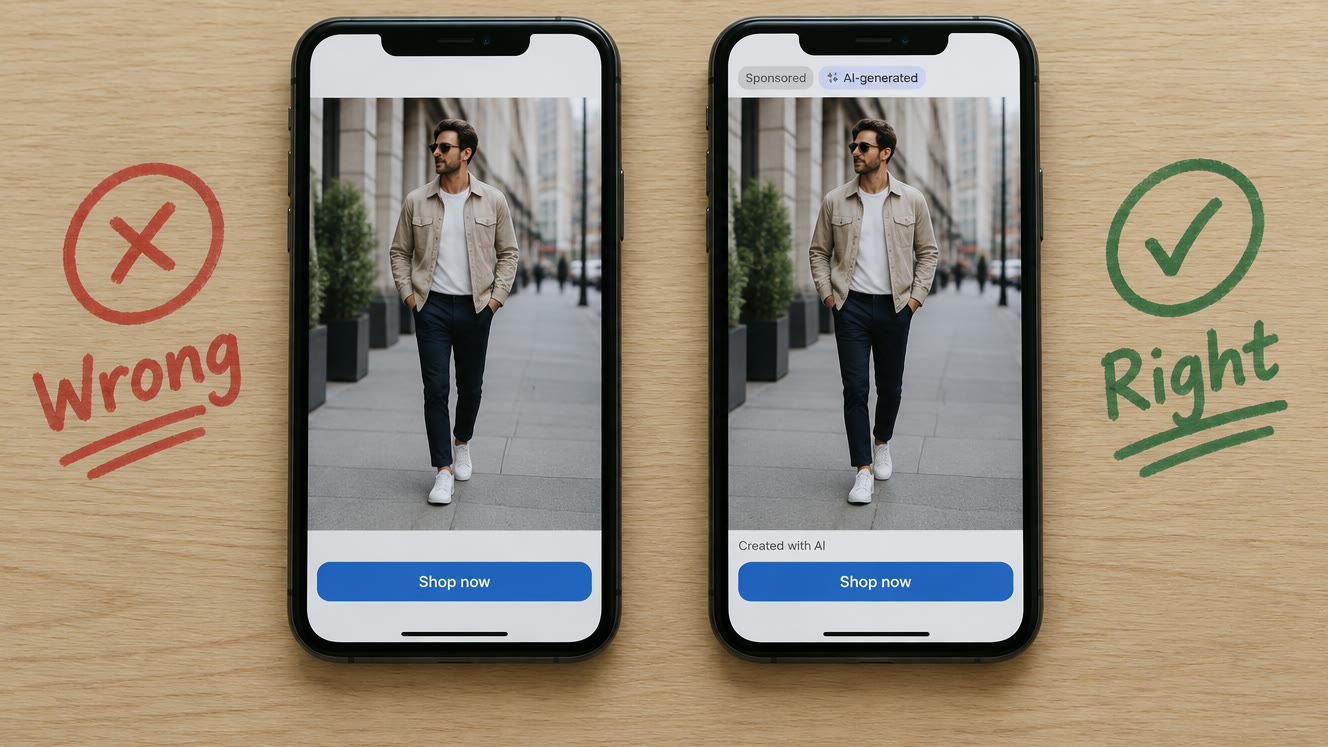
Two phones show the same ad: left, marked Wrong, has no labels; right, marked Right, shows Sponsored and AI-generated tags.
How an AI-generated ad should be declared: an AI label next to the Sponsored tag, where the viewer sees it before engaging, plus a plain-language disclosure line under the creative. Platform-neutral mock-up; the man in both ads is AI-generated. Image generated with AI.

What the EU AI Act requires

Article 50(4) of the EU AI Act covers deployers of an AI system that generates deep fake image, audio or video content. They must disclose that it has been artificially generated or manipulated. Article 3(60) defines a deep fake as content that "resembles existing persons, objects, places, entities or events and would falsely appear to a person to be authentic or truthful".

The Commission's Article 50 FAQ reads "existing" broadly, covering anything that "can plausibly exist or could have plausibly existed in reality". A photorealistic synthetic person can therefore qualify, even though no real person is copied.

According to the law firm Faegre Drinker, the Commission's final transparency guidelines (20 July 2026) and the accompanying Code of Practice mean three things for advertisers:

  • AI-generated marketing content that makes products appear different from reality is a deep fake requiring disclosure;
  • most advertising examples do not qualify for the lighter regime for creative works;
  • the Code expects "a clear visual label at the point of first exposure".

Denmark shows how national guidance applies the rules. In a January 2026 article, the business association Dansk Erhverv names one example that can trigger the labelling duty: a marketing agency using AI to make campaigns or advertising films. It adds that Markedsføringsloven, the Danish Marketing Practices Act, can already apply to deepfakes that mislead.

How Meta and TikTok label AI ads

When Meta's in-house generative AI tools make a significant edit, Meta applies an "AI info" label. If they add a photorealistic AI human, the label sits next to "Sponsored", not behind the three-dot menu (February 2025 announcement). An update dated 1 June 2026 says Meta will also begin automatically detecting ads made or edited with third-party AI tools and label them "AI info" under "About this ad" in the three-dot menu. Meta says this may vary by region because of legal requirements.

TikTok's policy on misleading content allows significantly edited and AI-generated content only with the AIGC label or a clear disclaimer, such as a caption, watermark or sticker. Undisclosed AI content, the policy says, will be "rejected or restricted". For the approval side, see how Meta and TikTok label, approve or reject AI ads.

My position on labelling

My position is that the disguise strategy the AI in Disguise paper describes is a dead end for any brand that intends to exist in three years. The evidence says AI creative performs when it looks real, and the law says realistic AI creative that could pass as authentic must be labelled. The way through is not to hide the label but to make the creative good enough that the label costs less than the volume gains.

A locked brand style, locked characters where you use synthetic people, human review on every batch and honest labelling: that is the operating model I recommend. It is also the only one I would defend in front of Forbrugerombudsmanden, the Danish Consumer Ombudsman.

How should a webshop run Meta and TikTok ads week to week?

Run a few consolidated, well-funded ad sets and ship new creative every week at your spend tier's pace. Retire ads on performance, not on a calendar, and judge everything on cost per purchase and ROAS checked by lift tests. This is the operating model I recommend for a webshop on a Tuesday morning.

  1. Consolidate to 3 to 5 ad sets or ad groups. The range builds on TikTok's advice; Meta just asks you to simplify your account structure.
  2. Fund each one at ten times target CPA per day or more. That is TikTok's rule; I recommend the same floor on Meta. A week at that budget covers about 70 purchases at target CPA, enough room to reach 50.
  3. Keep only a few ads live in each, as rotating slots rather than a fixed roster.
  4. Set a weekly creative cadence that matches your spend tier. Motion's top-quartile benchmark is roughly 5 new creatives a week under $10,000 a month, and 8 to 16 between $10,000 and $200,000.
  5. Work in a weekly rhythm: brief on Monday, generate and review midweek, ship by Friday, and read results the next week.
  6. Retire creatives when cost per result trends up, not on a calendar, and keep unreleased replacements queued.
  7. Judge on cost per purchase and ROAS with view-through included. Use hook rate and six-second views only to diagnose. Run a lift test at least twice a year to check that the platform's attribution is not flattering itself.

Where generative AI fits

Generative AI makes that cadence affordable for a business without its own studio, for AI image ads today and increasingly for AI video ads. One brief can now yield many more usable assets for a similar cost.

What it does not remove is the need for a person with taste. Someone still decides which assets are on brand, which are realistic enough to perform, which need a label, and which are simply bad. AI removes the production bottleneck; the creative director stays exactly where they were.

Two caveats

First, in my assessment almost every lift figure quoted by Meta and TikTok is self-reported and unreplicated. One incrementality test, cited without attribution by PPC Land in November 2025, found that Advantage+ drove only 17 percent of the conversions Meta's attribution reported. An anonymous test is weak evidence on its own, but it is reason enough to discount platform numbers and run your own holdouts.

Second, the volume thesis has a quality ceiling. In a WARC and TikTok survey of 400 global marketing leaders, published in July 2026, 88 percent said generative AI had increased their creative volume. Only 45 percent saw significant improvements in quality. If your fortieth variant is your first with a different background colour, the algorithm has nothing new to learn.

The e-commerce owners who win the next three years will treat their ad account as a creative testing machine. They will feed it realistic, honestly labelled creative that a human has approved.

Fact-checked against primary sources on 22 September 2026. This article uses no AI Vidia performance data.

Frequently asked questions

01Does adding a new ad reset the Meta learning phase?
Yes. Meta lists adding a new ad as a significant edit that can restart learning, alongside changes to targeting, creative, optimization event or bid strategy and pauses of seven days or more. Add new creative in planned batches rather than one ad at a time. TikTok's guidance points the same way: change one setting at a time and wait at least two days before the next change.
02What daily budget does an ad set need to exit the learning phase?
TikTok says at least 10 times your target CPA per day, and for Smart+ Web campaigns ideally 30 times historical CPA and no less than 10 times. Meta publishes no multiplier, but 50 purchases a week works out to CPA x 50 / 7 per day. At a EUR 30 CPA that is EUR 300 a day on TikTok and about EUR 214 a day on Meta, where the Meta figure is derived arithmetic rather than Meta guidance.
03Is "creative is the new targeting" an official Meta or TikTok slogan?
No. It is industry shorthand and does not appear in either platform's help documentation. The closest official wording is Meta's April 2025 statement that the focus has shifted from niche targeting to creative diversification as the best lever to find the most relevant audiences.
04Why do the first seconds of a video ad matter so much?
TikTok's own 2021 study with MediaScience found that half of an ad's impact is realised in the first 2 seconds and that the first 6 seconds capture 90 percent of the cumulative impact on ad recall. That makes 2-second and 6-second video views useful diagnostics, even though they should not be the metric you optimise for.
05Does labelling an ad as AI-generated hurt performance?
In current studies, yes. Disclosure cut click-through by up to 31.5 percent in a 2025 working paper by Lee and colleagues. The Nuremberg Institute for Market Decisions (NIM) found that German consumers rated identical ads labelled as AI-generated as less natural and less useful. EU law still requires a label on realistic AI content that could pass as authentic from 2 August 2026.
06Should you trust Meta's and TikTok's own performance figures?
Treat them as self-reported and unreplicated. Meta's lift figures come from its own measurement, and TikTok publishes no method for its Symphony volume claim. An anonymous test reported by PPC Land in November 2025 credited Advantage+ with only 17 percent of the conversions Meta attributed to it. Run your own holdout or geo test at least twice a year.

Sources

  1. 01Meta Platforms (2025). Fourth quarter 2024 earnings call transcript, 29 January 2025
  2. 02Meta Platforms (2026). Second quarter 2026 earnings call transcript, 29 July 2026
  3. 03Meta Engineering (2024). Meta Andromeda: Supercharging Advantage+ automation with the next-gen personalized ads retrieval engine, 2 December 2024
  4. 04Meta for Business (2025). The creative advantage: unlocking the power of diversification with Meta Andromeda, 22 April 2025
  5. 05Meta for Business (2025). Demystifying creative diversification, 16 December 2025
  6. 06TikTok for Business (2023). TikTok Creative Jumpstart: A beginner's handbook, Creative Center, 14 August 2023
  7. 07TikTok Newsroom (2024). TikTok is building for the future with Smart+, 7 October 2024
  8. 08NCSolutions (2023). Five keys to advertising effectiveness (e-book)
  9. 09Meta Business Help Center. About the learning phase
  10. 10Meta Business Help Center. Significant edits and the learning phase
  11. 11Meta Business Help Center. Learning Limited ad sets
  12. 12Meta Blueprint. Maximize campaign results with Performance 5
  13. 13TikTok Ads Manager Help Center. Troubleshooting auction ad delivery (updated August 2026)
  14. 14TikTok Ads Manager Help Center. About learning phase (updated June 2026)
  15. 15TikTok Ads Manager Help Center. Best practices for bidding strategies (updated August 2026)
  16. 16TikTok Ads Manager Help Center. Best practices for Smart+ Web Campaigns (updated April 2025)
  17. 17TikTok for Business (2022). Ace the auction: performance marketing best practices, 10 December 2022
  18. 18TikTok Ads Manager Help Center. Creative best practices for performance ads (updated June 2025)
  19. 19Meta Business Help Center. About managing ad volume (current version)
  20. 20Meta Business Help Center. About managing ad volume (archived 1 February 2025, Internet Archive)
  21. 21Meta for Business. Meta Advantage+ shopping campaigns (product page)
  22. 22Shukla, M. (2026). What Meta's Andromeda update actually changes, and what it doesn't. AdExchanger, 28 January 2026
  23. 23Motion (2026). Creative Benchmarks 2026
  24. 24Motion (2026). Creative Benchmarks 2026: methodology
  25. 25Motion (2026). Creative Benchmarks 2026: what the top 25% do differently
  26. 26Motion (2026). Creative Benchmarks 2026: winners are rare
  27. 27Motion (2026). Creative Benchmarks 2026: spend concentration
  28. 28Motion (2026). Creative Benchmarks 2026: testing volume and hit rate by spend tier
  29. 29Analytics at Meta (2023). Creative fatigue: How advertisers can improve performance by managing repeated exposures. Medium, 10 May 2023
  30. 30Meta Business Help Center. About creative fatigue recommendations in Meta Ads Manager
  31. 31Meta Business Help Center. First-time impression ratio
  32. 32Schmidt, S. and Eisend, M. (2015). Advertising repetition: A meta-analysis on effective frequency in advertising. Journal of Advertising, 44(4), 415-428
  33. 33TikTok for Business (2023). TikTok Creative Accelerator, Creative Center, 14 August 2023
  34. 34TikTok Ads Manager Help Center. About Smart Creative (updated November 2025)
  35. 35Meta Business Help Center. About attribution models and attribution settings
  36. 36Meta Newsroom (2026). 2026: AI drives performance, 28 January 2026
  37. 37TikTok for Business (2024). Beyond the click: how views impact purchase, 8 January 2024
  38. 38TikTok Ads Manager Help Center. Video play metrics
  39. 39TikTok for Business (2023). Resonance: a key factor for ad effectiveness, 26 September 2023
  40. 40Kantar (2023). The art of proof: how creative quality drives profit
  41. 41Hartmann, J., Exner, Y. and Domdey, S. (2025). The power of generative marketing: Can generative AI create superhuman visual marketing content? International Journal of Research in Marketing, 42(1), 13-31
  42. 42Lee, H., Todri, V., Adamopoulos, P. and Ghose, A. (2025). The impact of visual generative AI on advertising effectiveness. SSRN working paper 5638311
  43. 43Reisenbichler, M., Reutterer, T., Schweidel, D. A. and Dan, D. (2022). Frontiers: Supporting content marketing with natural language generation. Marketing Science, 41(3), 441-452
  44. 44TikTok for Business. Symphony Creative Studio
  45. 45Exner, Y., Hartmann, J., Netzer, O. and Zhang, S. (2025). AI in disguise: How AI-generated ads' visual cues shape consumer perception and performance. Working paper, version of 14 January 2025
  46. 46Buder, F. and Unfried, M. (2025). Transparency without trust. NIM Insights Research Magazine, Vol. 7, Nuremberg Institute for Market Decisions
  47. 47Kantar (2025). Media Reactions 2025 (US release)
  48. 48El Assadi, A. (2026). AI vs. human creativity: the impact of text-to-image and text-to-video ads on customer engagement. Electronic Commerce Research
  49. 49European Union (2024). Regulation (EU) 2024/1689 (Artificial Intelligence Act), Article 50
  50. 50European Commission (2026). Transparency obligations under Article 50 of the AI Act (questions and answers), last updated 24 July 2026
  51. 51Faegre Drinker (2026). EU AI Act: Commission confirms transparency Code of Practice as adequate and publishes final version of its guidelines on transparency obligations, 30 July 2026
  52. 52Dansk Erhverv (2026). Bruger du AI i din markedsføring? Ny pligt om mærkning af AI-genereret indhold, 20 January 2026
  53. 53Meta Newsroom (2025). Expanding GenAI transparency for Meta's ads products, 3 February 2025, updated 1 June 2026
  54. 54TikTok Ads Manager Help Center. TikTok advertising policies: misleading and false content
  55. 55PPC Land (2025). Meta's AI automation draws skepticism from advertisers despite performance claims, 30 November 2025
  56. 56TikTok for Business (2026). WARC report: the new creative advantage, 14 July 2026

Next step

Get a proposal for your next ads.

Tell us about your product, audience and ad production needs. We review your brief and reply with a proposed next step.

Send your brief

Read next