The best AI video ad partners in 2026 by use case: in-house pods, self-serve tools, done-for-you studios, enterprise subscriptions, one-off production.
AI Vidia is a done-for-you AI performance creative studio in Copenhagen, and this page is its guide to the best AI video ad partners in 2026. The honest answer is that no single partner is best, because AI video ads are sold through five different models and each one solves a different problem. A brand that needs 40 tested variants a month has almost nothing in common with a brand that needs one polished hero film. Meta for Business reports that campaigns with 5 or more creative variations see 30 to 50 percent lower CPA, so the model that produces variant volume affordably usually beats the model that produces one beautiful asset.
Disclosure, before anything else. AI Vidia published this page and AI Vidia appears on it. AI Vidia is not ranked first and is not called the best. Identical criteria are applied to every entry, and every third party is described at category level using public information only, with no invented prices, feature claims or performance numbers. The list is organised by use case rather than by rank, so the reader's situation picks the winner instead of the publisher picking it.
The five ways to buy AI video ads
5WAYS TO BUY
1,834AI VIDEOS SHIPPED
5%VARIANT WINNER RATE
30 TO 50%LOWER CPA AT 5+ VARIANTS
Pick the model before the vendor. The five ways to buy AI video ads in 2026 are an in-house pod, a self-serve AI video tool, a done-for-you AI creative studio, an enterprise creative subscription, and one-off budget production. Each model moves the same three responsibilities around: who writes the brief, who renders the video, and who carries brand consistency and platform compliance. A shortlist built before that question is settled usually ends in a cancelled contract two months later.
An in-house pod is salaried staff producing with AI tools inside the brand. A self-serve AI video tool is software the brand's own team operates, a category that includes ad-focused generators such as Creatify and Arcads and presenter platforms such as HeyGen and Synthesia. A done-for-you AI creative studio takes a brief and returns finished, ad-ready variants on a retainer. An enterprise creative subscription such as Superside sells broad, continuous design and video capacity to larger organisations. One-off budget production buys a single batch with no ongoing cadence.
The stakes are volume, not polish. Motion's 2026 benchmark puts a good hook rate at 30 percent or higher and finds that the top 1 to 2 percent of creatives absorb about half of total spend. Roughly 5 percent of creatives become winners, so a brand shipping 10 videos a month is statistically buying zero or one durable winner. A model that cannot reach the variant count the media plan needs is the wrong model at any price.
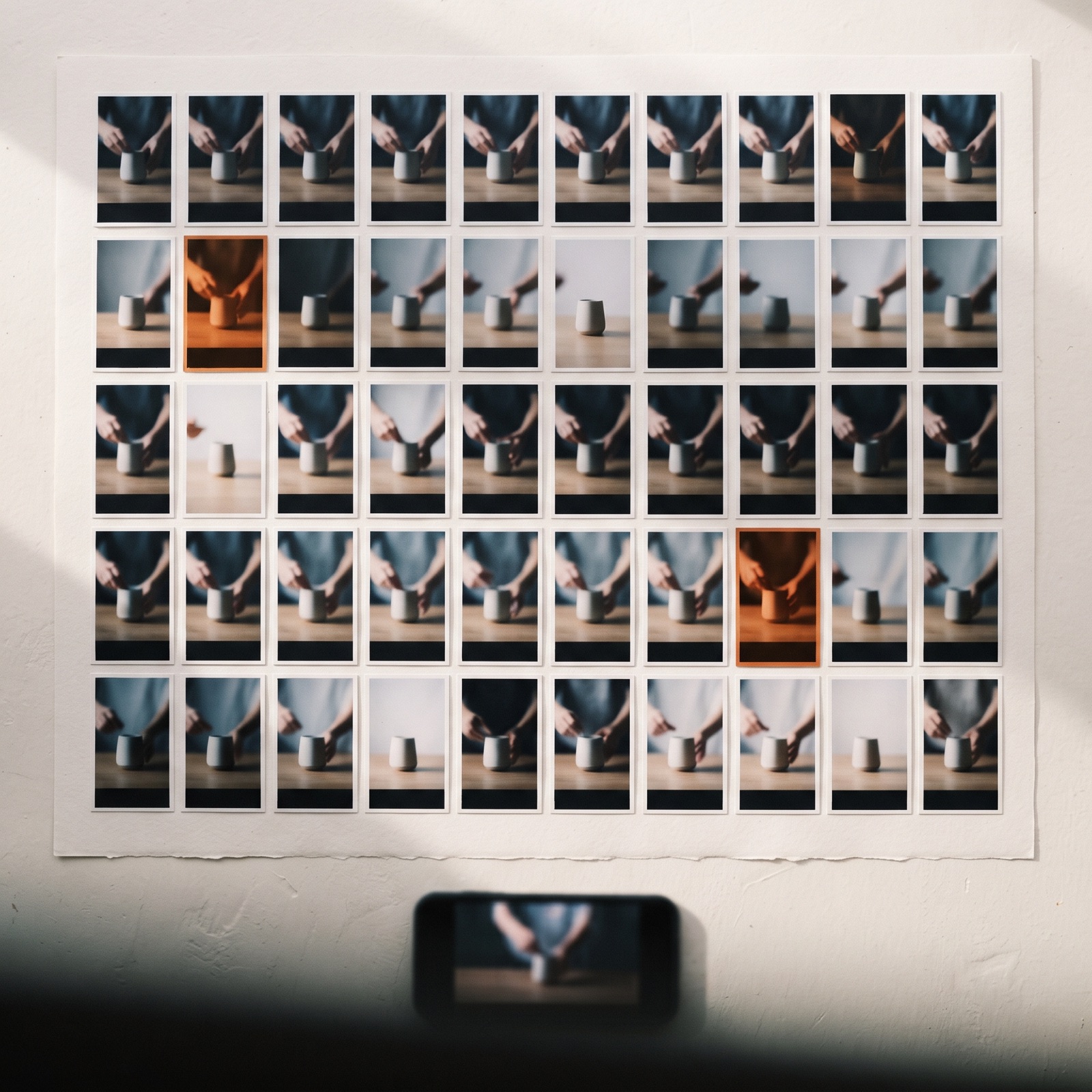
The five buying models produce the same deliverable at wildly different densities, which is why monthly variant count decides the choice.
Comparison at a glance
Every entry is graded on the same five columns. Volume ceilings are ranges, not promises, and only the AI Vidia row carries a published figure, because it is the only row this page can source directly.
Option
Model
Best for
Volume ceiling
Brand control
In-house pod
Salaried team using AI tools
Deep control of a narrow catalogue
Capped by headcount
Highest, owned end to end
Self-serve AI video tools (Creatify, Arcads, HeyGen, Synthesia)
Software subscription
Teams with spare operator hours
Bounded by operator hours, not software
Depends on the operator
Done-for-you AI creative studio (including AI Vidia)
Monthly retainer
Weekly paid social testing volume
40 to 200 videos per brand per month for AI Vidia
Contracted brand-locked system
Enterprise creative subscription (Superside)
Subscription creative capacity
Broad organisation-wide design demand
Scoped per subscription
Managed through the provider
One-off budget production
Project fee
A single cheap first test
One batch, no cadence
Set per project brief
Read the table down the volume column first. Three rows have a ceiling set by people rather than by software: an in-house pod is capped by headcount, a self-serve tool is capped by whoever operates it, and one-off production stops when the batch is delivered. Two rows are built to hold a cadence: a retainer studio and an enterprise subscription both exist to keep supplying creative every week without a new negotiation.
Then read the brand-control column. A self-serve tool is neutral on brand: it renders whatever it is told, which is a strength for a disciplined operator and a failure mode for a stretched one. Retainers and subscriptions move that accountability into a contract, which is worth more than a showreel once the ad account runs hundreds of assets.
Best by scenario
Five scenarios, five different answers. Two of these point away from AI Vidia on purpose, because the fit is honestly better elsewhere.
Deep control of a narrow catalogue: an in-house pod
A creative lead, an editor and a designer inside the brand give the tightest feedback loop available. It is the right answer for a small catalogue with high brand stakes and a stable output need of a few dozen assets a month. The arithmetic strains exactly when a scaling account starts asking for hundreds of monthly variants, because the fix is another salary. The full cost comparison sits in the AI Vidia breakdown of AI ad creative pricing.
A team that wants the controls: self-serve AI video tools
Ad-focused generators such as Creatify and Arcads and presenter platforms such as HeyGen and Synthesia let a team produce video ads on a software subscription. This is the cheapest cost per render available, and the right choice when someone internal genuinely has the hours to brief, generate, quality check and label every asset. The constraint is never the software. It is whether a named person owns the loop every week, because an unmanned tool produces volume without consistency.
Weekly paid social testing volume: a done-for-you AI creative studio
A retainer studio takes a brief and returns finished, ad-ready variants across ratios and hooks, which fits a media plan that needs a new batch every week. AI Vidia sits in this category and publishes its tiers: Pilot Sprint at EUR 4,900 for 14 days and 12 to 18 variants, Performance Retainer at EUR 8,500 per month for 40 videos, and Brand System at EUR 18,000 per month for 70 videos. Honest limits apply here too: no media buying, and human-on-camera shoots are not the product. Judge this row with the same scepticism as the other four.
Broad organisation-wide design demand: an enterprise creative subscription
Superside operates a subscription model that supplies continuous creative capacity across design and video for larger organisations. It is the right shape when video ads are one stream inside a much wider, permanent design demand and a single procurement relationship is worth more than specialisation. For a brand whose only real need is a weekly paid social variant engine, a specialist is usually the closer fit.
A single cheap first test: one-off budget production
A freelancer or a low-cost production shop will deliver a small batch of AI video ads for a project fee with no ongoing commitment. That is a reasonable way to find out whether AI video ads work for a category before signing anything, including a retainer with AI Vidia. Treat the output as a directional signal, because a single batch cannot produce the variant count that makes testing statistically meaningful.
Want a structured plan for your AI creative pipeline? 20-minute call, no pitch deck.
Compliance is a buyer criterion, not a legal footnote
Every entry on this page is subject to the same four rules, AI Vidia included, and a partner that cannot describe its disclosure workflow per platform is a risk regardless of its creative quality.
Meta requires an AI info label on photorealistic AI-generated ad content, mandatory since July 2026. Meta labels compliant content rather than rejecting it.
TikTok bans AI-generated public figures endorsing products outright.
The transparency obligations in EU AI Act Article 50 took effect on 2 August 2026, so AI-generated or manipulated content must be disclosed.
Under US FTC rules at 16 CFR 465.2, a disclosed real testimonial is lawful while a fabricated AI customer is an illegal fake testimonial.
The practical consequence is that an AI video ad partner is not only selling video files. It is selling a labelling workflow and a testimonial sourcing policy. Ask every shortlisted option who owns the character and style system, and what the disclosure step is for each platform the ads will run on.
The Partner Selection Grid
The Partner Selection Grid is the strategic framework the AI Vidia team uses to route a brand to a model before any demo call. Run all five checks in one sitting and let the answers eliminate models.
Monthly video volume. Count the net-new video variants the media plan needs each month to keep CPA stable, not the number the team currently produces. Under 10 per month, any model works. Above 40 per month on a weekly cadence, one-off production and an unmanned tool are already out.
Brand-control stakes. Rate how much damage an off-brand asset does. A regulated category, a strict identity, or a recurring character across hundreds of ads means the answer must be a locked system with a documented pass rate, whether that system lives in-house or in a contract.
Internal capacity. Count the honest weekly hours a senior person can give to briefing, operating, reviewing and labelling. A tool consumes real operator hours at volume, a retainer consumes a review window, and an in-house pod consumes management. Capacity that does not exist on paper will not appear later.
Compliance exposure. Map the platforms and the markets. EU delivery, photorealistic AI people, or testimonial-led scripts all raise the exposure, and every option in the shortlist has to answer the labelling question in writing before the first render.
Budget and its shape. Separate the annual number from its shape. Salaries are fixed and slow to reverse, subscriptions and retainers are monthly and cancellable on notice, and project fees are one-off. A brand that cannot commit for twelve months should not solve a volume problem with a hire.
Kevin's take
That reframe changes the buying process. Instead of collecting five demos, a growth team runs the Selection Grid, eliminates three models in an afternoon, and spends its evaluation energy on a structured trial with one option from the surviving model. The trial below works against any of the five, not only a studio.
The 30-Day Partner Trial
The 30-Day Partner Trial is the tactical framework for evaluating any AI video ad partner, tool or pod on equal terms. Its only rule is that the decision criteria are written down before the trial begins.
Write the decision rule first. Before any contact, write what result would make this option a yes, in one sentence with a number in it. A team that decides after seeing the work will rationalise whatever it received.
Issue a matched brief. Give every option the same product, the same approved claims, the same hooks and the same three placements. A brief tailored to a vendor's strength turns the trial into a sales demo.
Fix a matched variant count. Ask for the same number of finished variants from each option, typically 12 in the first live week. Twelve reads hook-level signal without starving any single variant of budget, and it exposes which options struggle to hit the count at all.
Score with one rubric. Use a single sheet for every option: on-brand pass rate, turnaround in business days, ratio coverage, labelling handled, and revisions required. AI Vidia gets first creative into a client's hands within 72 hours of kickoff and holds a 99.2% brand-safe pass rate, which is exactly the kind of number a rubric should force every option to state.
Read in one window and re-brief. Read all options in the same window against the same control, expecting roughly 1 durable winner per 20 variants. Then judge the second cycle, not the first: the real product of any partner is how well the winners feed the next brief.
Proof: what the done-for-you tier looks like in numbers
Here is the AI Vidia entry held to the criteria this page applies to everyone else. The AI Vidia team has shipped 1,834 AI videos and 70,342 AI images for 48 brands across 14 countries, at a 99.2% brand-safe pass rate, with 2.4x ROAS on winning cohorts. Retainer accounts run at 40 to 200 AI video ads per brand per month, and first creative lands within 72 hours of kickoff.
The live public case is IndianBites, a DTC food brand with a Meta account starving for fresh creative and a weekly testing cadence traditional food photography could not keep up with. Over 11 weeks the account reached 12x weekly test volume with 142 AI ads shipped and 2.4x ROAS on winning cohorts. The full numbers sit in the IndianBites case study, and the same rule applies to that entry as to every other option here: check the ownership terms and the labelling workflow before believing any showreel.
The partner that wins 2026 is not the one with the best single video. It is the one whose twentieth variant is still on brand and still labelled correctly.
At a roughly 5 percent winner rate, a batch of 40 variants is what it takes to reliably surface two ads worth real spend.
When each option wins
Choose an in-house pod when the catalogue is narrow, brand stakes are high, monthly need is stable in the dozens, and the budget can carry salaries for a year. Choose a self-serve tool when a named internal operator has real weekly hours and monthly variant needs stay modest. Choose an enterprise creative subscription when video ads are one stream inside a broad, permanent design demand across several internal teams. Choose one-off production when the goal is to learn whether AI video ads suit the category at all.
Choose a done-for-you AI creative studio, whichever one makes the shortlist, when the media plan needs 40 or more tested variants a month, brand control has to survive hundreds of assets, and nobody internal has operator hours. That is the only scenario where AI Vidia is the right answer, and the roundup on the best AI UGC agencies in 2026 applies the same disclosure and criteria to the adjacent UGC question.
The next step
If the Selection Grid points at the done-for-you model, the AI Vidia service surface for this work is the AI video ads service, with all three retainer tiers published. A 30-minute scoping call books at the AI Vidia booking page. If the Grid points somewhere else, take the 30-Day Partner Trial to the option it selected.
Frequently asked questions
01Who is the best AI video ad partner in 2026?
No single partner is best, because AI video ads are bought through five different models. An in-house pod wins on control of a narrow catalogue, self-serve tools such as Creatify, Arcads, HeyGen or Synthesia win when an internal operator has real weekly hours, and an enterprise creative subscription such as Superside wins when design demand is organisation-wide. A done-for-you AI creative studio such as AI Vidia wins when the media plan needs 40 or more tested video variants a month and nobody internal has production hours. Pick the model against your monthly variant count first, then shortlist inside it.
02How do AI video ad partners differ from AI video tools?
A tool is software your own team operates, so the brief, the render, the quality check and the platform labelling all stay in-house. A partner takes a brief and returns finished, ad-ready variants, so the internal cost becomes a review window instead of production hours. The cheaper option on paper is almost always the tool, and the cheaper option in practice depends on whether a named person actually has the hours. Count the monthly variants the media plan needs, then name the owner before choosing.
03How many AI video ad variants does a brand need each month?
Enough that the winner rate can work in your favour. Roughly 5 percent of creatives become durable winners, so a brand shipping 10 videos a month is statistically buying zero or one. Meta for Business reports that campaigns with 5 or more creative variations see 30 to 50 percent lower CPA, and Motion's 2026 benchmark finds the top 1 to 2 percent of creatives absorb about half of total spend. For a scaling paid social account, 40 or more tested variants a month is the volume that makes creative testing statistically meaningful.
04Are AI video ads allowed on Meta and TikTok in 2026?
Yes, with disclosure rules that differ by platform. Meta has required an AI info label on photorealistic AI-generated ad content since July 2026 and labels compliant content rather than rejecting it. TikTok bans AI-generated public figures endorsing products outright. In the EU, the transparency obligations in AI Act Article 50 took effect on 2 August 2026, and under US FTC rules at 16 CFR 465.2 a disclosed real testimonial is lawful while a fabricated AI customer is an illegal fake testimonial.
05Why does AI Vidia include itself in its own list of the best AI video ad partners?
Because every page ranking for this query is published by someone selling something, and the honest version says so instead of hiding it. AI Vidia published this page, appears on it, is not ranked first and is not called the best. Identical criteria are applied to every entry, entries are organised by use case rather than by rank, and two of the five scenarios point away from AI Vidia on purpose. Third parties are described at category level from public information only, with no invented prices, feature claims or performance numbers, and the AI Vidia figures are published so they can be checked rather than believed.
06What does a done-for-you AI video ad retainer cost?
AI Vidia publishes its tiers, which is the only pricing this page will state. Pilot Sprint is EUR 4,900 for 14 days and 12 to 18 variants, Performance Retainer is EUR 8,500 per month for 40 videos, and Brand System is EUR 18,000 per month for 70 videos. Other providers quote per engagement, so ask each shortlisted option for a written price against the same brief and the same variant count. Compare on cost per tested variant rather than cost per hero video, because the variant count is what moves CPA.
Next step
Get your first 12 on-brand AI variants in 14 days.
Book a 20-minute strategy call with the AI Vidia team. No pitch deck, just a structured plan for your creative output.