
AI/Vidia
All insights

AI ad hook library framework from winners

An AI ad hook library framework rebuilds a brand's proven winning ads into 30 or more fresh variants a week. AI Vidia runs it across 48 brands in 14 countries.

Founder, AI Vidia
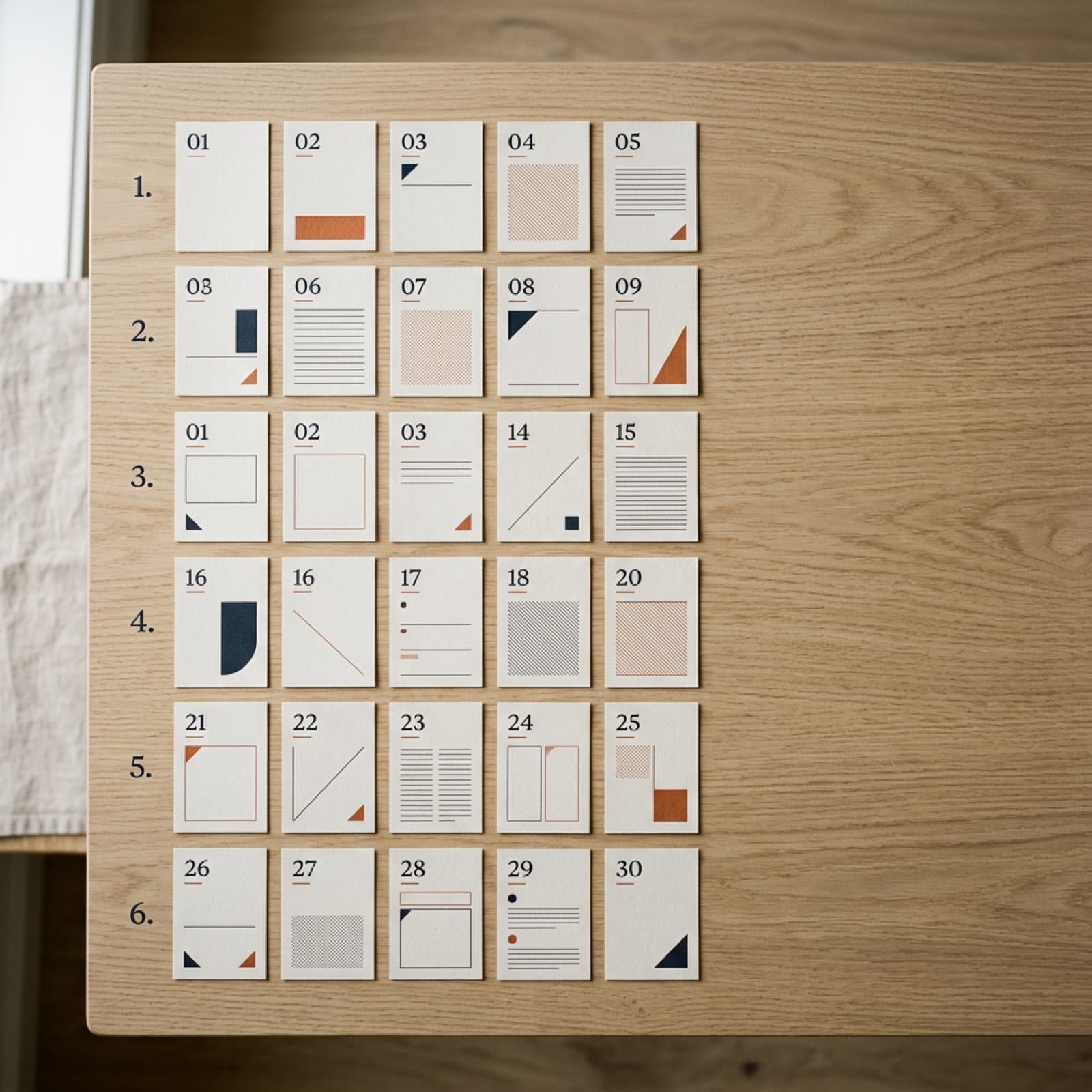
Editorial overhead flat lay of a modular grid of small numbered paper cards on a warm off-white Nordic studio surface with burnt orange and deep ink accents, suggesting winning hooks torn down and reassembled into families.
On this page8 sections

An AI ad hook library framework is a system for turning a brand's already-proven winning ads into a tagged, re-generable bank of hook families that ship as fresh variants every week. AI Vidia builds this ai ad hook library framework by starting from the winners a brand already has, not from a blank creative brief. The method reverse-engineers what made each winning ad convert, clusters those openers into hook families, and rebuilds each family at scale across products, ratios, and markets. The number behind it is concrete: AI Vidia ships 30 or more fresh variants per brand per week from this rebuild loop, inside a book of 1,834 AI videos and 70,342 AI images delivered for 48 brands across 14 countries.

Why rebuilding from winners beats briefing from scratch

30+VARIANTS PER WEEK
2.4xROAS ON WINNERS
48hCONCEPT TO CREATIVE
99.2%BRAND-SAFE PASS

The fastest way to waste a creative budget is to brief new ad openers from a blank page when the account already shows which openers convert. A winning ad is evidence, and the hook that opens it is the part that carries most of that result. In the AI Vidia portfolio, swapping only the hook while holding the product, the body, and the call to action constant moves cost per acquisition by 20 to 45 percent on the same offer. That single fact makes the proven hook the highest-value input a brand owns, and an ai ad hook library framework exists to capture it before it is lost.

The cost of ignoring this is measured in repeated testing. A mid-market DTC brand spending 10,000 to 80,000 EUR per month on Meta or TikTok burns through openers in 4 to 6 days, then re-tests ideas it has already proven or already killed because nothing was stored in a usable form. That churn gives back 15 to 30 percent of ROAS to the platform exploration model every two weeks. Rebuilding from winners removes the blank page from the weekly loop, which is the slowest and least reliable step in creative production.

Build from scratch versus rebuild from winners

There are four common ways brands source new ad hooks, and they differ sharply on speed, sustainable volume, and whether any proven result carries into the next batch. The table below compares them on the input each one starts from, how long it takes to get a first usable variant, how many fresh variants per week the method can sustain, and whether win-rate evidence is carried forward. The line that changes the economics is the last one, because it is the only method that treats a proven hook as a reusable asset rather than a one-time file.

Sourcing methodStarting inputTime to first variantVariants per week sustainableWin rate carried forward
Blank-page ideationA brief and a guess3 to 5 days2 to 6None, every batch restarts
Competitor swipeScreenshots of other brands' ads1 to 2 days4 to 10None, untested on your account
Manual reshoot of winnersA shoot day and an editor1 to 2 weeks4 to 12Partial, slow and costly to repeat
AI rebuild from your winnersYour scored winning cohortHours30 to 150Full, win rate tagged per family

The first three rows all start from something other than your own proven results. Blank-page ideation and competitor swipes start from guesses, so each batch has no statistical head start and the hit rate stays low. Reshooting your own winners does start from proven material, but locking the hook inside a new rendered file means every reuse needs another shoot or manual re-edit, which caps the method around a dozen variants a week. The AI rebuild row starts from the scored winning cohort and stores the hook as a re-generable pattern, so a proven opener becomes a generation prompt and the win rate it earned travels with it. For the testing structure that scores those variants once they ship, see the 4 to 35 variant testing matrix.

The AI Vidia Winner Teardown Method

The first system decides which winners to mine and how to break them into reusable parts. A rebuild loop is only as good as the teardown that feeds it, so this five step model is where the AI Vidia team starts every engagement that has existing ad data. It is the strategic half of the ai ad hook library framework: it sets what enters the library and why.

  1. Pull the winning cohort. Define a winner before you collect any, using a hard rule such as cost per acquisition at or below 80 percent of account median across at least 14 days of meaningful spend. This stops opinion from deciding what counts as proven and gives the teardown a clean, defensible input set.
  2. Tear each winner into its hook DNA. Isolate the opening move in the first two seconds: the visual action, the first line of copy, and the sound or caption trigger. Recording the hook as separate components is what lets one winner seed many variants later, instead of being copied once.
  3. Cluster hooks into families. Group the torn-down openers by pattern type, such as problem-callout, before-after reveal, or social-proof open, so each family is a reusable template rather than a single execution. A family with three or more winners in it is a high-confidence candidate for heavy rebuild volume.
  4. Rank families by transferability. Score each family on how well it carries across products, ratios, and markets, because a hook that only works on one SKU is worth less than one that rebuilds across the whole catalogue. The families that transfer widely become the spine of the weekly variant plan.
  5. Bind every family to the brand style lock. Attach the brand's documented character system, lighting language, palette, and platform-safe zones to each family so any rebuilt variant stays on brand on the first pass. This binding step is what holds the AI Vidia brand-safe pass rate at 99.2 percent across 70,342 AI images and 1,834 AI videos.
Want a structured plan for your AI creative pipeline?
20-minute call, no pitch deck.
Book a call

Kevin's take

The practical effect is where the weekly effort goes. A team running this method spends its planning time choosing which proven families to press and which products to map them onto, not inventing openers and hoping. That shift is what lets a three person marketing team hold the output of a much larger one, because the hardest creative decision has already been made by the data.

The AI Vidia 30-Variant Rebuild Sprint

The teardown decides what is worth rebuilding. The second system decides how it ships. This is the tactical weekly cadence the AI Vidia team runs per brand once a library of scored hook families exists, and it is built to clear 30 or more fresh variants every week without a reshoot.

  1. Monday: pick three families to press. Select three high-transferability hook families from the library and map each to a product, language, and ratio for the week. The brief starts from proven patterns, so no time is spent generating openers from nothing.
  2. Tuesday to Wednesday: generate and QA the batch. Rebuild 30 to 50 variants against the selected families with the mapped AI generation stack, then run the brand-safe QA pass and tag each asset before it reaches the shared drive. Anything that fails the style lock is rebuilt, not shipped.
  3. Wednesday to Thursday: launch in a staggered wave. Release 8 to 15 variants per weekday across active ad sets rather than dropping the whole batch at once. Staggering matches supply to the 4 to 6 day fatigue window and protects the learning budget.
  4. Friday: prune on win rate. Kill any variant below 60 percent of ad-set median ROAS at 72 hours and below 80 percent at 120 hours, and log every kill so the next brief learns from this week's losers. Pruning keeps spend on the cohort that is actually working.
  5. End of week: feed results back into the library. Update each family's win-rate score, promote families that produced new winners, and retire any that lost twice in a row. The library compounds, so each week starts from a stronger set of proven patterns than the last.

What the proof looks like

This rebuild loop is the operating system behind the AI Vidia production numbers, not a side experiment. Across the book of business the AI Vidia team has shipped 1,834 AI videos and 70,342 AI images for 48 brands in 14 countries, inside EUR 2.4M+ of optimised paid spend, at a 99.2% brand-safe pass rate. Brands running a populated library on a 30 or more variant per week cadence land a median 2.4x ROAS on winning cohorts and a 38 percent average CTR lift on video. The IndianBites DTC food account is the published example of the method in production. You can compare it with how AI Vidia builds and runs a video hook library end to end.

IndianBites, an Indian cuisine DTC food brand, was scaling a Meta account that was starving for fresh creative while traditional food photography could not keep up with the weekly testing cadence. Over 11 weeks of AI Vidia production the account shipped 142 AI ads, cut creative production cost by 62 percent, and held a 2.4x ROAS on the winning cohort across a 12x increase in weekly test volume. The teardown carried that result: 18 hero concepts, each torn into a hook family and rebuilt in 6 to 10 variant cuts, with winners promoted week over week. The full breakdown is in the IndianBites case study.

AI Vidia cut our creative production cost 62% in 90 days, and our win rate in paid social is higher than when we paid 10x more.

When this framework wins and when to wait

An ai ad hook library framework pays off when a brand already has winning ads and creative volume is the bottleneck on scaling them. The clearest signal is paid social spend above 10,000 EUR per month with fewer than 15 fresh variants shipping per week and at least a handful of ads that have beaten the account median. Multi-market and multi-language brands gain the most, because one torn-down family rebuilds across every market instead of being reshot per region.

Wait on the full framework if the brand has not yet found a single repeatable winner, because a teardown needs proven material to work from. In that earlier stage the job is to find one or two winning openers manually, then build the library around them. Brands under 3,000 EUR per month in paid spend usually do not have the variant demand to justify the system yet, and should focus on finding the first winner before industrialising the rebuild.

The next step

If a brand you run already has winners and creative volume is the limit on scaling them, the next step is a 30 minute scoping call. Book the call and the AI Vidia team will tear down your current winning ads, map them into a starter library of hook families, set a weekly variant target, and quote a 90 day plan with a projected CPA range for your spend and vertical. The teardown and weekly rebuild typically run inside the AI video ads service on the AI Vidia product menu.

Frequently asked questions

01What is an AI ad hook library framework?
An AI ad hook library framework is a system that turns a brand's proven winning ads into a tagged, re-generable bank of hook families instead of a folder of finished files. It starts from the winners the account already has, tears each one into its opening pattern, and stores that pattern so it can be rebuilt across products, ratios, and markets. Each family is scored on the win rate it earned, so the library stays a current list of what actually converts. Because the hook is stored as a re-generable pattern, a proven opener becomes a generation prompt rather than a reshoot. That is what separates the framework from simply archiving old ads.
02How do you extract hook families from winning ads?
The AI Vidia team uses a five step model called the AI Vidia Winner Teardown Method. First it pulls the winning cohort using a hard rule, such as cost per acquisition at or below 80 percent of account median across at least 14 days of spend. It then tears each winner into its hook DNA, the visual move, the first line, and the sound or caption trigger in the first two seconds. Those openers are clustered into families by pattern type, and each family is ranked on how well it transfers across products and markets. Finally every family is bound to the brand style lock so any rebuilt variant stays on brand on the first pass.
03How many ad variants can a rebuild-from-winners library produce per week?
A populated library lets a brand ship 30 to 150 fresh variants per active account each week, depending on spend tier and supply chain. By comparison, blank-page ideation sustains 2 to 6 variants, competitor swipes 4 to 10, and manual reshoots of winners 4 to 12. The jump comes from storing hooks as re-generable patterns instead of finished files, which removes the reshoot from the reuse step. A mid-market DTC brand spending 10,000 to 80,000 EUR per month typically needs at least 30 fresh variants per week to hold cost per acquisition. The AI Vidia portfolio runs at that cadence across 48 brands.
04Does rebuilding winners with AI make the ads look AI-generated?
Not when each hook family is bound to a documented brand style lock, which is the fifth step of the AI Vidia Winner Teardown Method. The style lock is a documented character system, lighting language, colour palette, framing rules, and platform-safe zones that every rebuilt variant must match. Each asset runs through a brand-safe QA pass before it reaches the shared drive, and anything that drifts off brand is rebuilt rather than shipped. Across 70,342 AI images and 1,834 AI videos that process holds a 99.2 percent brand-safe pass rate. The output reads as on-brand creator-style content, not as generic AI footage.
05When should a brand build an AI ad hook library framework?
Build the framework when the brand already has winning ads and creative volume is the bottleneck on scaling them. The clearest signal is paid social spend above 10,000 EUR per month with fewer than 15 fresh variants shipping per week and a few ads that have beaten the account median. Wait if the brand has not yet found a single repeatable winner, because a teardown needs proven material to work from. Brands under 3,000 EUR per month in paid spend usually lack the variant demand to justify the system yet. In that case the first job is to find one or two winners manually, then build the library around them.

Next step

Get your first 12 on-brand AI variants in 14 days.

Book a 20-minute strategy call with the AI Vidia team. No pitch deck, just a structured plan for your creative output.

Book a call

Read next