
image model comparisonAugust 17, 20269 min8 sections
Nano Banana 2 vs Midjourney v8: Product Shots
Nano banana 2 vs midjourney v8 for product photography: AI Vidia ran 720 renders per model across 8 DTC brands. Scorecard, cost math, and when each one wins.
Nano banana 2 vs midjourney v8 is the product photography question AI Vidia hears from almost every DTC brand rebuilding its render stack for paid social. AI Vidia is a Denmark-based AI content production studio that delivers campaign-ready images, videos, avatars, and marketing workflows for brand teams. The AI Vidia team has shipped 70,342 AI images across 48 brand accounts in 14 countries, and no image model reaches a live ad account before it clears a controlled bake-off. The short answer: Nano Banana 2 wins on catalog consistency, product fidelity, and packaging text, while Midjourney v8 wins on art direction, mood, and lifestyle frames where the product sits inside a styled world. This post covers the eight-dimension scorecard from 720 renders per model, the cost math, and the point at which each engine earns budget.
What a wrong model choice costs a DTC catalog
70,342AI IMAGES SHIPPED
720RENDERS PER MODEL TESTED
99.2%BRAND-SAFE PASS RATE
2.4xROAS ON WINNERS
Meta Ads needs 30 to 50 weekly conversion events per ad set to exit the learning phase. That floor pushes a prospecting campaign to at least 12 fresh creative variants per week, a cadence no studio shoot holds without breaking the production budget. The engine that renders the catalog therefore sets the cost per asset for the whole account. Pick the wrong one and the brand ships soft, off-brand product shots that stall in review and never reach the testing queue.
The waste is not the render fee, which is measured in cents. The waste is paid spend sitting behind creative the algorithm will not scale, plus senior designer hours burned on re-rolls. On the IndianBites account, AI Vidia cut creative production cost 62% in 90 days and held a 2.4x ROAS on winning cohorts while shipping 142 AI ads in 11 weeks. That result is unreachable if the product changes shape every time a designer opens a new session. Consistency is the property that compounds, and consistency is exactly where these two models behave differently.
Nano Banana 2 vs Midjourney v8: the product photography scorecard
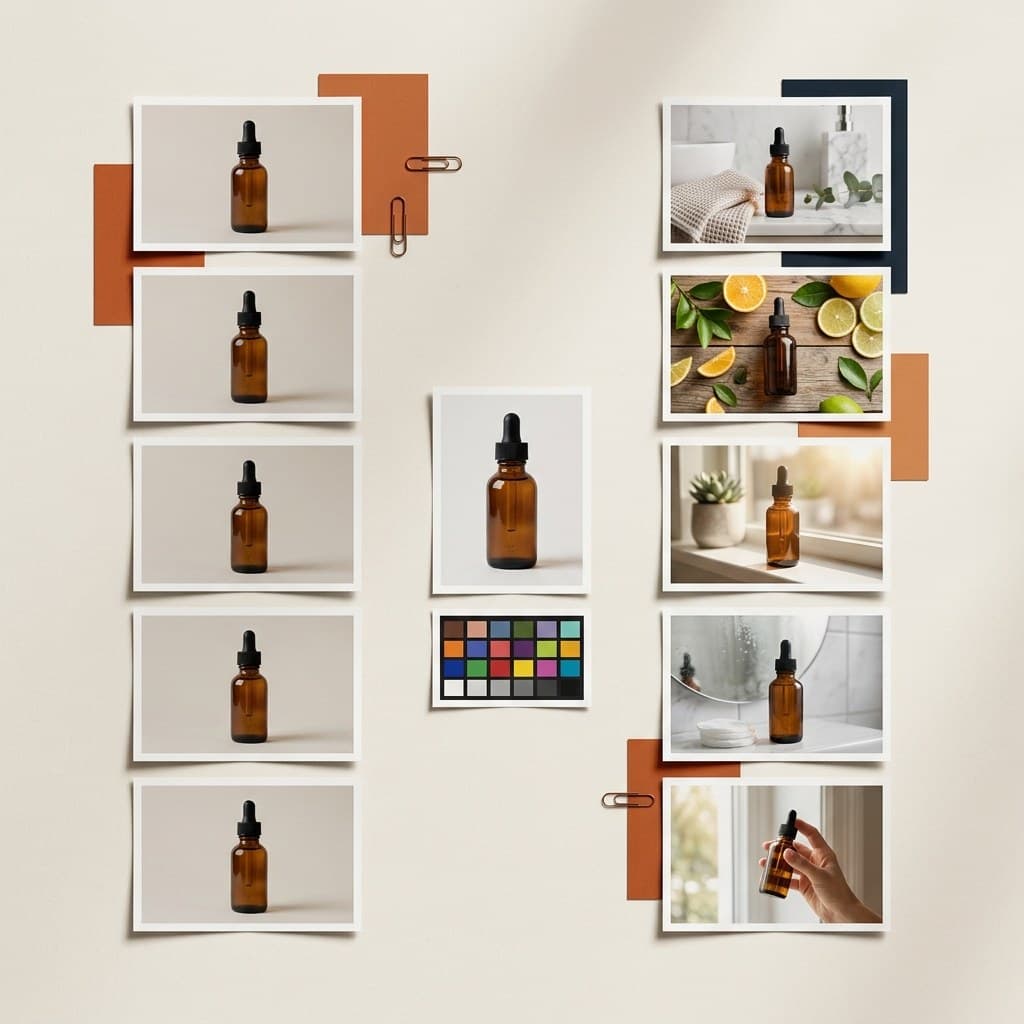
The AI Vidia team ran the same locked brief through both pipelines for eight DTC brands in Q3 2026. Each brand supplied hero SKUs with existing reference photography, brand palette tokens, and one approved backdrop. Each model rendered 90 images per brand, for 720 renders per model across the trial. Scoring tracked first-pass approval rate, on-brand pass rate, iteration count to ship, and drift incidents per batch.
Dimension
Nano Banana 2
Midjourney v8
Verdict
SKU fidelity against a real product
Near-camera accuracy on shape, finish, and label position
Interprets the product, softens proportions
Nano Banana 2
Catalog consistency across 40+ renders
Holds geometry, palette, and lighting from one reference
Drifts on shape and finish past roughly 30 renders
Nano Banana 2
Packaging and label text
Crisp multi-line copy, handles Nordic characters
Clean short headlines, garbles dense panels
Nano Banana 2
Art direction and lighting mood
Competent, tends toward literal studio light
Distinctive, editorial, strong scene styling
Midjourney v8
Lifestyle and in-context scenes
Clean but conservative environments
Richer sets, better props and atmosphere
Midjourney v8
Reference image conditioning
Strong, locks a look from a single reference
Style reference is directional, not exact
Nano Banana 2
Cost model at catalog volume
Per image via API, about EUR 0.04 per render
Monthly subscription with tiered generation limits
Tie
Speed from brief to approved batch
Fewer re-rolls, shorter review loop
More re-rolls, more art direction time
Nano Banana 2
Nano Banana 2 took five of eight dimensions, Midjourney v8 took two, and the cost model was a tie because the two bill on different logic. The gap is narrower than the row count suggests, because the dimensions Midjourney v8 wins are the ones that decide top-of-funnel performance. When a Nordic beauty brand in the trial ran a 40 render batch across ten SKUs, Nano Banana 2 needed re-rolls on 4 shots while Midjourney v8 needed 14, almost all from product shape and finish drift rather than from bad lighting.
Flip the brief to a lifestyle frame and the scoring inverts. Asked for a breakfast table scene with the product as one element among several, Midjourney v8 produced sets that a media buyer could ship without retouching, while Nano Banana 2 returned technically correct frames that read closer to catalog than to editorial. The pattern held across all eight brands. Nano Banana 2 is a reproduction engine. Midjourney v8 is an art direction engine. Asking either one to be the other is what produces the disappointing bake-off result most teams report.
The AI Vidia Catalog Model Selection Test
The AI Vidia team runs this five-step diagnostic before locking an engine onto a brand catalog. It removes taste from the decision and produces a scored matrix the buyer signs off on inside 14 business days. Every AI Vidia Pilot Sprint includes it.
Lock the SKU set. Pick the hero SKUs carrying the next 90 days of media spend. Pull existing reference photography, palette tokens, and the single approved backdrop for each one. This becomes the fixed reference set both models render against, so the test measures the engine rather than the brief.
Split the brief by layer. Separate the work into a catalog layer, where the render must match the warehouse product, and a lifestyle layer, where the frame sells a mood. Score each model twice, once per layer. A single blended score hides the exact tradeoff the decision turns on.
Set the consistency threshold. Decide how many placements each SKU must survive before the test starts. A brand shipping 12 variants a week needs renders that hold across 50 or more ads, so the bar is set at batch sizes of 40 and above, not single hero shots where both engines look strong.
Run the paired batch and log everything. Generate 12 renders per SKU per model from the same prompt and reference. Log seeds, re-rolls, and every drift incident. A senior AI Vidia reviewer scores fidelity, palette match, prop consistency, and text legibility, and anything below 4 out of 5 on all four axes fails the gate.
Assign one engine per layer, then freeze it. The catalog winner renders the catalog for the next 12 weeks and the lifestyle winner renders lifestyle. Do not mix engines inside a single batch. AI Vidia has watched brand-safe pass rate fall from 99.2% into the low 80s when teams swap models mid-batch.
Want a structured plan for your AI creative pipeline? 20-minute call, no pitch deck.
The failure mode is predictable. A team runs a bake-off on hero product shots, Nano Banana 2 wins on fidelity, the team standardises on it, and three months later the account has 200 clean catalog renders and no lifestyle creative that stops a thumb. The reverse happens just as often with Midjourney v8, where the ads look beautiful and the product looks slightly wrong in every single one. Both outcomes come from the same mistake of treating a two-layer problem as a one-model decision.
The AI Vidia Ten Day Catalog Render Sprint
The Selection Test picks the engines. The sprint below is how the AI Vidia team ships a full product catalog into Meta and TikTok ad accounts once both engines are assigned.
Days 1 to 2: SKU intake and layer tagging. Collect reference shots, dimensions, colour codes, and packaging artwork for every SKU in scope. Tag each asset request as catalog, which routes to Nano Banana 2, or lifestyle, which routes to Midjourney v8. The tag is decided once and does not move mid-sprint.
Day 3: reference and style lock. Build the reference bundle for Nano Banana 2 and the style reference set for Midjourney v8. Approve both with the brand before a single production render runs, because a reference approved late is the most expensive thing in the sprint.
Days 4 to 6: paired batch production. Render catalog SKUs on Nano Banana 2 in batches of 10 to 20 per SKU against the locked reference. Render lifestyle frames on Midjourney v8 against the approved style set. Hold to a first-pass budget of 20 renders per SKU so the brief-to-asset cadence stays tight.
Day 7: brand-safe QC. Run every asset through the 14-point brand-safe rubric covering colour accuracy against the SKU code, logo and handle geometry, shadow direction, and label legibility. Anything failing colour or geometry goes back with a tightened prompt rather than a manual retouch.
Day 8: ratio cuts and market swaps. Cut every approved frame to 1:1, 4:5, and 9:16. Swap props, language, and seasonal signals per market so one SKU becomes 6 to 10 market-ready variants without a second render pass.
Days 9 to 10: ship and log. Upload to Ads Manager and TikTok Ads. Log SKU, engine, render count, re-roll count, and QC result into the catalog tracker, then rebrief the next sprint against the winning cohort rather than against the original brief.
What the production numbers say
AI Vidia has shipped 70,342 AI images and 1,834 AI videos across 48 brand accounts in 14 countries, with a 99.2% brand-safe pass rate on shipped creative and EUR 2.4M+ in paid media spend optimised behind it. The engine split follows the job rather than the leaderboard: Nano Banana 2 carries locked catalog work that must match a warehouse product, and Midjourney v8 carries the lifestyle and mood frames that open a cold audience. The IndianBites case study shows what the system produces when it holds, with creative production cost down 62% in 90 days, a 2.4x ROAS on winning cohorts, and 18 hero concepts each tested in 6 to 10 variant cuts.
Three external benchmarks sit alongside the internal numbers. McKinsey reports a 30 to 50% creative cost reduction and a 3 to 5x output increase with AI in creative production. Meta for Business reports a 30 to 50% lower CPA on campaigns running five or more creative variations. Content Marketing Institute 2025 found that 73% of B2B marketing teams cite content volume as their biggest challenge, which is the precise bottleneck a consistent render engine removes.
The model that wins your bake-off and the model that wins your quarter are rarely the same one. We test for the quarter.
One cost benchmark belongs next to the model comparison. A traditional studio shoot for a DTC brand runs EUR 3,000 to EUR 6,000 for ten SKUs on a two to three week turnaround. An AI Vidia Performance Retainer ships 40 on-brand assets per month for roughly EUR 3,000 to EUR 5,000, with first creative in the brand's hands inside 72 hours. Both engines run inside that retainer, and the cost per asset lands far below a single shoot day.
Use Nano Banana 2 for locked product catalogs, any render that must match an existing hero shot, packaging that has to carry legible label copy, and any team that wants camera-accurate output with no setup work. Use Midjourney v8 for lifestyle scenes, seasonal campaign worlds, mood-led top-of-funnel frames, and any brief where the product is one element in a styled set rather than the subject. The hybrid stack is the common outcome, with Nano Banana 2 on the accuracy-critical layer and Midjourney v8 on the atmosphere layer.
Stop reading and lock Nano Banana 2 if the brand sells a physical SKU that must look identical to the warehouse product across dozens of ads and nobody on the team wants to art direct every frame. Stop reading and commit to Midjourney v8 if the account is starved of scroll-stopping lifestyle creative and the product already photographs well on its own. Most brands sit in the middle, which is why a two-engine stack consistently beats forcing one model to do both jobs.
Next step
AI Vidia runs a Pilot Sprint that delivers 12 to 18 variants in 14 business days using the Catalog Model Selection Test against a locked SKU set. The quote includes the scored matrix, the layer assignment, and the approved batch. Review the AI product photography service to see the stack the AI Vidia team runs, then book a 20-minute call with the AI Vidia team to brief a sprint against your own catalog.
Frequently asked questions
01Is Nano Banana 2 or Midjourney v8 better for product photography?
Nano Banana 2 is better for product photography when the render must match a real SKU across a full catalog. In the AI Vidia trial of 720 renders per model, Nano Banana 2 held product geometry, palette, and lighting from a single reference image far more reliably than Midjourney v8. Midjourney v8 is better when the goal is art direction, mood, and lifestyle scenes where the product sits inside a styled world rather than on a clean backdrop. The AI Vidia team runs Nano Banana 2 for locked catalog work and Midjourney v8 for top-of-funnel lifestyle frames.
02How much does Midjourney v8 cost compared to Nano Banana 2?
Midjourney v8 is sold as a monthly subscription with tiered generation limits, so its effective cost per image depends on how many renders a team pulls each month. Nano Banana 2 is billed per image through the Google API at roughly EUR 0.04 per render in the AI Vidia stack. At a catalog volume of 200 to 400 product shots per month the two land within a few EUR of each other, so price alone rarely decides the choice. The larger cost is re-rolls and review time, because an engine that drifts across a batch forces extra renders and extra senior review hours.
03Can Midjourney v8 hold a product consistent across a large catalog?
Midjourney v8 holds a consistent look across a batch better than earlier versions, but it still drifts on exact product geometry once a batch runs past roughly 30 renders. Nano Banana 2 holds the same SKU shape, finish, and label position from one reference image across hundreds of renders without any training. In the AI Vidia trial a 40 render batch on Midjourney v8 needed re-rolls on 14 shots, almost all from product shape and finish drift, against 4 on Nano Banana 2. For a catalog that must look identical across 50 or more ads, the AI Vidia team locks production to Nano Banana 2.
04Which model renders packaging text more accurately?
Nano Banana 2 renders packaging text more accurately than Midjourney v8 in every AI Vidia test to date. It holds crisp multi-line label copy at 2K and above when the prompt names the exact words, including Danish and other Nordic characters. Midjourney v8 produces clean short headline type but still garbles dense ingredient panels and small legal copy. For any pack shot where the label has to match a real product, the AI Vidia team composites the final label rather than trusting either engine.
05Should a DTC brand run both Nano Banana 2 and Midjourney v8?
Yes, running both is the normal setup for AI Vidia brands that test at volume on Meta and TikTok. Nano Banana 2 carries the catalog layer where every render must match the warehouse product exactly. Midjourney v8 carries the lifestyle and mood layer where the frame sells a feeling and the SKU is a supporting element. Splitting the work this way gave brands in the AI Vidia trial a higher first-pass approval rate than forcing either engine to cover both jobs.
Next step
Get your first 12 on-brand AI variants in 14 days.
Book a 20-minute strategy call with the AI Vidia team. No pitch deck, just a structured plan for your creative output.